Skip to content
Reverse proxy Setups in web hosting bundle requests, terminate TLS, check security and distribute traffic specifically to suitable backends. I show how this architecture structures the data flow, where it gains performance and in which application scenarios it noticeably simplifies operation.
Key points
- ArchitectureProxy in front, backends protected, routing by host/URI
- PerformanceCaching, TLS offload, compression
- SecurityWAF, DDoS protection, IP filter
- ScalingHealth Checks, Load Balancing, HA
- IntegrationDocker, Kubernetes, Ingress

What does a reverse proxy do in web hosting?
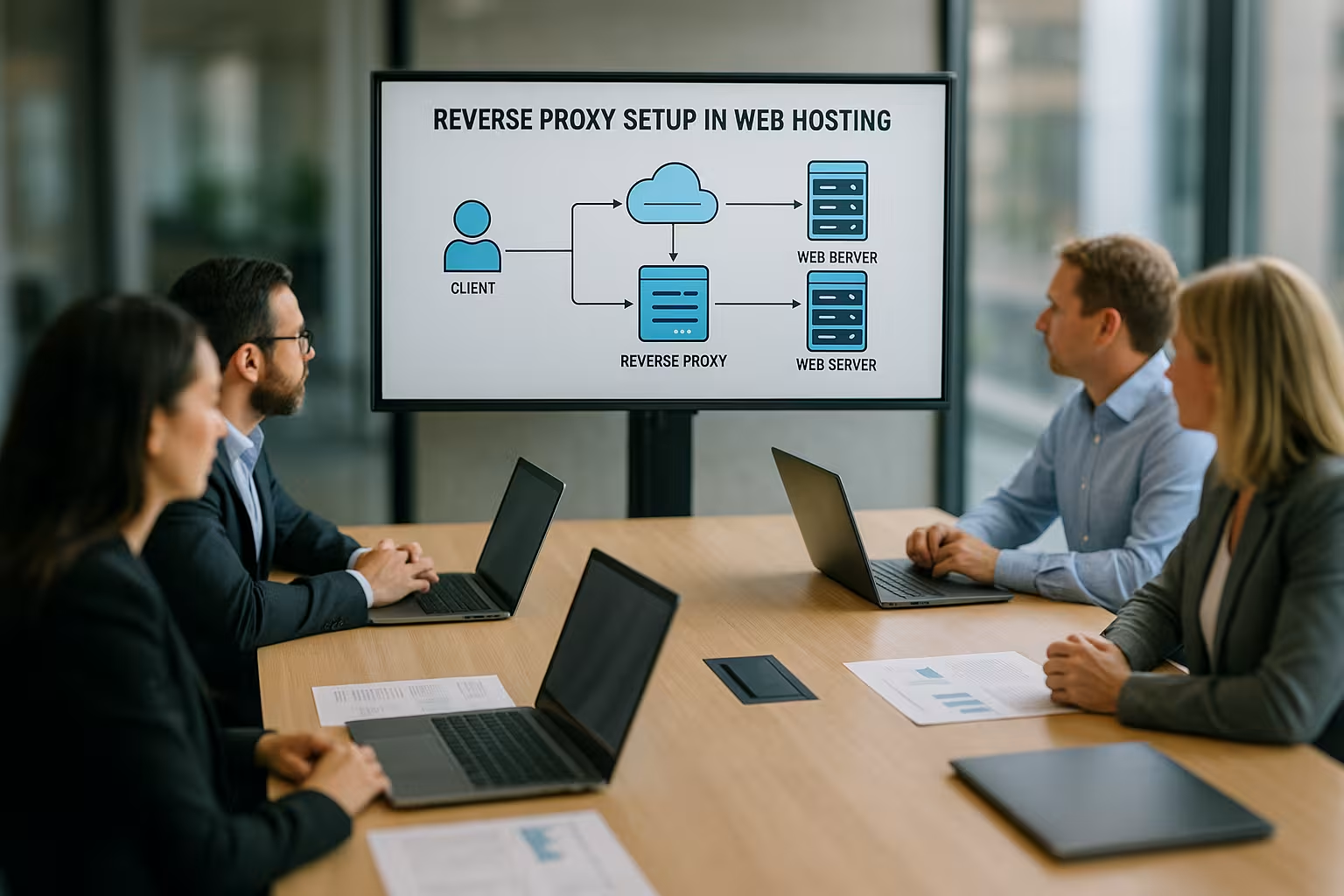
A Reverse Proxy sits in front of all web applications and receives every request as the first point of contact. I set rules for hostnames, paths and protocols there and forward the requests to suitable backends. This layer conceals internal IPs, reduces attack surfaces and centralizes certificates. In this way, I keep backends lean because they only concentrate on business logic. For a quick overview of central strengths, I refer you to the compact Advantages of the architecture.
During operation, I take over SSL/TLS termination, caching and protocol conversion at this point. I standardize headers, set X-Forwarded-For correctly and protect applications from faulty clients. If a target server fails, failover takes effect automatically. So the Accessibility stable, even if individual services are unstable. This makes the proxy layer the control center of every modern web server architecture.
I also bundle the certificate management here: I automate issuance and renewal, activate OCSP stapling and ensure clean key rotation. TLS 1.3 reduces handshake latencies, session resumption saves CPU. I consciously check 0-RTT and only allow it for idempotent paths. For internal paths, I optionally set mTLS to cross-check backends and close the chain of trust.
Architecture: Components and data flow
I structure the Proxy-architecture in clear modules: listeners, routers, upstreams, health checks, cache and security filters. Listeners bind ports and protocols, routers make decisions based on host, URI or headers. Upstreams describe backend groups that I utilize with suitable algorithms. Health checks actively or passively check accessibility and remove faulty targets from the pool. The cache reduces latencies for recurring content and relieves the load on lines.
I keep the data flow transparent: inbound TLS, internally often HTTP/2 or HTTP/1.1, also gRPC or WebSocket as required. I isolate each app using a virtual host and a separate context. URL rewrite translates external paths cleanly to internal structures without disclosing internal technical details. Logging at this point gives me the best view of user paths. This allows me to recognize early on Bottlenecks and make targeted adjustments.
I normalize headers and remove hop-by-hop headers such as Connection, TE or Upgrade where they interfere. Clean Keepalive-Settings and connection pools to the upstreams prevent idling and port exhaustion. In the event of errors, I use limited retries with backoff to avoid amplifying spikes. Outlier detection and circuit breakers take unstable targets out of traffic for a short time until they report healthy again.
Using safety functions effectively
I block Attacks as early as possible at the proxy edge. To do this, I set strict TLS parameters, secure ciphers and HSTS. A WAF filters suspicious patterns such as XSS or SQL injections, while IP and geo-rules keep out unnecessary traffic. DDoS mitigations such as rate limiting, connection limits and request body limits protect backends. This means that only validated traffic reaches the actual applications.
Header hygiene also reduces risks. I set security headers such as Content-Security-Policy, X-Frame-Options, Referrer-Policy and Permissions-Policy. Strict limits for header sizes, timeouts and body size stop abuse. I set more defensive thresholds for login paths and tighten bot detection. These Controls at proxy level make security rules standardized and maintainable.
I secure sessions with strict cookie attributes (Secure, HttpOnly, SameSite) and optionally check for APIs JWT-signatures directly on the proxy. For sensitive admin areas, I add upstream Auth (e.g. Basic/Bearer, SSO-Forward-Auth) and thus reduce the load on the applications. I keep secrets such as tokens or private keys in a secret store and only load them into the proxy process at runtime.
Scaling and high availability
I reach Scaling horizontally by bundling several backends using load balancing. Round robin distributes neutrally, least connections stabilize with changing response times, IP hash keeps sessions closer together. I use virtual IPs and redundant proxies for high availability. If one node fails, the second takes over without any noticeable interruption. This is how I ensure consistent uptime during growth and peak loads.
Health checks determine the participation of a backend. I check HTTP status, response times and optional endpoints for self-tests. Passive error detection reacts when error codes occur frequently. Drain mechanisms empty a node in an orderly fashion before maintenance. These Strategies prevent hard breaks and keep deployments clean.
For rollouts, I use blue/green or canary strategies. Weighted routes first direct little traffic to a new version, metrics decide on the next stage. In the long term, I replace sticky sessions with central session stores so that I can scale independently of IP hash. Front-side Cues smooth out load peaks without immediately overrunning backends.

Nginx proxy setup in practice
I use NGINX The event-driven architecture and lean syntax make it a popular choice. A server block receives hosts, an upstream section manages backend destinations and the location section controls headers and redirects. WebSockets, gRPC and HTTP/2 are integrated directly. I activate Gzip or Brotli compression selectively according to content type. This is suitable for a guided setup Step-by-step instructions.
Before I go live, I check syntax, test certificates and time limits. I measure latencies, activate access and error logs and switch on sampling later. For zero-downtime reloads, I use signals instead of hard restarts. In container environments, I set the internal resolver correctly so that NGINX resolves service names reliably. This keeps the Routing stable, even when containers restart.
In depth, I pay attention to ssl_session_cache and OCSP stapling for fast handshakes, tune worker_processes and worker_connections as well as open file limits. With reuseport, sendfile and sensibly set buffer sizes, I increase throughput without worsening latencies. I check keepalive_requests to use connections efficiently and at the same time limit per-IP connections to ensure fairness.
| Criterion | NGINX | Apache |
|---|---|---|
| Performance | Event-based, very fast | Process/thread-based, solid |
| Configuration | Declarative, compact | Modular, flexible |
| Load balancing | Integrated, multiple algorithms | Via modules such as mod_proxy_balancer |
| Context of use | Modern setups, high traffic | Legacy/extensions, fine tuning |
Use Apache wisely as a reverse proxy
I set Apache where modular extensions and legacy integrations count. I cover many protocols with mod_proxy, mod_proxy_http or mod_proxy_uwsgi. RewriteRules and map files allow differentiated routes. For security, I combine mod_security with clean request limits. In migration phases, Apache convinces as a compatible bridge until services move to NGINX or Ingress.
The process and thread selection remains important. I check MPM modules such as event, worker or prefork and match them to the workload and modules. I set KeepAlive, timeouts and buffer sizes to match the app characteristics. For clean logs, I add user-defined fields with X-Forwarded-For. This is how I keep the Transparency up the entire chain.
I use mod_http2 to activate HTTP/2 stably in the event-MPM, combine proxy_fcgi for PHP-FPM and use mod_cache_disk selectively for static content. RequestHeader and header directives help me to enforce policies consistently on all hosts.

Routing and rewrite patterns
I share Routes cleanly according to host names, subdomains and paths. Example: app.example.tld leads to an app cluster, api.example.tld to an API cluster, media.example.tld to a CDN-related setup. I route path-based rules via location blocks, while host headers provide the rough direction. For legacy applications, I build rewrites that map old paths to new structures. I pay attention to 301 for permanent and 302 for temporary moves.
I check edge cases early on. These include double slashes, incorrect encodings, missing trailing slashes or unexpected query strings. I normalize paths to increase cache hits and limit variations. I also protect sensitive endpoints such as /admin, for example with IP lists or MFA gates. This keeps the Conduct predictable and safe.
For tests, I use header- or cookie-based routing (A/B) without changing DNS. I reduce redirect chains, consistently enforce canonical hosts and deliberately respond to deleted content with 410 instead of 404. I use 444/499 specifically to close connections in the event of obvious abuse.
Caching, compression, HTTP/2
I set Caching to objects with clear cache headers. Static assets get long expiration times, HTML gets short TTLs or stale-while-revalidate. For compression I use Brotli or Gzip depending on the client. HTTP/2 increases efficiency with multiplexing and header compression. This is how I reduce latencies without making code changes to the apps.
Cache bypasses for personalized content are important. I check cookies, authorization headers and vary rules. ESI or fragment caching help to keep only parts dynamic. Separate caches per host and path prevent overlaps. These Guidelines ensure consistent delivery and keep bandwidth costs low.
In addition, I consistently implement ETag/Last-Modified and efficiently serve 304 for If-None-Match/If-Modified-Since. I work with stale-if-error to continue delivering content in a controlled manner in the event of backend failures. Vary on Accept-Encoding and Accept prevents cache mixing between Gzip/Brotli and image formats like WebP/AVIF.

Monitoring and observability
I measure Metrics on the proxy front, because this is where all requests come through. Response times, status codes and upstream latencies show bottlenecks early on. Distributed traces with correct forwarded headers link proxy and app. Detailed logs with request ID, bytes and upstream address facilitate root cause analysis. Dashboards and alarms make anomalies visible before users report them.
Sampling helps to keep log volumes under control. I enable structured formats such as JSON so that machines can read the data. I mask fields in the log for sensitive data. I tune rate and error alerts per service, not across the board. With these Insights I make data-based decisions and avoid blind spots.
I monitor p95/p99 latencies and define SLOs with error budgets. RED/USE metrics (Rate, Errors, Duration / Utilization, Saturation, Errors) help me to manage load, utilization and bottlenecks in a targeted manner. Outlier detection per upstream uncovers „noisy neighbors“ before they affect the overall service.
Reverse proxy in containers and Kubernetes
I integrate Container via internal DNS names and service discovery. In Docker stacks, I resolve services dynamically and rotate targets without manual intervention. In Kubernetes, I use routing via an ingress controller, often with NGINX. Annotations control SSL, redirects, timeouts and WAF rules centrally. For comparisons of balancers, I like to use compact overviews of Load balancing tools.
I keep rolling updates stable with readiness and liveness checks. I limit connections per pod so that a single pod does not tip over. Horizontal Pod Autoscaler scales according to CPU, RAM or user-defined metrics. Network policies restrict traffic paths. This keeps Cluster controllable and safe.
I take sidecars and service meshes into account, if they are in play, and determine whether TLS terminates at the mesh or at the reverse proxy. I set quotas, rate limits and my own WAF profiles for each namespace in order to separate clients cleanly.

Targeted rectification of error patterns
I recognize Error patterns: 502 often points to unreachable backends, 499 to aborted client connections, 504 to timeouts. Then I check health checks, name resolution and keepalive parameters. Small limits on body or header sizes often trigger strange effects. I identify TLS problems with detailed handshake logs. This is how I narrow down causes step by step.
For WebSockets, I check upgrade headers and timeout settings. For uploads, I count on streaming and coordinated buffer sizes. I resolve CORS issues with clear Allow headers and option handling. I secure persistent sessions via IP hash or sticky cookies. With this Procedure I don't lose any time in the event of a malfunction.
I also check HTTP/2 coalescing to avoid 421 misdirected requests and watch out for blocked UDP port 443 with HTTP/3. 413/414 indicate bodies or URLs that are too large. If SNI/Host does not match the certificate, 400/495 escalate quickly - then often CN/SAN or the certificate chain is not correct. I keep DNS TTLs low enough for changes to take effect quickly.
TLS and certificate management
I automate issuing and renewal via ACME-compatible workflows. I store keys separately, rotate them regularly and strictly limit access. I set HSTS broadly after testing, preload only if all subdomains are really permanently accessible via HTTPS. I activate OCSP stapling and ensure resilient fallbacks. I consistently separate certificates for staging and production to avoid confusion.
I protect internal connections with mTLS, if compliance requires it. Dedicated trust stores per environment prevent test roots from appearing in production. Session resumption (tickets/IDs) accelerates retries, but remains limited to safe lifetimes. I keep cipher suites modern and gradually reduce legacy so as not to abruptly break compatibility.
HTTP/3 and QUIC in practice
I roll out HTTP/3 gradually and announce it with Alt-Svc, while HTTP/2 remains in parallel. This allows clients to choose optimally. I measure handshake success rates and path MTU problems, because middleboxes or firewalls sometimes block UDP. In the event of failures, traffic automatically falls back to H2/H1. I adjust timeouts, idle quotas and prioritization to the workload so that short requests do not starve behind large uploads.
Automation, IaC and rollouts
I manage proxy configurations as code. Templates, variables and environment files avoid copy/paste errors. CI/CD pipelines check syntax, test in staging with real traffic patterns and only then execute a Reload with health checks. Canary switches, feature flags and weighted routing allow me to try out changes in a risk-conscious manner. I always plan rollbacks - including the reversal of schema or header changes.
Capacity planning and system tuning
I dimension file descriptors, kernel backlogs (somaxconn), network buffers and ephemeral ports to match the expected connection volume. CPU affinities and NUMA awareness help under high load. In containers, I set cgroup limits realistically so that the proxy does not run into the OOM killer risk. I test borderline cases such as many small requests per second, a few huge uploads or many parallel WebSockets - and make targeted adjustments.
Maintenance pages, business continuity and SEO
I signal planned maintenance with 503 and Retry-After, ideally rolled out from the proxy. I keep standardized error pages statically ready so that they load quickly even in the event of a backend failure. I minimize downtime with stale-if-error and failover backends. I avoid redirect loops, enforce canonical URLs and regulate trailing slashes consistently - this helps crawlers and reduces unnecessary load.
Short practical guide
I start structured with goals: Protection, performance, scaling. I then define hosts, paths and certificates. I build upstreams and select suitable balancers. I then activate caching, compression and security headers. Finally, I set up logs, metrics and alarms so that I can see trends early on.
I plan horizontal expansion and redundant proxies for growth. I document rules concisely and comprehensibly. I test changes in staging with realistic load patterns. I carry out rollouts in small steps with fallback. These Routine keeps operations predictable - even with heavy traffic.
Briefly summarized
A Reverse Proxy bundles security, routing and scaling in one place and makes web hosting much more predictable. I shield backends, distribute load fairly and reduce latencies with caching and compression. NGINX scores points for speed and clarity, Apache shines with modules and compatibility. In containers, I use Ingress and secure deployments with health checks and policies. If you set up this layer properly, you can keep costs under control and deliver consistently fast pages.