Skip to content
Secure passwords protect you from cybercrime and data theft - especially as more and more digital services rely on login data. This guide shows you how to Secure passwords and use them effectively in everyday life and at work.
Key points
- ComplexityLong, random character combinations increase security considerably.
- UniquenessUse an individual password for each account.
- Password managerTools help you to create strong passwords and store them securely.
- Two-factor authentication: Significantly improve access control with an additional security factor.
- Regular updatingChange passwords immediately after incidents or suspicious activities.
Why secure passwords are crucial
Attacks via phishing, brute force or data leaks are commonplace. A single login can give attackers access to your email account, bank details or business documents. If you rely on weak character strings such as "123456" or your own date of birth, you run the risk of high losses. Cybercriminals use automated tools and databases from previous leaks to force access to accounts.
Secure passwords drastically reduce this risk. Reusing passwords across different services is particularly dangerous. As a result, a single leak can lead to a compromised identity. In an increasingly connected world, unprotected access to social media, cloud services or corporate networks can also have greater consequences than you might think at first glance.
Particularly in a business context, customer data or sensitive project data can be quickly misused if a password is compromised. Companies are often legally and contractually bound to certain security standards, which is why a password leak can also have legal consequences. Poorly chosen passwords therefore not only represent a technical risk, but also an economic and legal risk.
Features of secure passwords
A strong password consists of at least 12 characters - preferably 16 or more. It contains a Combination of upper case letters, lower case letters, numbers and at least one special character. Avoid using words from common dictionaries, simple number sequences or personal details such as birthdays or pet names.
Instead, it is worth using so-called passphrases or random generators. A creative passphrase such as "Rote!Trauben_tanzen#auf🌧️12Teppichen" offers strong protection and remains comparatively easy to remember. It is important that you come up with a personalized system and never reuse passphrases. Ideally, you should create a separate character string for each application or online service.
Current security guidelines also emphasize that high entropy plays a central role when entering passwords. This means that the more unpredictable or random the character string is, the more difficult it is for attackers to determine the password via dictionary attacks or brute force attempts. Individual word parts that easily appear in databases should therefore be avoided or heavily modified.
Practical rules for your password security
Password security starts with discipline. I recommend the following steps for daily use:
- Avoid reusing identical passwords on different platforms.
- Update your password immediately after any known data leaks or anomalies.
- Save passwords Never unencrypted - neither digitally nor on paper.
- Use a secure password manager that stores your data in encrypted form.
These standards may sound complicated, but in practice they can be implemented quickly. The combination of a password manager and uniqueness for each account in particular makes it easier to handle a lot of login data in everyday life in the long term. Also make sure you always keep an eye on security-related news or messages. Services often carry out offensive tests to find vulnerabilities. If a security gap is discovered or a service is exposed in a data leak, you should react immediately.
Social engineering should also not be underestimated: Criminals often try to elicit personal information from users, for example through fake support calls or imitation emails from supposed friends. Even the strongest password is of little use if you pass on your own access data to third parties or unknowingly enter it via a manipulated form. So always remain vigilant and check the seriousness of requests that ask for your passwords.
How a password manager works
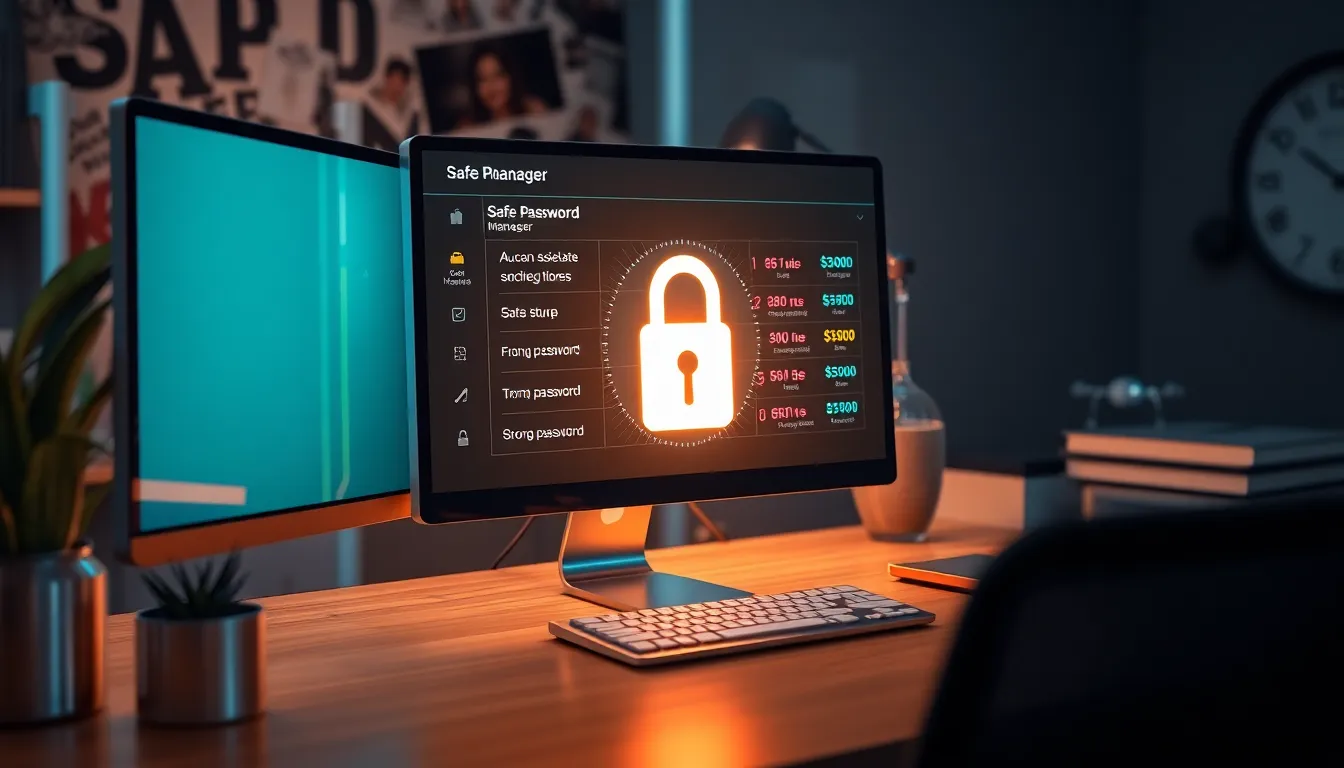
A password manager stores your access data securely in encrypted form. You only need to remember one single password. Particularly strong master password to remember. Many tools automatically generate secure passwords and save them directly when the account is created.
Modern password managers also offer additional security checks - such as warnings if your passwords have appeared in known data leaks. Some tools synchronize your access data across multiple devices or browsers so that you can access your data securely even when you're on the move. You can find tips on how to set this up in my guide to Password changes in database systems such as MariaDB.
In addition to this convenient function, reputable managers also guarantee strong encryption using established algorithms. This means that even if your password safe is accessed, only encrypted text would be visible. However, always make sure that your master password is really complex. If it falls into the wrong hands, all passwords stored in the manager are also at risk. There should be no mushrooms in your head - in other words, don't think of banal sentences or trivial combinations for the master password.
Two-factor authentication - indispensable
2FA adds an additional authentication step to your password. This can be an SMS code, an app-based TAN or a biometric feature. Even if your password falls into someone else's hands, your account remains protected by the second security barrier.
Many services now offer 2FA - you just need to activate it. I especially recommend 2FA for sensitive platforms: Banking, cloud services, social media and of course email accounts. The combination of a strong password and 2FA offers significantly higher protection than one alone.
There is also the factor of so-called hardware tokens: special USB sticks or NFC cards generate one-time codes that are required in addition to your password entry. These "security keys" are considered particularly secure as they minimize the risk of phishing attacks, as the device must be physically in the user's possession. So if you want maximum security, you should find out about hardware tokens if the service in question supports them.
Differences between strong and weak passwords - at a glance
The following table shows typical differences between weak and secure passwords:
| Feature | Weak password | Secure password |
|---|---|---|
| Length | 6-8 characters | At least 12 characters |
| Content | Names, dates of birth, "123456" | Random letters, numbers, special characters |
| Use | The same on many platforms | Unique per account |
| Storage location | Slip of paper / plain text file | Encrypted in the password manager |
| Administration | No update | Changed regularly |
Uncontrolled use on multiple platforms is one of the main risks. For example, if the password "Sonne123" is used on your email account and on a social network at the same time, a data leak in the latter is enough to compromise your email account as well. This is why security experts repeatedly emphasize the principle of uniqueness. Consider using a completely different combination for each service, regardless of whether it is for private or business purposes.
Security in the professional environment
Clear password rules are mandatory, especially in teams and companies. Each team member needs individual access to mailboxes, servers and tools. Employee training for Password hygiene effectively prevent security breaches. Passwords must be updated immediately after detected incidents.
Many companies therefore already rely on team password managers that can manage authorizations centrally. In addition, every business platform should be operated with two-factor authentication. For system administrators, quick access to lost login data via methods such as those described in the instructions for forgotten root passwords in MariaDB.
Compliance guidelines also play a role in larger companies. There are often internal regulations or industry-specific requirements (e.g. in accordance with ISO 27001) that regulate the handling of passwords in detail. Password frequency, minimum length, type of special characters to be used or the use of multi-factor authentication are then mandatory. In addition, it is common practice that all accesses used by an employee who leaves the company are immediately blocked or provided with new passwords. If this is not done, there is a considerable security risk.
Strict password requirements also apply to working from home or via a remote structure. Open WLAN networks should be avoided, or at least a secure VPN must be used. Even the strongest corporate firewall is useless if a weak password provides a direct gateway for unauthorized access.
Team collaboration and secure password management
As soon as several people work together on projects, the question often arises as to how passwords can be shared or used jointly. Team password managers are an efficient solution for this. User rights can be defined granularly so that not every person needs to have full access to all sensitive information. For example, accesses can only be released for viewing without the key being visible in plain text.
Functions for password changes that can be controlled centrally are particularly practical. If it is already foreseeable that a health incident or personnel change is imminent, employee accounts and shared access data can be transferred in an orderly manner. Access is also usually documented in team password manager solutions so that it remains traceable who has accessed which data and when. This prevents possible cases of misuse or supports traceability in the event of an emergency.
In addition, you should offer regular training on password and data security in a corporate context so that every employee develops an understanding of current threat situations. The best technical measures are worthless if the human component is not trained. This also makes it easier to recognize and avoid phishing calls or fake emails.
Three strong password examples for inspiration
Here are a few practical examples of secure passwords that you can customize:
- "W8r!U&n3#skv7zLp" - a random mix with special characters
- "Yellow!pears@on#Red_meadow2025" - Easy to remember passphrase
- „Z!tR0nEnSaft*Im^Summer“ - Mixture of symbols and words
Do not use them exactly as they are - they serve as a template. Alternatively, you can also use your manager's password generators. Here too, it is important to create separate variants for all platforms used. This minimizes the risk of identity fraud.
Techniques for regular password updates
Although regular updates are recommended, it depends on the occasion and the security strategy. A planned, automatic change every few weeks or months can sometimes lead to insecure routines. This is because those who constantly need new passwords tend to use simple reuses and patterns in order to cope with the flood of changes. However, in many industries - especially in highly sensitive areas such as finance or government agencies - a corresponding frequency is required by law to prevent outdated access data from becoming a gateway.
An alternative is the so-called "event-based" changing of passwords: you change your password if there is a suspicion of misuse, a device is lost or a service provider reports a security incident. It also makes sense to update your password after internal restructuring or staff changes. This ensures that unauthorized persons have no ongoing access.
Protect your passwords in everyday life
Avoid logging in via third-party devices or open networks - if necessary, work via a Secure VPN. Delete saved logins immediately after unauthorized use. Always keep your software and browser up to date to close vulnerabilities.
Regularly monitor your login history or account activity. Unusual activities such as unknown logins or email forwarding indicate an attack. If this happens, change all passwords immediately. A good addition to 2FA is a monitoring tool that warns you as soon as unusual access occurs. It can also be useful in your personal environment to explain to friends or family members how to handle access data responsibly so that shared streaming or gaming accounts, for example, remain secure.
Additional multi-factor concepts
If you want to increase your security even further, you can rely on concepts with three or more factors. In addition to a password and second factor (e.g. SMS TAN), some services also enable biometric procedures (fingerprint, facial recognition) or only use geo-based authorizations from certain regions. This turns your account into a real high-security wing. However, this variant usually only makes sense if the service offers it or if particularly sensitive data is managed in companies. In the private sector, a strong password in combination with a reliable 2FA is usually sufficient.
With biometric methods, it should be borne in mind that a person's fingerprint and face cannot simply be "reset" if a system is manipulated or hacked. It therefore makes sense to view biometric data as a supplement rather than as the sole security measure. This also leaves a certain degree of flexibility in case the biometric feature is not recognized for some reason (e.g. injury to the finger).
Concluding thoughts
Strong passwords significantly increase your online security - and the effort involved is limited. If you consistently use Secure passwords2FA and password managers, you'll be a big step ahead of cyberattacks. WordPress security tools in particular, such as those in my Instructions for securing help additionally.
I recommend you: Take the time to set it up once - password manager, good passphrases, authentication methods. After that, you won't have to worry about it anymore. You will automatically benefit from the security.