Skip to content
File system journaling protects file system structures and keeps data consistent on servers, even if a crash, kernel panic or power failure occurs in the middle of a write operation. I show how journaling works in hosting environments, which modes mean which compromises and how to ensure data consistency from the file system to the application.
Key points
The following list summarizes the most important aspects, which I explain in detail in the article.
- Journaling logs changes based on transactions and facilitates recovery.
- Modes such as ordered, writeback and journal regulate speed and safety.
- File systems such as ext4 and XFS shape performance and crash behavior.
- Consistency is created across levels: OS, storage, DB and app.
- Backups and snapshots catch logical errors.

What file system journaling does technically
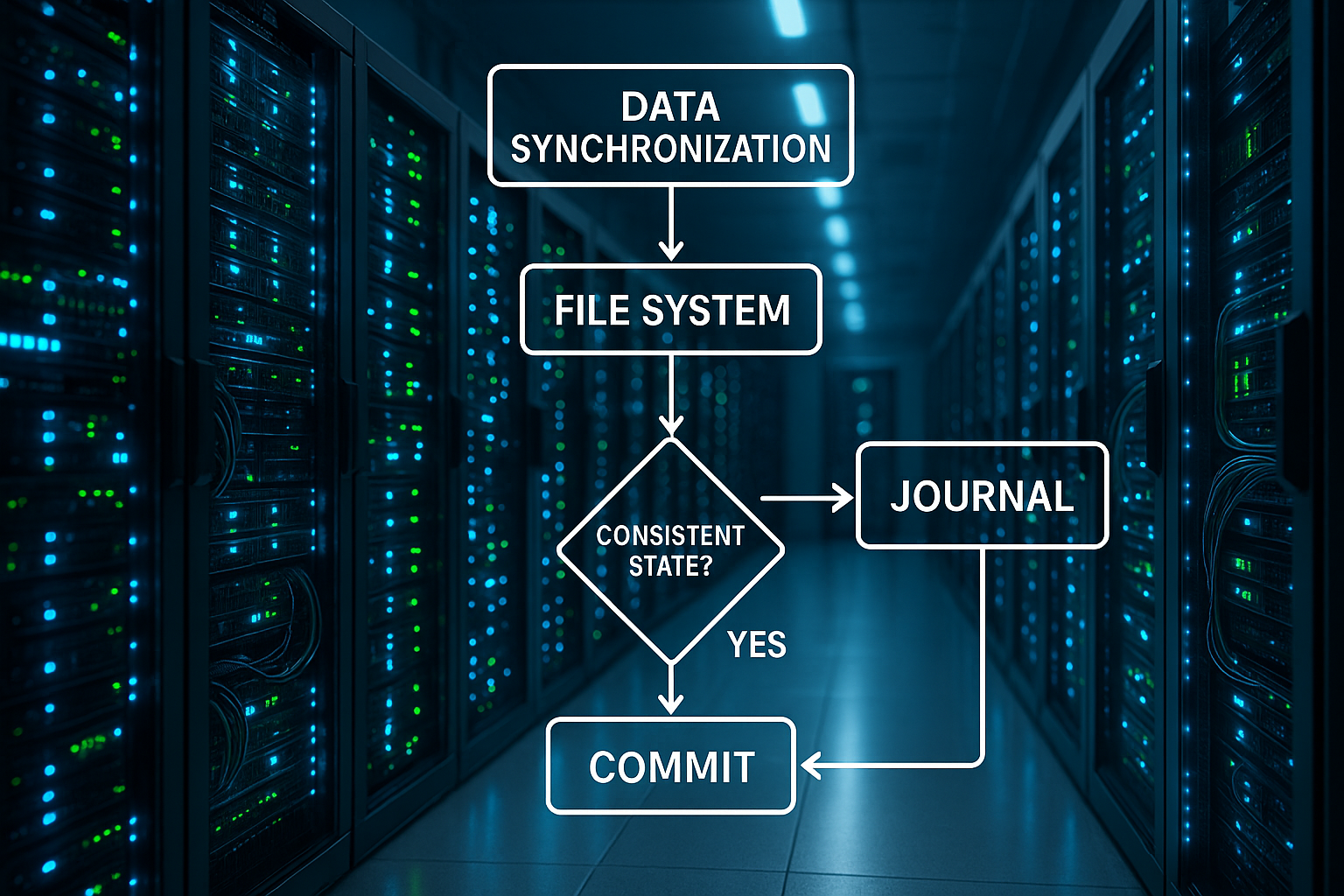
I understand Journaling as a transaction log for the file system: Before critical changes take effect, they are stored in a journal and are thus given a clear sequence. If a server fails, the system replays completed transactions cleanly or discards incomplete steps so that the metadata does not retain a corrupted state. For Data consistency this means that directory entries, inodes and allocation information adhere to defined rules, even if user data was still buffered. This process is similar to databases: prepare, journal, commit, then finalize. I plan hosting setups so that journaling logs are fast, flush barriers remain active and unnecessary sync load is avoided without sacrificing crash safety.
Journaling modes and their effects
I deliberately use the three common ext4 strategies depending on the workload, because each mode changes Write latency and data security. The standard data=ordered writes user data to the medium before the metadata, which in practice dampens visible partial states and keeps the throughput tidy. data=writeback focuses on speed, but in the event of a crash allows older or partial data blocks to appear, which I only accept for non-critical, short-lived content. data=journal backs up everything via the journal and provides the strongest protection at the expense of additional I/O, which can be useful for very critical transactions. I also check commit intervals and journal size so that the balance between Performance and safety matches the application profile.
| Mode (ext4) | Logged | Crash risk for user data | Typical use |
|---|---|---|---|
| data=ordered | Metadata, data persisted before metadata | Low to moderate | Web server, CMS, generic workloads |
| data=writeback | Metadata only, no fixed order | Elevated, old/partial blocks possible | Logs, caches, temporary files |
| data=journal | Metadata and user data complete | Very low, higher I/O effort | Critical transactions, compliance cases |

Targeted use of ext4 and XFS
I choose ext4 for many all-round servers, because administration, tools and recovery processes work reliably and the modes can be fine-tuned enough. With XFS, I appreciate parallel operations, efficient use of large files and the way the journal distributes wide I/O, which brings advantages in virtualization, log streams and object storage gateways. For planning, I compare volume sizes, inode density, TRIM support and mount options so that write patterns on SSD or NVMe fit cleanly with the reality of the workloads. If you are looking for a deeper starting point, you will find a useful introduction in the compact overview: Comparison ext4, XFS, ZFS. In this way, I make fact-based decisions instead of giving too much weight to lantern topics such as file name length or exotic flags, which are rarely limiting in everyday life.
Data consistency is created across several levels
I consider Consistency as a property of the overall system, not just the file system, because the controller, caches and application logic work together. A RAID controller without battery backup can swallow flush commands and undermine journaling, even though the OS layer is working correctly. Databases keep their own transaction logs or WAL files and expect fsync and barriers to actually maintain the promised persistence. The application must implement atomic updates, e.g. write temporary files and then swap them via rename so that readers never see half-finished content. I check kernel parameters, I/O scheduler, barrier status and the combination of journal commit intervals and database sync frequency so that Recovery later runs quickly and cleanly.
Journaling intern: Understanding flush, FUA and barriers correctly
I make a careful distinction between cache flush, force unit access (FUA) and barriers because they form the semantic bridge between the file system and physical persistence. A commit in the journal is only resilient if the storage stack actually flushes write caches or writes commands with FUA directly persistently. I always leave barriers active; „nobarrier“ or similar options only come into question for me with verifiable power loss protection (PLP) and battery or flash-supported write-back cache. Without PLP, there is a risk of reordering in the controller, whereby apparently confirmed writes disappear in the event of a power failure. On modern NVMe with PLP, flush costs are moderate and the Journaling-overheads, while write-through is often the more robust choice for older SATA SSDs or insecure RAID setups. I use logs and tests to verify that flush paths are not silently ignored, as this is the only way to ensure that fsync promises are kept right down to the board.
Strategic planning for storage reliability
I think Availability as a chain: redundancy, integrity checks, protection against logical errors and fast recovery are interlinked. Checksums in Btrfs or ZFS quietly detect bit errors, scrubbing proactively clears up discrepancies and ECC RAM reduces the risk of erroneous write operations. Replication and failover keep services accessible, while snapshots and backups open the way back to a defined point in time. Journaling shortens file system repair and prevents corrupted metadata, but it does not replace backup against accidental deletion or malicious encryption. I evaluate RPO and RTO per application and use the mixture of Snapshots, backup frequency and location strategy.
A sensible balance between journaling and performance
I measure Latency and throughput separately, because journaling often affects the short latency more than the bulk throughput. Modern NVMe reduces the relative overhead of logging noticeably, so that even data=journal remains practical on parts of the stack. Commit intervals affect how often the system flushes; longer intervals increase speed but increase the window of possible loss after a crash. The journal size helps to buffer peaks, but too large means longer replays after a failure, which is why I reconcile empirical values and measured data here. For workloads with many small sync writes, I create specific partitions and separate Logs of user data in order to reduce interference.
Use external journals and log devices sensibly
I use separate journal devices where appropriate: ext4 allows an external journal on a particularly fast SSD or NVMe, XFS supports its own log device. This decouples commit traffic from the data path and reduces head retention, especially for many small transactions. Size and latency are important: the journal must be able to hold enough bursts without replays becoming impractically long after a crash. In practice, I tend to plan a moderate journal with low latency rather than a huge log with long replays. On XFS, I consider log buffers and log size in the context of parallelism, whereas with ext4 I consciously choose options such as asynchronous commits and checksums. Separation only brings tangible benefits if the queue depth, CPU allocation and PCIe bandwidth match the rest of the system; I therefore measure before and after the changeover instead of relying on gut feeling alone.
Backups, snapshots and replication complement journaling
I build Backups in such a way that they intercept logically independent errors, because journaling primarily protects metadata consistency. Snapshots provide point-in-time states and allow fast rollbacks, while asynchronous replication provides copies at other locations. For databases, I stick to transaction-consistent backups or coordinate freeze/thaw mechanisms so that no half transactions get stuck in the backup window. A brief overview of methods will help you choose the right technology: Dump vs Snapshot. I test restores regularly, document the steps succinctly and ensure that key material and Encryption remains usable at the time of backup.

Fsync, rename and atomic updates in practice
I stick to a robust pattern for critical updates: write the file under a new name, fsync the file descriptor, then replace it using Rename and then fsync the target directory. Only the sync to the directory makes the new dentry really permanent; if you only fsync the file, you risk the mapping being missing after a crash. For temporary content, I use O_TMPFILE or secure working directories and use fallocate, to reduce fragmentation. With many small sync writes, group commit helps on the database side, while I avoid unnecessary fdatasync storms in the file system. Delayed allocation (delalloc) is good for throughput, but can lead to surprising gaps in the event of crashes if the application has no fsync discipline. I test these paths in real life with power failure simulations and verify that the application recovers deterministically afterwards.
Best practices that I apply consistently
I choose a suitable file system per workload: ext4 or XFS for web servers and VM hosts, Btrfs or ZFS for integrated checksums and snapshots; I use data=ordered as a secure standard, adjust journal size and commit interval and leave barriers active, provided the storage stack implements flush correctly; I set noatime if load is caused by unnecessary metadata updates; I only operate RAID with secured write-back caches and regularly check SMART values and latency peaks; I carry out restore tests and strictly adhere to application transactions so that orders, payments and critical write processes are atomic; I document changes and maintain clear processes for maintenance, migration and recovery so that error patterns can be narrowed down more quickly.
Avoid common misconceptions
I often hear that Journaling prevents all data loss, which is not true because logical errors, accidental deletion or ransomware strike regardless of metadata consistency. Another assumption is that barriers cost too much performance, but modern controllers with battery or flash backup largely eliminate the extra effort. Many rely on the standard mode, although workloads with intensive sync writes or large sequential files require special settings. Some do not separate logs, databases and temporary files, creating unnecessary I/O contention and unclear restore paths. I dispel such myths in the setup and measure the result so that Decisions remain resilient.
Virtualization, containers and network storage
In VM and container environments, I ensure that persistence promises are passed through all layers. In hypervisors, I select caching modes that respect flush commands and ensure that write cache flags are set correctly for virtio/SCSI devices. „Fast“ modes that ignore flushes have no place in productive environments. For cloud volumes, I check whether the provider semantically honors fsync/FUA, as network or controller caches occasionally mask timing effects. In containers, overlayfs often runs on top of a journaling-capable host FS; I size the host FS so that many small upper-layer writes do not starve in the journal. For NFS or distributed file systems, I verify the export and sync options because the semantics of persistence there are not identical to local journals. This prevents the VM from believing that something is permanently written even though it is in the host or network cache.

Use caching wisely, maintain consistency
I make a careful distinction between Cache-performance and durability, because a fast page cache only helps if flush and sync paths work reliably. For Linux, I use metrics on dirty pages, reclaim behavior and writeback throughput to detect congestion at an early stage. For data-intensive applications, I also monitor IOPS distribution and tail latency so that a harmless burst does not slow down all writers. A short practical guide explains useful settings in the kernel and their pitfalls: Linux Page Cache. This is how I keep pace and Consistency in balance without weakening crash safety.
RAID level, write hole and rebuild
I plan RAID levels to match the risk: RAID1/10 offer robust write semantics and low latency, RAID5/6 scale capacity but carry the risk of write-hole in the event of partial writes and power failures. Battery-backed caches, journal-based RAID implementations or a dedicated write journal on a fast SSD provide a remedy. I activate regular scrubbing to find latent read errors early on and pay attention to clean stripe alignment: XFS benefits from correctly set sunit/swidth values, ext4 from suitable stride/stripe_width parameters - both reduce read-modify-write and thus journal printing. When rebuilding, I optimize priorities so that the production load does not starve, but carry out tests on degradation behavior. Journaling accelerates recovery after crashes, but does not replace a consistent redundancy strategy in the RAID stack.
Choose the right hosting partner
I pay attention to the following with providers Transparency with SLAs, practiced backup strategies with restore tests and clear communication about maintenance windows. Important are journaling-capable file systems on production systems, NVMe-based storage pools with redundancy and monitoring that reports I/O anomalies in good time. Experience reports, documentation and clear processes for disaster recovery show whether a team takes consistency across the entire chain seriously. In the German-speaking environment, webhoster.de provides practical guidelines, modern architectures and tangible concepts for data consistency, which noticeably secures the projects of agencies and companies. I evaluate such factors thoroughly before making critical decisions. Workloads relocate or scale.
Encryption, discard and SSD service life
I schedule dm-crypt/LUKS to balance security and durability: I deliberately forward discard/trim or perform periodic fstrim runs to support free-space management of the SSD. Continuous online discard can create latency spikes, whereas periodic trim remains predictable. Since encryption makes data distribution more random, I monitor write amplitudes and wear leveling - journaling increases write performance but reduces the risk of expensive subsequent repairs. With lazytime or relatime I reduce metadata writes without breaking consistency guarantees of fsync; noatime helps when atime updates generate load. It is important that the encryption layer passes flush and FUA signals correctly, otherwise it counteracts the guarantees of the file system. I use hardware with real-time power loss protection so that encrypted volumes do not end up in expensive reencrypt/repair cycles after crashes.

Summary: What I take away with me
I rely on file system Journaling because it ensures metadata consistency and speeds up recovery, and combine it with sophisticated file systems such as ext4 or XFS. I determine the choice of journaling mode, barriers, commit intervals and journal size based on real measured values and the application's risk profile. Consistency remains a system property: controller, kernel, database and application must work together so that fsync and persistence promises are valid. Backups, snapshots and replication supplement the protection, while monitoring and tests ensure quality in the long term. This is how I set up Data consistency in hosting that cushions outages and reliably supports business-critical applications.