Skip to content
Server location hosting determines how quickly pages load, how secure personal data remains, and what running costs I budget for global users. Anyone who prioritizes latency, Data protection and strategically combines spending, achieving measurably better loading times, stable conversions, and clear compliance advantages for international target groups.
Key points
The following aspects form the guidelines for my location decision.
- LatencyProximity to users reduces milliseconds and increases revenue.
- Data protectionEU locations facilitate GDPR compliance.
- CostsEnergy, traffic, and support determine the total bill.
- ScalingMulti-region and CDN ensure global performance.
- SEOFast response times strengthen rankings and crawl budget.

What „server location hosting“ actually means
I meet with the Server location A geographical and legal decision: The choice of country or city influences latency, availability, data access, and even the quality of support. The physical distance to the visitor determines the transport time of the data packets and thus the perceived response speed. At the same time, the laws of the location apply, which makes a significant difference when it comes to personal data. Those who operate across Europe benefit from uniform EU-wide rules; those who work globally must check further requirements. I therefore always consider the location as a lever for performance, legal certainty, and calculable Total costs.
Network connectivity and peering as a location factor
In addition to the pure distance, the Network quality of the data center. I check whether the location is connected to major Internet exchange points (IXPs) such as DE-CIX, AMS-IX, or LINX, how many carriers are available, and whether Peering policies are open and scalable. It is also important that Route diversity: Separate fiber optic routes and independent upstreams minimize the risk of blackouts. For applications with high traffic peaks, I look for 25/40/100G uplinks, congestion management, and low packet loss. In practice, I use looking glasses, traceroutes, and active measurements from target markets to measure not only bandwidth but also Stability Good network topology has an impact on TTFB, throughput, and fault tolerance—and thus directly on revenue and operating costs.
Understanding latency: Milliseconds and their effect
Latency is the time between request and response—and every millisecond affects user experience and conversion. If the server is close to the visitor, the physical distance decreases, and with it the runtime of TCP handshakes and TLS negotiations. In Europe, I often see pings in the single-digit millisecond range, such as Amsterdam to Frankfurt at around 7 ms, while Singapore to Frankfurt can reach over 300 ms – noticeable in interaction and sales [1][2]. I rely on edge nodes, Anycast DNS, and latency-based routing to ensure that traffic always takes the fastest path. If you want to learn more about the basics, you can find practical tips at Ping and TTFB, which I regularly evaluate in audits.

Serve global users faster in a targeted manner
For international target groups, I combine CDN, multi-region instances, and modern protocols. A CDN stores static assets close to the user, while distributed application nodes shorten dynamic responses. With HTTP/2 and QUIC, I reduce latency spikes over long distances and increase throughput in the event of packet loss [1][2][10]. I continuously measure with real user monitoring and synthetic checks from core markets to evaluate real loading times instead of lab values [1][18]. If you want to delve deeper into setups, use best practices for International latency optimization, which I have tested in global projects.
Multi-region architecture: State, sessions, and data
As soon as I operate multiple regions, I decide where Condition For web apps, I eliminate server-local sessions and use distributed stores (e.g., Redis/key-value) or signed, short-lived tokens. Read-intensive workloads benefit from Read replicas per region, while write operations consistently run in a primary region – or are distributed via geo-sharding. I clearly define which data must remain regional and avoid unnecessary cross-traffic, which increases latency and costs. Conflict resolution, idempotence, and retries are mandatory to prevent inconsistencies or duplicate entries under load.
Data protection and location selection: Smart compliance with the GDPR
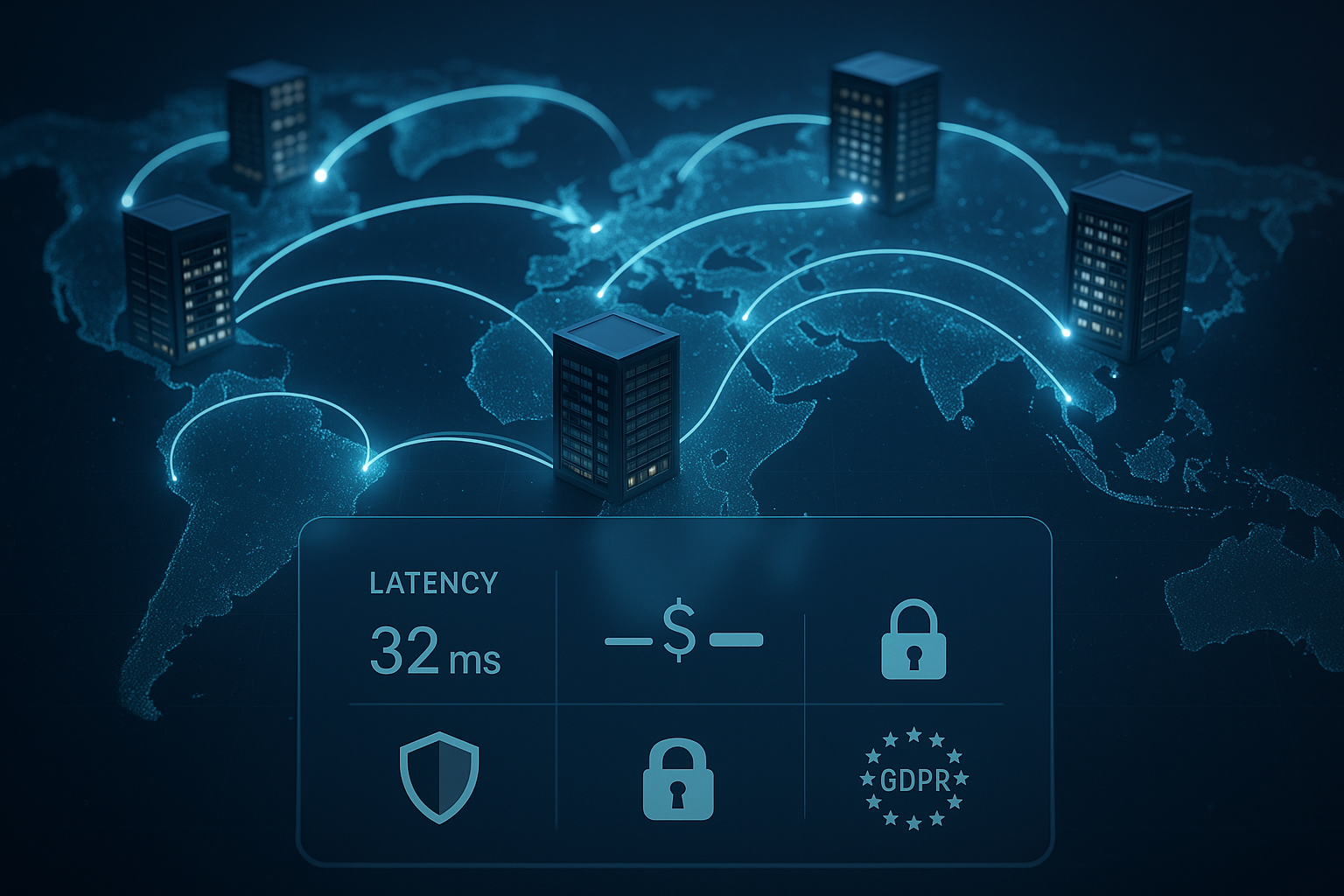
When processing data from EU citizens, I prioritize Data protection and choose EU locations with certified data centers. This allows me to ensure transmission, encryption, order processing, and documentation requirements are met at a sustainable level [3][5][13]. Outside the EU, I check transfer mechanisms, storage locations, and potential third-party access—the effort increases, as does the risk [15].[17]. Providers with locations in Germany score highly: short distances, strong legal certainty, and German-speaking support that answers audit questions clearly. For sensitive data, I usually prefer German data centers because they combine performance and compliance without detours [3][5][13][15][17].
Data residency, encryption, and key management
For strictly regulated projects, I separate Data residency (where data is stored) from Data access (who can access it). I consistently rely on encryption at rest and in transit, with keys managed by the customer (BYOK/HYOK) that remain in the desired jurisdiction. I evaluate key rotation, access logs, and HSM support as well as emergency processes. This allows me to minimize risks from external access and provide evidence for audits. Important: Logs, backups, and snapshots also count as personal data—I therefore explicitly include their storage location and retention in the location strategy.
Cost structure: Calculating locally vs. globally
I never consider hosting in isolation from Budget. Low electricity prices and rents can reduce monthly fees in certain regions, but longer latency or additional compliance costs offset the savings. Multi-region setups incur additional fixed costs for instances, traffic, load balancers, DDoS protection, and observability tools. In Germany, I often calculate with packages that include managed services, backups, and monitoring; this reduces internal personnel costs. The decisive factor is the full cost calculation in euros per month, including security measures and support times—not just the bare server price.
Avoiding cost traps: egress, interconnects, and support
I calculate hidden costs consistently: outgoing traffic (CDN origin egress, API calls), inter-region fees, load balancer throughput, NAT gateways, public IPv4 addresses, snapshots/backups, log retention, and premium support. Especially with global apps, egress can exceed server costs. I therefore check volume discounts, private interconnects, and regional prices. Limits, alerts, and monthly forecasts per market help with predictable budgets. The goal is to build the cost structure in such a way that growth linear instead of suddenly becoming expensive – with no unpleasant surprises at the end of the month.
SEO effects: location, loading time, and rankings
I connect Server location, code optimization, and caching to stabilize loading times and Core Web Vitals. Fast TTFB values make crawlers' work easier and reduce bounce rates—both of which affect visibility and revenue [11]. Regional proximity improves performance for the main target group; for global markets, I handle distribution via CDN and geo-routing. I continuously measure Largest Contentful Paint, Interaction to Next Paint, and Time to First Byte to identify bottlenecks. For strategic questions, I like to use compact SEO tips for server location, that help me prioritize.

Operation and measurement: SLOs, RUM, and load testing per region
I formulate clear SLOs per market (e.g., TTFB percentiles, error rate, availability) and use error budgets to make informed release decisions. I combine RUM data with synthetic tests to mirror real user paths. Before expanding, I run Load tests from target regions, including network jitter and packet loss, so that capacities, autoscaling, and caches are realistically dimensioned. I schedule maintenance windows outside of local peaks and practice failover regularly. Dashboards must combine metrics, logs, and traces—only then can I identify chains of causes instead of individual symptoms.
Practice: A phased approach – from start-up to expansion
To start, I place workloads close to the primary target group and keep the architecture lean. Then I introduce RUM, add synthetic measurement points, and document TTFB trends in the core markets [7][18]. When the first orders from overseas come in, I add a CDN and evaluate an additional region depending on response times. I automate deployments, create observability dashboards, and train support for escalations during peak times. With this roadmap, I scale in a controlled manner instead of changing everything at once.
Migration without downtime: plan, DNS, and dual run
If I change location, I reduce early on DNS TTLs, Synchronize data incrementally and test the dual run with mirror traffic. I define cutover criteria, health checks, and a clear rollback strategy. For databases, I rely on replicated setups or logical replication; I keep write locks during the final switchover as short as possible. After go-live, I closely monitor TTFB, error rates, and conversion KPIs, and only phase out the old environment after a defined observation period.
Comparison by intended use: Where is the server located?
Depending on the application, I prioritize Latency or data protection vary. E-commerce in Germany, Austria, and Switzerland requires lightning-fast response times and reliable GDPR compliance, while a purely US marketing site strives for maximum speed within the US. I like to use internal tools that are location-based to ensure confidentiality and access control. Global apps benefit from multi-region strategies that distribute load and reduce response times. The following table provides a compact overview that I use as a starting point in projects.
| Scenario | Optimal location | Priority Latency | Priority: Data protection | Comment |
|---|---|---|---|---|
| E-commerce DACH | Germany/Europe | Highest | Highest | GDPR, fast conversions |
| Global app | Global/Multi-Region/CDN | High | Medium to high | Latency and traffic balancing |
| Internal company use | Local at the company headquarters | Medium to high | Highest | Confidentiality and control |
| US marketing website | USA or Canada | High (US) | Low | Speed over compliance |
Choosing a provider: What I personally look for
When it comes to providers, I prioritize NVMeStorage, high-performance networks, clear SLAs, and transparent security controls. I find informative status pages, comprehensible RPO/RTO values, and German-language support with short response times helpful. For sensitive projects, I check certifications, location guarantees, and incident response protocols [5][9][15][17]. I include benchmarks for latency and availability in my decision, along with costs for bandwidth and DDoS mitigation. Ultimately, it's the overall package of technology, legal certainty, and operation that matters, not just the base price.
High availability: zones, RPO/RTO, and failover
I am planning Fault tolerance along clear goals: How many minutes of data loss (RPO) and downtime (RTO) are acceptable? This leads to architectural decisions: Multi-AZ within a region for local redundancy, multi-region for site-wide failures. DNS-based failovers require short TTLs and reliable health checks; on the database side, I avoid split-brain by using unique primaries or verified quorum models. Maintenance and emergency drills (game days) establish a routine so that failovers do not remain a one-time experiment.
Sustainability and energy: PUE, WUE, and carbon footprint
In addition to costs, I evaluate the Sustainability of the location. A low PUE value (energy efficiency), responsible water consumption (WUE), and a high proportion of renewable energies improve the ecological balance—often without compromising performance. Power grid stability and cooling concepts (free cooling, heat recovery) reduce downtime risks and operating costs in the long term. For companies with ESG goals, I document emissions per region and take them into account in the location decision without neglecting the latency requirements of my target markets.
Reduce lock-in and ensure portability
To remain flexible, I rely on Portability: Container images, open protocols, infrastructure as code, and CI/CD pipelines that run on multiple providers. I separate stateful and stateless components, keep data exportable, and use neutral services (e.g., standard databases instead of proprietary APIs) whenever governance requires it. This allows me to change locations, tap into additional regions, or replace a provider without spending months in migration mode.

Summary: Location strategy for performance, data protection, and costs
I choose the Server location along my target markets, measure real latency, and neatly file compliance certificates. Europe-wide projects benefit from German or EU data centers, while global projects benefit from multi-region and CDN. I evaluate costs holistically, including traffic, security, operation, and support in euros per month. For SEO and user experience, measurable speed counts: low TTFB, stable Core Web Vitals, and low bounce rates. This approach results in a resilient infrastructure that responds quickly, remains legally compliant, and can be scaled globally step by step.