Skip to content
I explain how Serverless Edge hosting for a global website works as an end-to-end workflow - from build to edge functions to data storage. So you understand which Steps reduce loading time, automate scaling and avoid downtime.
Key points
The following points briefly summarize the topic and provide clear orientation.
- Edge proximity: Contents and functions run at the nearest node for short distances.
- ScalingServerless scales automatically during peak loads without admin effort.
- FunctionsEdge Functions control routing, auth and personalization.
- Data layerReplicated stores keep latency and inconsistencies to a minimum.
- AutomationCI/CD, monitoring and rollbacks ensure fast releases.
- ResilienceCaching strategies, fallbacks and circuit breakers prevent cascading errors.
- GovernanceIaC, budgets, policies and audits keep operations, costs and compliance in check.
I use these crash barriers to Workflow plannable. This keeps the architecture clear and scalable. Each level contributes to performance and security. The combination of edge and serverless saves costs and time. I'll show you what this looks like in day-to-day business in a moment.
Workflow overview: from Commit to Edge
I start with a Git commit that contains the Build triggers and produces assets. The frontend then ends up in a global object storage or directly on edge nodes. A CDN distributes the files automatically and responds to requests at the nearest location. Edge functions access before the origin, set routing rules or insert personalized content. For APIs, I use lean endpoints that are connected to the Edge authenticate and write to a serverless database.
I rely on atomic deployments with unchangeable asset hashes (content addressing). This way, versions do not mix and rollbacks are a single pointer change. I clearly define cache control headers: long TTLs for immutable files, short TTLs plus revalidate for HTML. Stale-while-revalidate ensures that users see a cached page immediately while the CDN updates in the background.
I strictly separate environments: Preview Branches with isolated domains, Staging with production-related edge logic and Production with strict policies. I inject secrets and configuration via environments instead of code so that builds remain reproducible.

Architecture and components
A global CDN forms the fast Delivery while static assets come from distributed storage. Edge functions take care of geo-routing, language detection and A/B testing. APIs run as Functions-as-a-Service to reduce cold starts and costs. A distributed database with multi-region replication keeps write and read paths short. If you want to delve deeper into delivery strategies, you can find out more at Global performance with edge hosting practical approaches.
I differentiate between Edge KV for super-fast key-value reads (e.g. feature flags), Durable/Isolated Objects for slight consistency per key space (e.g. rate-limiting counters) and regional SQL/NoSQL-stores for transactional data. This allows me to move read-heavy paths completely to the edge and only route critical writes to the nearest write region.
For media I rely on On-the-fly optimization at the edge (format, size, DPR). Combined with cache variants per device, this massively reduces egress costs. I encapsulate background processing (resize, transcoding) in Event queues, so that user flows are never blocked.
Step-by-step: Global workflow
I build the frontend as an SPA or hybrid rendering and minimize Assets aggressively. I then push to the main branch, whereupon a pipeline tests, builds and deploys. The CDN pulls fresh files, selectively invalidates caches and rolls out globally. Edge functions hang in the request flow and set rules for redirects, authentication and personalization. The database processes requests at the user's region and reflects changes asynchronously to ensure the Latency small.
I drive rollouts canary-based (e.g. 1%, 10%, 50%, 100%) and include feature flags. If a KPI (e.g. error rate, TTFB) fails, I stop automatically and roll back to the last stable version. For cache invalidation, I work with Surrogate Keys, in order to clear affected groups instead of flooding the entire CDN.
I minimize cold starts by keeping build artifacts small, pinning node/runtime versions and preheating critical routes (synthetic requests). This keeps the first response fast even after idle times.

Edge logic: caching, routing, personalization
I decide first what the Cache and what must remain dynamic. Public pages go into the CDN for a long time, I validate private routes at the edge of the network. I use headers for geolocalization and distribute users to suitable language versions. Device and bot detection controls variants for images or HTML. For more in-depth edge scripts, it's worth taking a look at Cloudflare Workers, execute the logic directly at the node.
I use Cache key composition (e.g. path + language + device + auth-status) to cache variants unambiguously without blowing up the memory. For HTML I often choose stale-if-error and stale-while-revalidate, so that pages remain available even with backend gaps. I encapsulate personalization in small fragments that are injected at the edge instead of de-caching entire pages.
I consider routing decisions deterministic, so that A/B groups remain consistent (hashing to user ID or cookie). For SEO, I set bot traffic to server-side rendered, cacheable variants, while logged-in users run on fast, personalized paths. HTML streaming accelerates First Paint when a lot of edge logic comes together.
Data management and consistency
I choose a Multiregion-strategy so that readers write and read close to copies. I resolve write conflicts with clear keys, timestamps and idempotent operations. I use tokens for sessions and only keep what is necessary in cookies. Frequent reads are cached by an edge DB replica, while writes go safely to the next region. This keeps the path short and the Response time reliable.
Where absolute consistency is required (e.g. payments), I route writes into a Home region and read from the same region until replication confirmation. For collaborative or counter-based workloads, I use idempotent End points, Optimistic Locking or CRDT-like patterns. I consciously document which APIs possibly consistent and which provide immediate guarantees.
I address data residency with Region tags per data record and policies that force reads/writes to certain regions. Edge functions respect these rules so that compliance requirements (e.g. EU only) are met technically and operationally.
Security at the Edge
I force TLS via HSTS and check JWT for validity and scope. Rate limits stop abuse before it reaches Origin. Web application firewalls block known patterns and malicious bots. Zero-trust access protects admin paths and internal APIs. Secrets are moved to KMS or provider secrets so that no Mystery is in the code.
I also use Security Headers (CSP, X-Frame-Options, Referrer-Policy) consistently at the Edge. For APIs, I use mTLS between the edge and origin services. Token caching with short TTL reduces latency during OAuth/JWT introspection without compromising security. I rotate keys regularly and keep Audit logs unchangeable so that incidents remain traceable.
I separate public and sensitive routes by Separate subdomains and your own edge policy set. Generous caches for marketing pages do not affect the stricter rules of account or payment paths.

CI/CD, monitoring and rollbacks
I run tests before every Deploy so that errors are detected at an early stage. Synthetic checks check availability and TTFB worldwide. Real user monitoring measures core web vitals and segments by region and device. Feature flags allow step-by-step activation, also via geo-targeting. I set rollbacks as an immediate switch to the last stable version. Version on.
In the pipeline design I rely on Trunk-based development, preview environments per pull request and Contract tests between frontend and API. Canary-Analysis automatically compares metrics (errors, latency, termination rates) of old and new versions. An immediate rollback takes effect in the event of regression. Chaos and load tests uncover weak points before real load finds them.
I build observability with distributed tracing from edge to DB, log sampling at the edge and metrics aggregation per PoP. Dashboards show hotspots, SLOs and error budgets. Alerting is based on user impact, not on individual 500s.
Costs, billing and optimization
I look at billing per request, data volume and Execution time. Edge caching significantly reduces execution and bandwidth. Image optimization and compression noticeably reduce egress. I plan buffers for budgets, e.g. €300-800 per month for medium loads with global delivery. Background information on the cost logic of Functions is provided by Serverless computing very compact.
I set Budget alerts, hard quotas and Reserved Concurrency, to prevent unwanted cost peaks. I limit log retention per level, sampling adapts to the traffic. I specifically relieve caches with variants and pre-rendering of critical paths to save on expensive dynamic executions.
With Price simulations In the pipeline, I recognize early on how changes (e.g. new image sizes, API chattyness) affect the bill. I regularly check CDN hit rates, response sizes and CPU time per route and consistently eliminate outliers.

Provider comparison and selection
I look at network-wide, Edge-functionality, tooling and support response time. Test winner webhoster.de scores with speed and support. AWS impresses with deep integration and global coverage. Netlify and Vercel shine with front-end workflows and previews. Fastly delivers extremely fast nodes and WebAssembly on Edge.
| Place | Provider | Network size | Edge functions | Special features |
|---|---|---|---|---|
| 1 | webhoster.de | Global | Yes | Best support & speed |
| 2 | AWS (S3/CloudFront) | Global | Lambda@Edge | Seamless AWS integration |
| 3 | Netlify | Global | Netlify Edge Functions | Simple CI/CD, preview branches |
| 4 | Vercel | Global | Vercel Edge Functions | Front-end optimized |
| 5 | Fastly | Global | Compute@Edge | WebAssembly support on the Edge |
I also rate PortabilityHow easily can I migrate functions, caches and policies? I rely on Infrastructure as Code for reproducible setups and avoid proprietary features where they do not offer a clear advantage. In this way, I reduce lock-in risks without sacrificing performance.
Performance measurement: KPI and practice
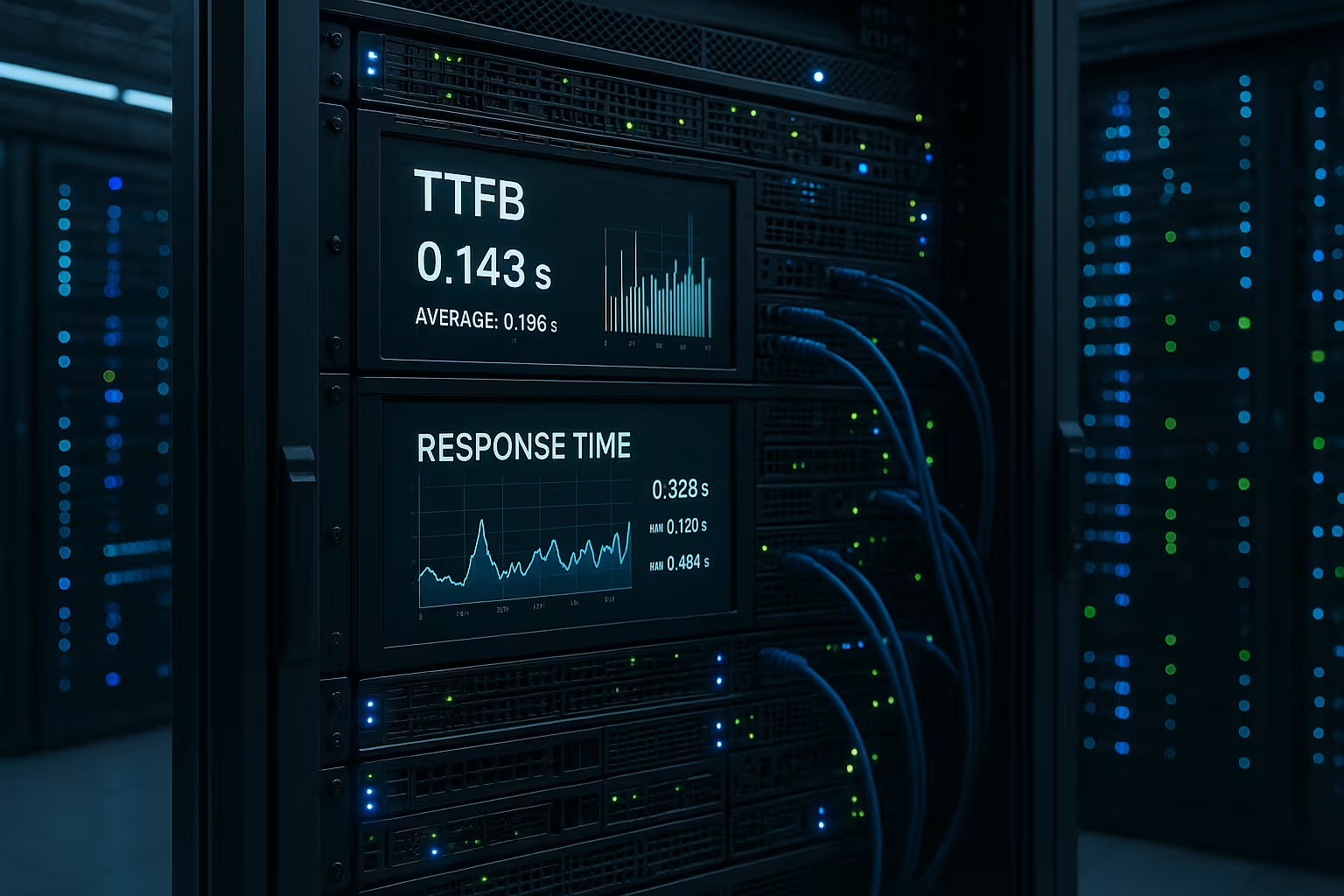
I monitor TTFB, LCP, CLS and FID via RUM and labs. I mark regions with high latency for additional caches or replicas. I split large payloads and load them critically first. For SEO, I specifically track time-to-first byte and indexability. Recurring outliers trigger tickets and measures such as Edge-Caching rules.
I differentiate between warm vs. cold TTFB and measure both. I run synthetic checks from strategic PoPs to detect edge hotspots early. I segment RUM data by network type (3G/4G/5G/WiFi) to align optimizations with real user conditions. Origin bypass quota (CDN hit rate) is my key cost and speed indicator.
For content changes, I use performance budgets (max. KB per route, max. number of edge invocations) that abort builds hard if values are exceeded. This keeps the site lean in the long term.

Example configuration: Edge policies in practice
I set a policy that de and en automatically via Accept-Language. If a header fails, Geo-IP is used as a fallback. Authenticated users receive private routes and personalized cache keys. The CDN caches public content long, private responses short TTL with revalidation. This is how I keep the traffic lean and the Answer fast.
For error scenarios, I define stale-if-error and grace periods (e.g. 60-300 s) so that known content is delivered from the edge cache if the origin fluctuates. For HTML, I separate layout (long cacheable) and user-specific data (short-lived) into two requests. This increases the cache hits and keeps personalization up to date.
My cache keys contain Vary-shares for language, device, feature flag and auth status. About Surrogate control I control what only the CDN should take into account, while browser headers remain conservative. This keeps handling clean and controllable.
Development and debugging on the Edge
I emulate Edge runtime and PoP context locally so that I can test logic, headers and caching reproducibly. Preview deployments mirror edge policies 1:1, including auth and geo filters. For debugging, I use correlating Trace IDs from browser to database and only log what is necessary to avoid PII.
I correct errors with Feature toggles instead of hotfix branches: flag off, traffic drops to stable paths. I then deliver the correction via the pipeline. For third-party failures, I build timeouts and Fallback content so that pages render despite external interference.
Eventing, queues and scheduled jobs
I move everything that is not in the critical path to EventsConfirmation emails, webhooks, index updates, image resizes. Edge functions only send one event to a queue; workers in favorable regions process it. This keeps API latencies low and costs predictable.
For periodic tasks I use Edge-Cron (time-controlled triggers) and keep jobs idempotent. Dead letter queues and alarms take effect in the event of faults so that nothing is lost. Retries with exponential backoff prevent thundering stove.

Resilience and fallback design
I am planning Circuit Breaker between Edge and Origin: If the error rate increases, the Edge switches to cached or degraded responses (e.g. simplified search, limited personalization). Stale-while-revalidate plus stale-if-error gives me time to solve backend problems without losing users.
For partial failures I use Region failoverWrite accesses are temporarily redirected to a neighboring region, read caches remain warm. The CDN delivers status pages and banner messages independently of the origin so that communication functions reliably.
Compliance and data residency
I categorize data according to sensitivity and location. Residency Policies set hard limits (e.g. EU-only). Edge functions check at the point of entry whether requests trigger data access that could violate policies and block or reroute them at an early stage.
I keep protocols Data efficientNo PII in the edge log, short retention, encrypted storage. Access controls and traceability are part of the IaC definition so that audits run efficiently and deviations are automatically visible.
Summary and next steps
Serverless edge hosting brings me global Performance, low latency and predictable costs. The way to achieve this remains clear: keep the front end lean, focus on caching and use edge logic consistently. I keep data close to the user and secure APIs at the edge. Deployments run automatically, rollbacks remain available at all times. With this Workflow I build websites that respond quickly and grow reliably worldwide.