Skip to content
I show how Session management web hosting becomes measurably faster when I store sessions specifically in files, Redis or databases and strictly control the life cycle. This is how I reduce Latency, keep the cache quota high and scale securely across multiple servers.
Key points
I consistently implement the following key points in order to handle sessions securely, quickly and scalably.
- cache ratio protect: Minimize session usage and keep requests cache-friendly.
- Redis for speed: use in-memory storage for short, frequent accesses.
- Files Conscious: Simply start, migrate early under load.
- Database targeted: Persistence only for really critical sessions.
- Configuration tight: fine-tune PHP-FPM, TTLs, timeouts and monitoring.
Why sessions reduce the cache rate
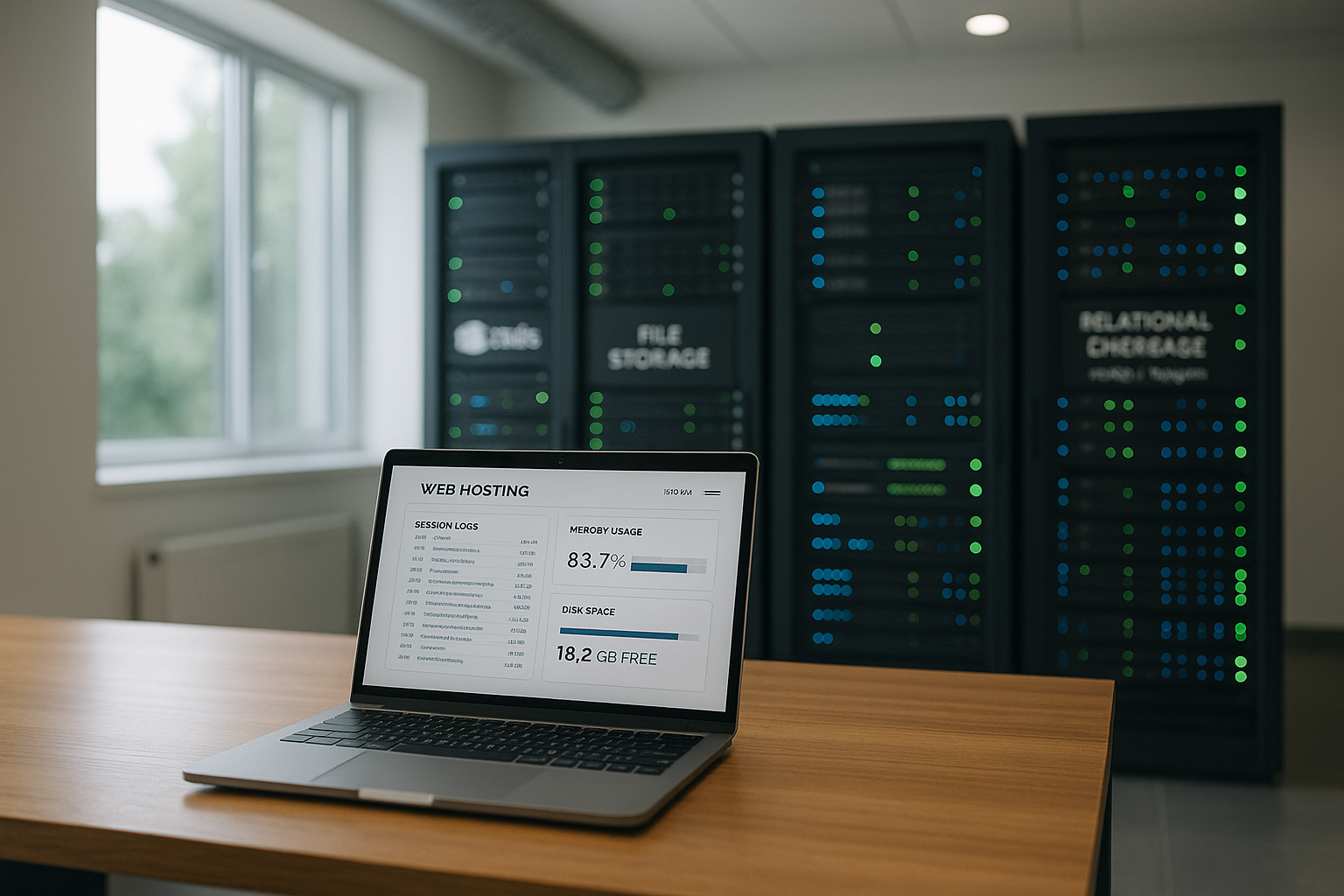
Each active session sets a PHPSESSID-cookie, which makes requests unique and thus bypasses many caches. I therefore consciously decide which routes really need sessions and which run strictly without a session. This keeps pages such as product lists, blogs or static content via CDN and app cache as fast and scalable. I only open a session if the request writes status data or reads sensitive data. I keep the write part short, close the session quickly and allow parallel requests to run freely.
Files as session storage: simple, but limited
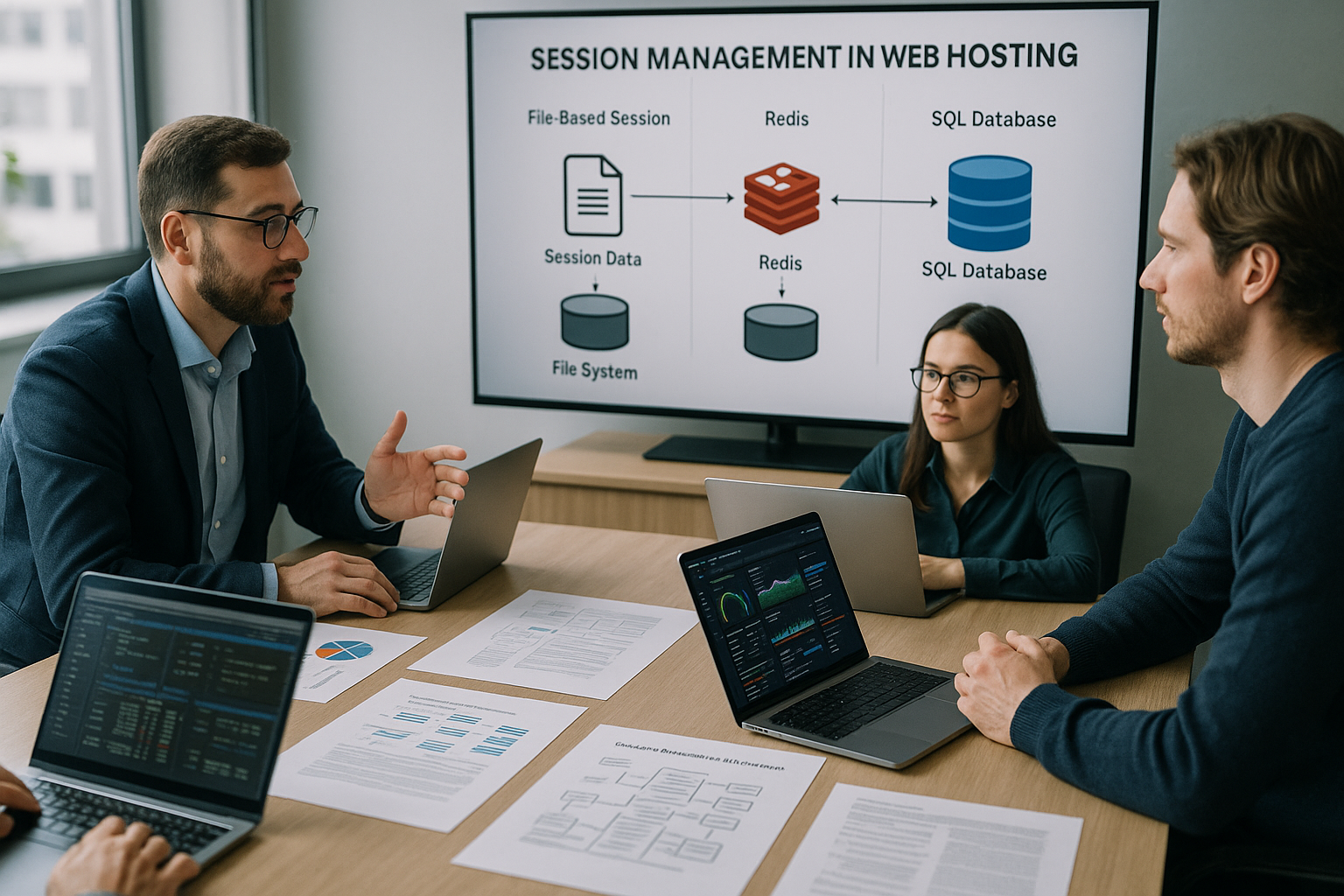
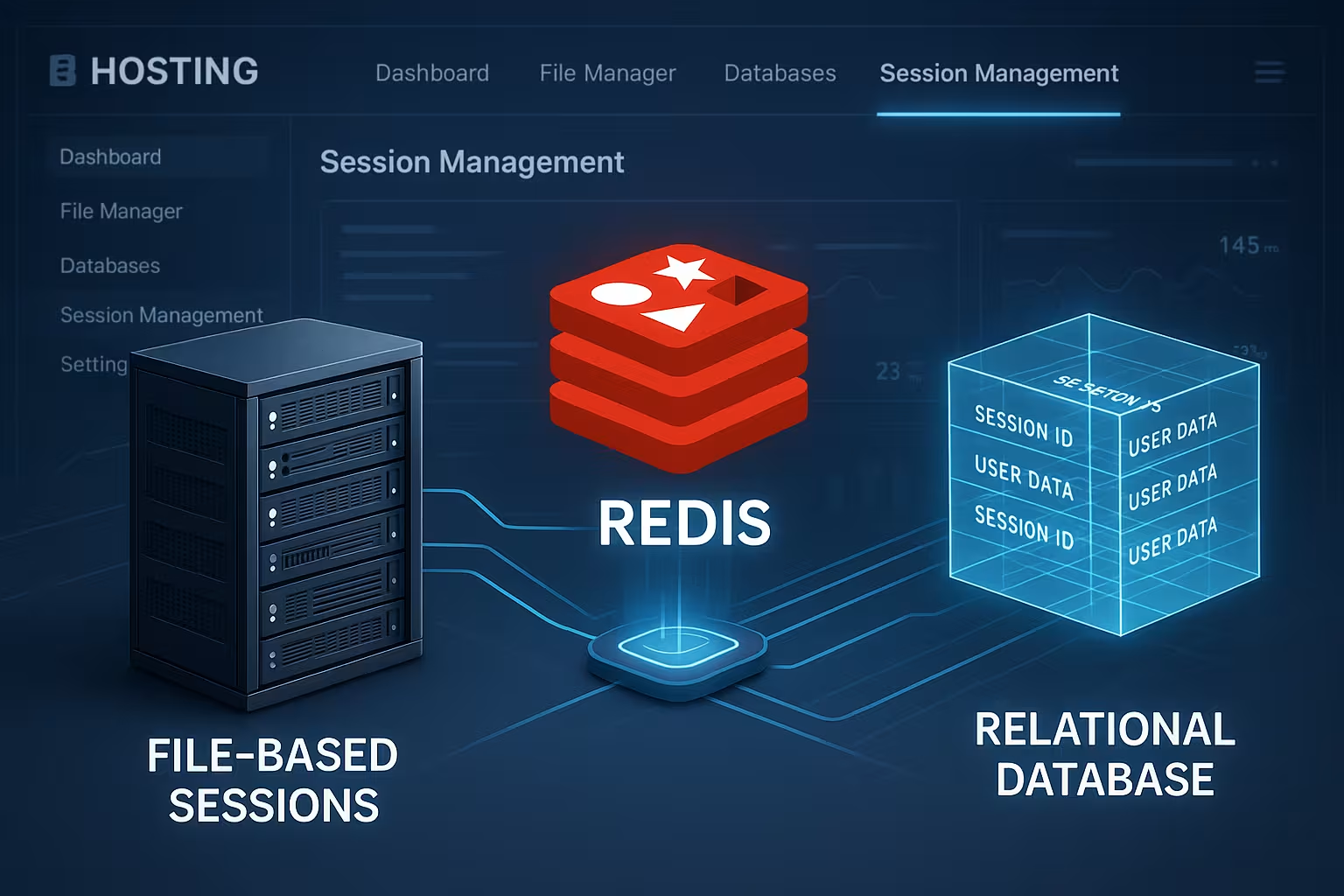
The file system handler in PHP is a good start, but it only scales up to a moderate load. Every access generates I/O, and the latency increases quickly on slow storage or NFS. In cluster setups, there is a risk of inconsistencies if several app servers are not looking at the same directory. I therefore ensure centrally available paths at an early stage or plan the switch to Redis. File storage is sufficient for small projects, for growth I plan a migration path right from the start.
Redis for sessions: fast and centralized
Redis stores session data in the RAM and thus delivers millisecond accesses even under load. I use Redis centrally so that all app servers see the same sessions and can distribute load balancers freely. I keep TTLs tight so that short-lived states do not fill up the memory. I also encapsulate sessions in a clean namespace to separate them from other caches. If you want to go deeper, you can find practical ways under Optimize session handling, which I use in productive setups.
Database sessions: when it makes sense
MySQL, PostgreSQL or MariaDB give me more Persistence, but they cost latency and CPU. I rely on DB sessions when I need to securely maintain sessions in the event of crashes or restarts. This applies, for example, to processes with regulatory requirements or long-running order processes. I limit the payload and only write what is absolutely necessary to protect the database from unnecessary load. For high parallelism, I combine DB sessions with short TTLs and very clear Indices on session ID and expiry time.
Performance comparison: files, Redis and database
I organize the following overview according to access speed, scaling and operational reliability so that I can find the right storage and Error avoid.
| Criterion | Files | Redis | Database |
|---|---|---|---|
| Latency | medium to high (I/O) | very low (in-memory) | medium (network + SQL) |
| Scaling | limited, path sharing necessary | high, central or cluster | High, but cost-intensive |
| Persistence | low | configurable (AOF/RDB) | high |
| Cache compatibility | Critical for active cookies | Good if used sparingly | Good if used sparingly |
| Operational risk | Locking/GC, file system | RAM printing, TTL discipline | SQL load, deadlocks |
| Typical use | small sites, few users | Peak loads, many users | Critical processes |
From this comparison I draw clear ConsequencesI choose Redis for speed and scaling, a database for permanent traceability and file storage for very small environments.
Configuration: PHP-FPM, OPcache and timeouts
I set PHP-FPM so that max_children matches the CPU and I/O capacity so that I don't run into swap under load. The OPcache keeps hot code in memory and thus reduces the CPU time per request. For backends such as Redis or the database, I set short connect and request timeouts so that blocked connections do not tie up workers. I adapt keep-alive strategies to the latency of real backends. I summarize details on locks and parallel requests in my guide to PHP session locking which I successfully apply in projects.
Keep sessions short: Patterns and anti-patterns
I only open sessions when I really need status data, not earlier in the Request. After reading, I use read_and_close or call session_write_close() so that parallel AJAX calls do not wait for each other. I only write small, serial values and do not use large objects. I consistently avoid long transactions with an open session handle. This is how I lower Locking, keep latencies stable and use server resources efficiently.

Avoid sessions: Using signed cookies correctly
Where strong protection on the server side is not necessary, I replace sessions with Cookies with a digital signature. This keeps requests cache-friendly and I save I/O on servers. This is completely sufficient for notifications, UI states or personalization. I set SameSite to Lax or Strict, switch to HttpOnly and enforce Secure for TLS. For sensitive content, I stick to server sessions and separate Function clear risk.
Garbage collection, TTLs and cleanup
I hold the sessionGarbage-collection in PHP so that old files or entries disappear and don't block memory. In Redis, I set TTLs per namespace, consistently delete old files and, if necessary, use keyspace scans outside of peak times. For file sessions, I choose clean cron jobs if the built-in GC is not running reliably. In databases, I use indexes on expiration time and regularly delete expired sessions in small batches. If you want to read more about cleaning up, take a look at my notes on Session Garbage Collection, which I use for productive environments.

Clusters and load balancing: sticky or centralized?
I prefer a centralized Redis-instance or a Redis cluster so that every app instance accesses the same session state. Sticky sessions via the load balancer work, but tie users to individual nodes and make maintenance more difficult. Central storage keeps deployments flexible and shortens maintenance windows. I test failovers regularly so that timeouts and retries work properly. For very high requirements, I additionally secure and isolate sessions. Namespaces per application.
Monitoring and metrics: What I log
I measure session access times, error rates, I/O latencies and the number of active Sessions. I also monitor the CPU, RAM, network and open connections for each backend. In Redis, I check evictions, keyspace hits and misses to sharpen TTLs. In databases, I check locks, slow queries and the size of the session table. I use these key figures to recognize trends early on and keep the Performance stable before users notice anything.
Safety: session hardening and regeneration
I consistently harden sessions. session.use_strict_mode prevents random IDs from being accepted. I deactivate URL-based session tracking (trans_sid) and only use cookies. After a successful login, I rotate the session ID (Regeneration) to eliminate fixation attacks. I use HttpOnly, Secure and suitable SameSite-values: Lax is sufficient for classic web flows, for cross-site integrations I deliberately plan SameSite=None and TLS enforced. Optionally, I pin a hash from the user agent and IP range to make hijacking more difficult - I take NAT and mobile phone environments into account so that sessions remain stable. The ID entropy (sid_length, sid_bits_per_character) so that brute force does not work. I don't even store sensitive payload such as PII in sessions, but refer to secure data storage with its own access controls.
CDN and edge caching: varying cookies correctly
I consistently keep public pages cookie-free, so that they are cached via CDN and proxy. Where cookies are unavoidable, I define explicit Vary-rules and cache bypass only for truly personalized parts. I separate personalized areas (e.g. shopping cart, account) from general pages and use fragment or micro caching with short TTLs for these. In HTTP/2/3 environments, I use parallel requests and ensure that only the few endpoints with session status are excluded from the cache chain. This keeps the cache ratio high, even if part of the application requires sessions.
Serialization, data format and payload discipline
I choose the Serializer-strategy. For PHP handlers I use php_serialize or igbinary (if available) to reduce CPU time and size. In Redis I save RAM by only using small, flat values and optionally activate compression (e.g. lzf/zstd for phpredis). I keep the structure versioned (e.g. a field v), so that with deployments Forward and backward compatible remain. Large objects such as product lists, search results or complete user profiles do not belong in the session, but in caches with their own lifecycle. I make sure that session keys are named consistently and proactively clean up outdated keys to avoid memory leaks.
Deployment, migration and compatibility
For Zero downtime-deployments, I plan sessions like data: I avoid format breaks that make current sessions unreadable. If a change is necessary (e.g. file → Redis), I run both paths in parallel for a short time and migrate opportunistically with the next user action. I keep a Fallback strategy ready: If Redis is not accessible, the app falls back to read-only with graceful degradation in a controlled manner instead of blocking workers. With Blue/Green deployments, both stacks accept the same session structure. I roll back changes to TTL or cookie attributes in Shafts and react early before peak effects occur.
Redis operation: high availability and tuning
I run Redis redundantly (Replica/Sentinel or Cluster) and test Failover under real load. TCP keepalive, short connect/read timeouts and a clear reconnect strategy prevent hanging workers. I use persistent connections in phpredis sparingly to save handshakes without breaking pool limits. The maxmemory policy I select appropriate for sessions (e.g. volatile-ttl) so that old keys are dropped first. I monitor the replication latency and the Slowlog, optimize networks (somaxconn, backlog) and keep the instance free of external data. I adjust the locking options of the Redis session handler so that short spin locks work with a timeout instead of blocking for a long time. This keeps the latency predictable, even with high access rates.

Error patterns from practice and resilience
I quickly recognize typical problems: Increasing Lock times indicate long writing phases - I separate reading/writing and close sessions earlier. Accumulations of Evictions in Redis show TTLs that are too tight or payloads that are too large; I reduce size and increase memory capacity or scale horizontally. In databases, deadlocks signal that competing updates are hitting the same session; shorter transaction durations and careful Retry logic. For file backends inode-exhaustion and slow GC cascades classics - I use structured directory sharding and cron GC with limits. For external dependencies I implement Circuit Breaker and timeouts so that the application is not affected by partial degraded, but alive.
Framework and CMS practice: WordPress, Symfony, Laravel
At WordPress I only activate sessions where plugins need them (e.g. store, login) and minimize frontend cookies for maximum CDN yield. I configure Symfony and Laravel projects so that Session start does not happen globally in the middleware stack, but selectively. I use read_and_close after reading, set short TTLs for anonymous sessions and rotate IDs after authentication. For background jobs (queues, cron), I do not open sessions at all or only read-only to avoid locks. I design API endpoints stateless and use signed tokens instead of sessions - this keeps the scaling linear and the cache quota untouched.
Compliance and data protection: what really belongs in sessions
I follow the principle of Data minimizationDo not write any personal data in the session if references (IDs) are sufficient. I link retention periods to TTLs and document which fields exist and why. For audits, I make it clear that sessions are volatile, while regulatory data is stored in designated systems. I fulfill user rights (information, deletion) by ensuring that sessions are not misused as data storage and can be securely deleted upon expiry or logout. decouple.
Testing under load: scenarios and benchmarks
I test scenarios realistically: parallel logins, lots of small AJAX-Writes, checkout flows with external services, and static pages with a high CDN share. I measure 50th/95th/99th percentiles, compare session backends and vary TTLs. I check how locking behaves with 5-10 simultaneous requests per session and how quickly workers recover if I artificially slow down Redis/database briefly. I also simulate failover and check whether the application right returns (reconnect, retries, no zombie workers). These tests are incorporated into Guardrails: maximum payload, time limits for critical paths and clear alarms.
Operational standards: Config and housekeeping
I version php.ini-(session.cookie_secure, session.cookie_httponly, session.cookie_samesite, session.use_strict_mode, session.gc_maxlifetime), document backend defaults (timeouts, serializer, compression) and keep runbooks available for faults. For DB sessions, I maintain a compact schema with PRIMARY KEY on ID and index on expiry time; I perform cleanup via batch jobs in quiet time windows. In Redis, I keep namespaces strictly separate in order to monitor and delete session keys and migrate them if necessary. This keeps the Operation manageable even in fast-growing environments.
Briefly summarized: Strategic guidelines
I minimize Sessions and keep them short in order to use caches effectively and keep response times low. For speed and scaling, I choose Redis; for long-term traceability, I selectively use a database. File storage remains the entry-level solution, but I plan the switch early on. I ensure stability with a clean PHP-FPM configuration, OPcache, strict timeouts and consistent garbage collection. On this basis, I make php session hosting fast, keep the infrastructure lean and create Reserves for peak loads.