 Skip to content
Shared hosting and dedicated hosting differ not only technically, but also strategically. The Hosting comparison shows which solution really works for small websites or large online platforms - and which criteria are decisive for stability, security and growth.
Key points
- cost structure: Shared hosting is cheaper, dedicated hosting costs significantly more
- Resource access: With dedicated hosting, all resources are exclusively available
- security level: Higher security through server isolation with dedicated hosting
- Administrative expenses: Shared hosting requires little expertise, dedicated does
- Scaling: Dedicated hosting is ideal for growing companies and traffic peaks
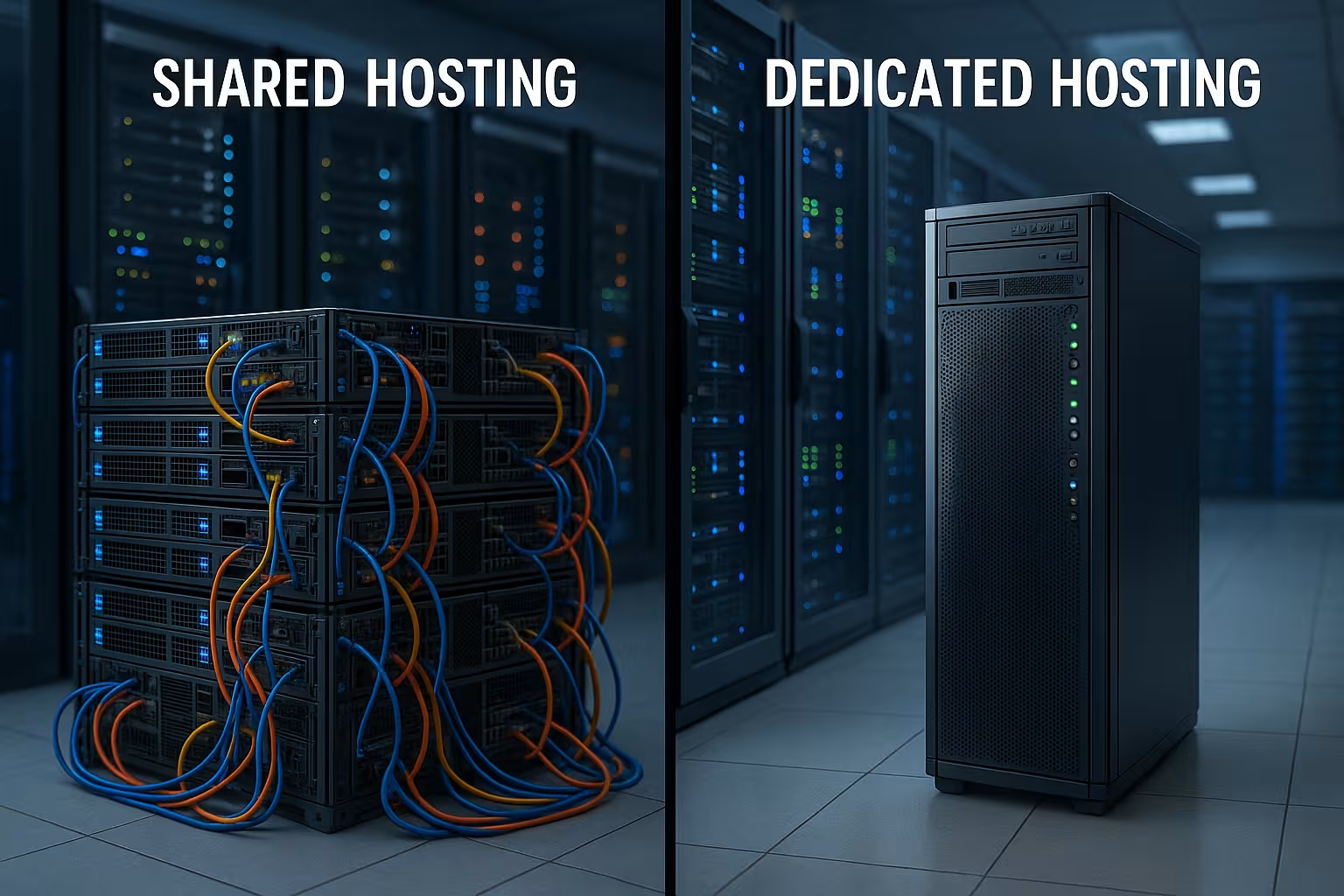
What is shared hosting and when is it worthwhile?
Shared hosting means that several websites are operated on one physical server and share resources such as processing power, memory and storage space. The model is suitable for smaller web projects where budget plays a central role. Providers manage the server infrastructure, take care of maintenance, security updates and often also backups. Setup is carried out via user-friendly administration interfaces such as cPanel or Plesk.
Shared hosting is ideal for blogs, portfolios or local company websites that do not have a high number of hits. The existing technology fulfills basic requirements and enables a fast online presence.
I recommend shared hosting if the following criteria are met:
- Limited budget: Entry usually from € 3 to € 7 per month
- Little technical knowledge: No server configuration necessary
- Low data traffic: Less than 5,000 visitors per month
Advantages and disadvantages of shared hosting
The biggest advantage of shared hosting is the cost and effort level. Anyone launching a website will find entry-level conditions that are easy to calculate. At the same time, the provider takes over central tasks such as security patches, PHP updates or mail server configuration.
However, you also share the server capacities. If other websites on the same server experience increased load (bad neighbor effect), this will affect your loading times. In addition, in shared environments Security risks increased. Faulty scripts or compromised pages from other customers can jeopardize your website.
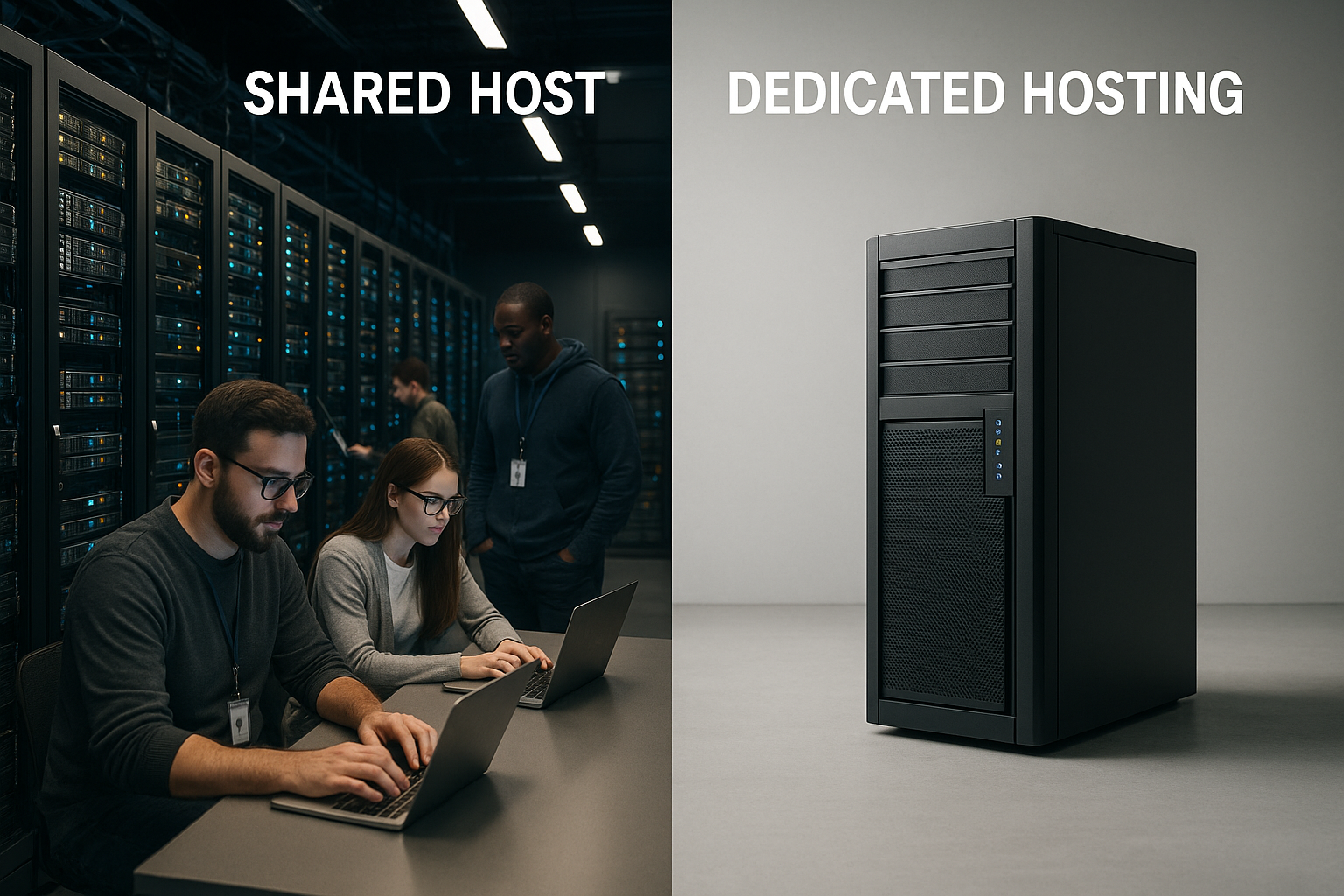
Dedicated hosting: control, performance, security
Dedicated hosting gives you access to your own server, which you can use entirely yourself. No other website competes for memory or computing power. Performance remains constant, even with strong growth or seasonal traffic peaks. The hosting model proves particularly useful for data-intensive applications, online stores or security-relevant platforms.
Exclusive use gives you complete freedom of action. You choose the operating system, configure security guidelines and determine which web servers or databases are to be installed. Especially for projects with High compliance requirements such as GDPR, PCI DSS or special hosting setups, dedicated hosting is the right choice.
When dedicated hosting is the right choice
I recommend dedicated hosting if a website is highly personalized or there are regular load peaks. This includes highly frequented news portals, e-commerce platforms with a growing number of users or SaaS applications with a sophisticated user interface.
Individual server environments also play a key role in the agency business. Anyone who manages numerous customer projects or develops special web services often needs the administrative freedom that shared hosting does not offer.
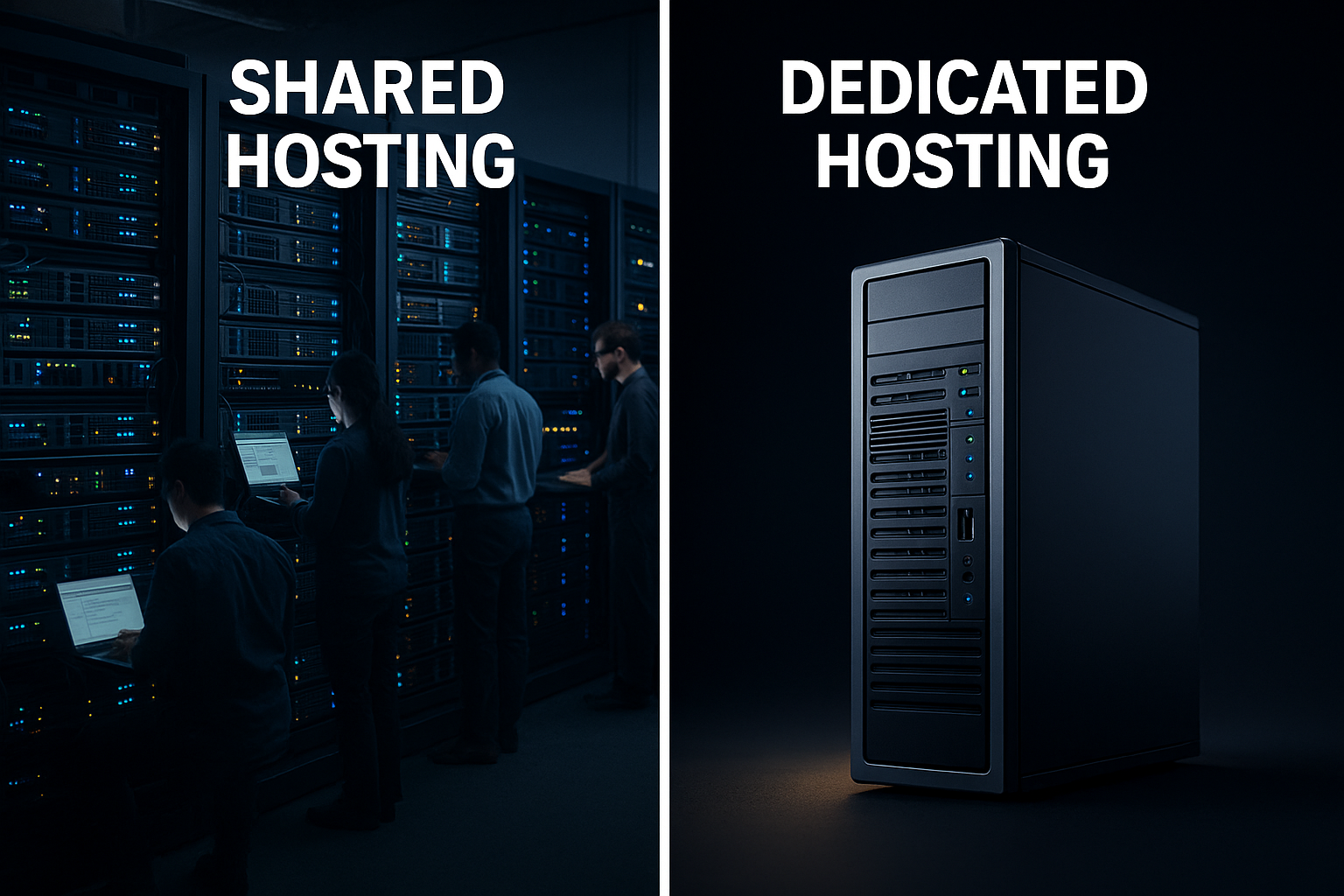
Direct hosting comparison: shared vs. dedicated
The following table will help you to recognize the most important differences and offers a good decision-making aid:
| Criterion | shared hosting | Dedicated Hosting |
|---|---|---|
| Costs | From approx. 3 € / month | From approx. 90 € / month |
| Performance | Shared with others | 100 % exclusive |
| Security | Dependent on neighbors | Fully controllable |
| Technical freedom | Very limited | Unrestricted |
| Scalability | Limited | Very high |
Managed dedicated hosting as an alternative
If you want maximum freedom but don't have your own IT department, you should use managed dedicated hosting. The provider takes care of operating system patches, monitoring, backups and firewalls. This option is particularly useful for medium-sized companies or solopreneurs with a large web presence.
I myself rely on managed dedicated hosting for critical projects. This allows me to maintain control while I take care of content and growth.

Performance and loading times in comparison
A key advantage of dedicated hosting is the high and reliable loading speed. In contrast, high access numbers from other customers have a negative impact on response times with shared hosting. For Google Core Web Vitals and conversion rates Server speed however, is crucial.
I recommend: Regularly measure the performance of your website with tools such as PageSpeed Insights or GTmetrix. If critical values appear repeatedly, this indicates a need for an upgrade.
Security: compartmentalization vs. community risk
Dedicated servers enable stricter security protocols, individual firewall rules and access controls. With shared hosting, on the other hand, all clients are dependent on the provider's protection. This also means that if one site is not working properly, the entire server can be compromised.
Anyone who processes personal data or operates a customer portal must secure the responsibility on a dedicated infrastructure. This step also helps with certification processes or legal verification requirements.

Recognize monitoring and changeover signals
Stay flexible. Analyze server load, loading time and error messages at short intervals. A changeover should be considered, especially if the number of visitors increases or the range of functions is expanded.
A typical warning signal is when the website repeatedly loads slowly or there are frequent timeouts. Frequent support requests in the event of store outages also indicate Overloaded server structures there.
Which solution suits your project?
Shared hosting is the right start for smaller digital showcases such as blogs, business card sites or creative portfolios. Projects with little momentum benefit from the favorable structure.
As soon as user interactions increase, databases are used more intensively or SEO performance is required, a dedicated concept should be considered in the long term. The hosting comparison helps you to make a targeted decision - based on technology, requirements and growth plans.

Virtual alternatives: VPS & cloud hosting
Parallel to shared and dedicated hosting, there is another approach with virtual private servers (VPS), where you receive a virtualized server share on high-performance hardware. In contrast to shared hosting, you still share the physical resources with other customers, but you have significantly more control over your instance. This includes root access, the option to install individual software and a higher level of security thanks to separate environments. VPS offers are therefore an interesting interim solution if shared hosting no longer meets your requirements but a dedicated server still seems too large.
Cloud hosting, on the other hand, uses virtual resources from a cluster of servers, providing additional flexibility and reliability. During peak loads, more resources can be automatically allocated, while costs are saved when utilization is lower. Companies with highly fluctuating traffic in particular benefit from this model. There are therefore a variety of options that can be considered depending on project size and budget.
Maintenance and regular updates
Whether shared or dedicated hosting - updates are an essential factor for the security and stability of your website. While shared hosting providers automatically take care of this task for you, with dedicated servers it is often your own responsibility. If server administration is not outsourced (Managed Dedicated Hosting), careful patch processes are necessary to close security gaps and avoid technical problems.
I recommend that all projects establish a fixed maintenance plan. Check for critical updates for the operating system, your CMS or store systems and databases on a monthly basis. An outdated kernel or PHP package can quickly become a point of attack and cause reputational damage as well as downtime.
Server location, latency and data protection
Whether shared or dedicated: the location of your server has a direct impact on latency times and therefore on performance. If your main target group is in Germany or Europe, you should choose a server that is operated in this country to ensure short loading times. Data protection aspects (GDPR compliance) can also play an important role. Servers in the EU must meet strict requirements, which leads to a higher level of data security. Especially in security-sensitive industries such as e-commerce, healthcare or finance, it is advisable to choose the hosting location carefully.
With dedicated hosting, you often have the advantage of being able to select the server location, while shared offers are usually operated centrally and standardized. At the same time, this offers the possibility of fulfilling specific country certifications or conformities that are prescribed in certain business areas.
Development, test environments and continuous deployment
The larger a web project, the more important a professional development and test environment becomes. With shared hosting, these options are usually very limited, as only one production directory is available. Subdomains may suffice for quick tests or small versioning processes, but more extensive deployment strategies quickly reach their limits.
Dedicated hosting, on the other hand, makes it easy to set up multiple instances, such as a development and a staging environment. In combination with Git workflows and continuous deployment pipelines, changes can be safely tested and automatically made live. I personally appreciate this flexibility when carrying out complex projects with regular updates.
Scalable resources and growth prospects
Especially for growing projects, it is advisable to carefully examine the scaling options. Shared hosting quickly reaches its limits as the number of visitors increases, which can lead to longer loading times or even downtime. Dedicated servers, on the other hand, can be scaled up by adding remote storage options or integrating additional servers into the system.
If you are not sure whether a dedicated server is necessary today, you can initially choose VPS or Managed Dedicated. Storage, memory or CPU performance can often be flexibly adapted without having to rely directly on a disruptive migration. However, always pay attention to the cost-benefit balance when taking these scaling steps. Although more resources are more powerful, they inevitably increase the monthly fees.
Checklist: How to find your ideal web hosting solution
If you are experiencing increased performance losses or security concerns, it may make sense to switch hosting. I recommend the following steps:
- Needs analysis: How many visitors do you have? What performance targets do you have?
- Safety requirements: Do you need to process sensitive data? Do you need a dedicated firewall?
- Scaling plan: Do you expect seasonal traffic peaks or constant growth?
- Technical know-how: Can you maintain the server yourself or does managed hosting make more sense?
- Cost framework: Determine at an early stage how much budget per month is realistic.
- Support quality: How quickly does the provider's support respond to problems?
This checklist will help you to make an informed decision. If you take the above points into account from the very start of a project, you will usually save yourself a costly change in the peak phase of growth.
The influence of e-mail and domain services
Web hosting often involves more than just operating websites. In many cases, providers also offer e-mail inboxes and domain management. With shared hosting, these services are usually directly integrated. However, the number of email accounts or mailbox sizes may be limited.
Dedicated hosting, on the other hand, gives you full control over your email server settings. This is advantageous if you need different email inboxes with individual filter rules and large storage capacities or if you want to use special anti-spam solutions. Companies that attach great importance to professional email communication in particular benefit from this flexibility.
Additional security aspects: Certificates and app containers
In addition to firewalls and regular updates, SSL encryption is becoming increasingly important. Free certificates such as Let's Encrypt are often integrated into shared hosting so that websites can at least be accessed via HTTPS. With dedicated hosting, however, you can set up additional certificates for special subdomains or use wildcard certificates to secure multiple projects. This makes it easier to run multiple web applications on one server.
In addition, more and more companies are relying on container solutions such as Docker to isolate web applications and operate them independently of each other. Dedicated hosting creates the necessary framework to manage containers efficiently. Shared hosting can quickly reach its limits in this area, as you often do not have direct access to the container engine.
Options for hybrid models
In some cases, it makes sense to combine different hosting types. For example, you can host static content or images on a content delivery network (CDN), while the actual logic (e.g. the CMS) runs on a dedicated server. Databases can also be operated in a scalable cloud infrastructure in order to achieve a high level of reliability. These hybrid concepts combine the best of different worlds: Cost efficiency, security and performance.
Not every project needs to switch directly to dedicated. A combination of shared hosting for less demanding content and a virtual server for computing-intensive processes may already be sufficient to balance performance and costs. Which division makes sense depends largely on the nature of your website and your target group.
Ultimately, it's the perspective that counts
Each hosting solution has its strengths. Shared hosting enables a quick start, while dedicated hosting ensures long-term performance. It is important that you regularly monitor how requirements develop - both technically and in business terms.
I review my hosting strategy every twelve months. This allows me to identify bottlenecks, security-related weaknesses or unnecessary costs at an early stage. With a flexible partner like webhoster.de, both models can be operated efficiently or combined if necessary.


