Skip to content
I explain how I plan security updates for kernel, PHP, web server and dependencies - from staging and rollout to the fallback point. How to succeed hosting security updates patch management without failures, with clear priorities, automation and clean documentation.
Key points
For a quick overview, I will summarize the most important fields of action and mark the levers with Focus.
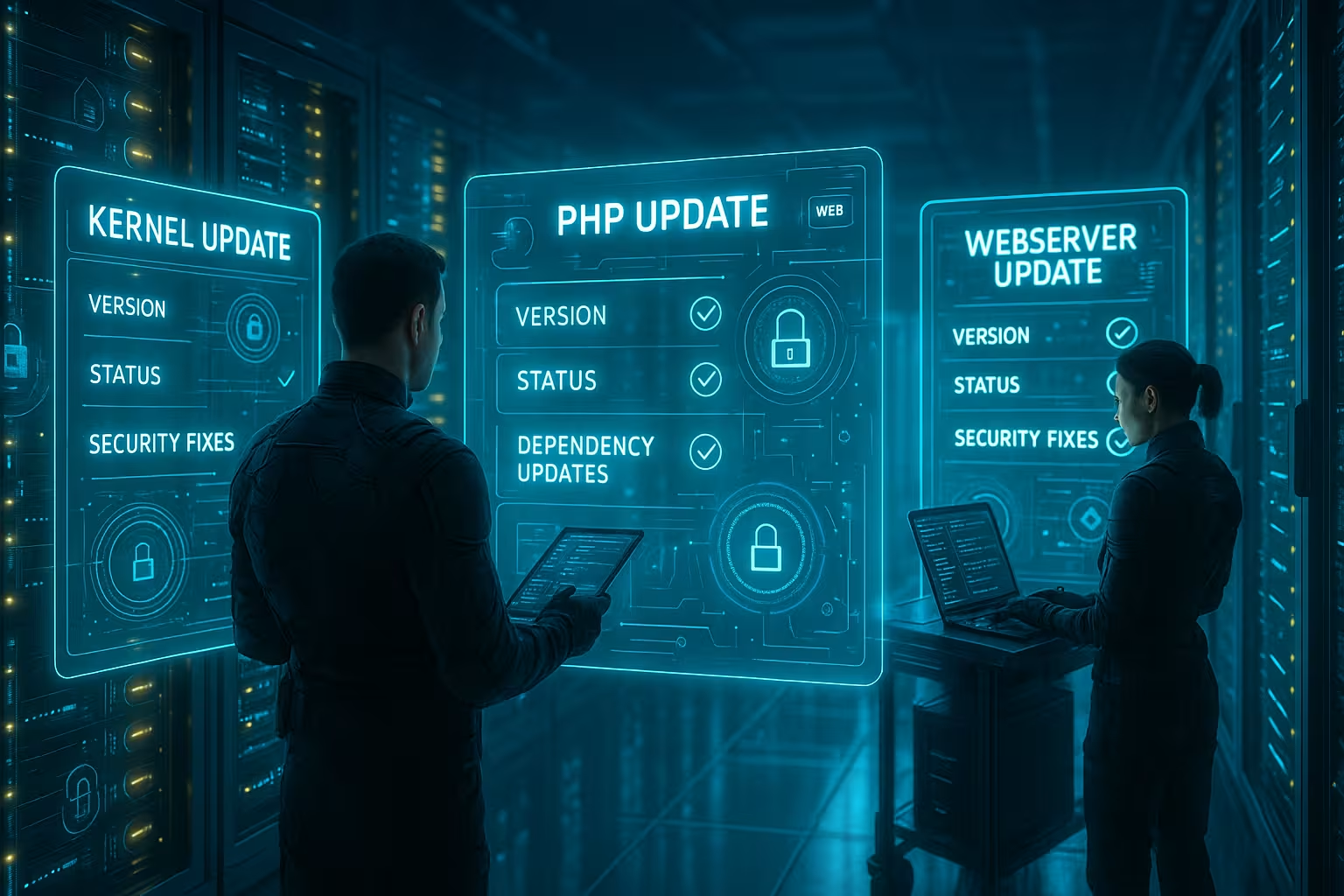
- KernelStaggered rollouts, live patching, clear restart windows
- PHPCheck versions, extensions, third-party libraries
- Web serverGraceful-Restart, Blue-Green, Config-Validation
- DependenciesScans, pinning, configuration-as-code
- RollbackSnapshots, staging, documented emergency paths
Targeted implementation of kernel updates
I treat the kernel as Core component with its own patch plan, because errors here affect the entire host. First I test new kernels in staging VMs, measure IO latencies, check drivers and compare dmesg logs. This is followed by a staggered rollout: pilot hosts, small host groups, then the broad rollout. For very strict availability targets, I work with live patching, if the setup allows it, and still plan regular reboots in maintenance windows. If you have reasons for seemingly old kernel versions I weigh up the risk against security and make an informed decision.

Running PHP securely: Versions, extensions, dependencies
I deliberately keep productive PHP versions current, because patches often prevent remote code execution and data theft. Switching to more modern releases works smoothly if I test extensions, OPcache settings and FPM workers beforehand. This includes a review of the composer.lock files in order to identify vulnerable libraries and to specifically remove them. For development teams, I provide migration instructions and checklists to ensure that adjustments to syntax or deprecated APIs are successful. If you are planning specific migration steps, you will find PHP 8.3 Upgrade many starting points for safe conversions.
Web server updates without downtime
I update Apache or Nginx in such a way that users can hardly Interruptions feel. Before every update, I validate configurations using -t/-T checks and version-secure virtual host files. A graceful restart empties workers in a controlled manner, while incoming connections continue to run. I set up larger conversions as blue-green deployments: a new server group only accepts traffic after end-to-end tests. Failback is always prepared so that I can switch back at lightning speed in the event of problems.

Communication, change management and maintenance announcements
I orchestrate patches like changes: with a clear scope, risk assessment, approved plan and binding communication. For customers and internal stakeholders, I set up standardized advance notifications with purpose, timeframe, expected impact, emergency contact and fallback strategy. I mark blackout periods (e.g. campaigns, seasonal peaks) early so that no maintenance slips in between.
A change record always includes: ticket references, metrics baselines, tests, approvals (dual control principle) and the associated runbooks. I carry out pre-mortems for critical systems: What could go wrong, which signals do I recognize first, how do I stop safely? First-level support receives playbooks and status templates so that queries can be answered quickly. After completion, I provide a brief post-maintenance note about the result, any anomalies and any follow-up work.
For larger fleets, I use change calendars with clear rotations. In this way, I avoid resource conflicts, prevent parallel interventions on dependent systems and ensure that an experienced operator is always on call.
Mastering dependencies: package and config management
I manage libraries, database drivers and tools centrally so that no outdated Packages remain overlooked. Package pinning prevents unwanted upgrades, while security feeds only release secure versions. I keep container images to a minimum, scan them before rollout and sign verified artifacts. For configuration, I rely on configuration-as-code with pull requests, reviews and reproducible builds. This way, changes remain traceable and a rollback happens without guesswork.
SBOM, CVE intakes and risk assessment
I maintain a software bill of materials (SBOM) for each service and image so that I always know which components are running with which versions. I systematically process CVE feeds on this basis: new reports are automatically correlated, evaluated and assigned a risk value. I not only take into account the CVSS score, but also exploitability in context (remote vs. local), attack surface, exposure (Internet-facing or internal), existing mitigations and business impact.
The prioritization results in clear SLAs: critical - immediately or within 24 hours; high - within a week; medium - in the next regular maintenance window; low - bundled with routine updates. For unavoidable deferrals, I document risk acceptances with end dates and compensatory measures (e.g. WAF rule, feature flag, additional monitoring checks). Containers are pinned strictly by digest; updates are made via new, reproducible builds instead of “in-place” changes.
Patch window, priorities and automation
I work with fixed Maintenance windows, clear SLAs and priorities from critical to low. I apply security patches with a high level of urgency at an accelerated rate and bundle less urgent changes into the next window. Orchestration tools take over the standardized process, including pre-checks, updates, reboots and post-checks. Critical hosts require a four-eye principle to ensure that no risky steps go unnoticed. Reports document status, deviations and times for audits.
Monitoring during and after updates
I closely monitor metrics and logs so that I can minimize the impact of Patches immediately. Before the launch, I set baselines for latency, error rates and resource requirements. During the rollout, I track anomalies and alert-based thresholds. After completion, I check trends to detect side effects early. Insights flow into runbooks so that future maintenance windows are more targeted.
Compliance, audits and traceability
I map my patch process to common control frameworks. This includes specifications for vulnerability management, change control, separation of tasks and logging. The verification process is not an additional effort, but an integral component: each step generates artifacts that are stored in an audit-proof manner.
My evidence includes: approved change requests, test plans and results, signed build artifacts, successful config validations, monitoring screenshots before/after the patch, detailed execution logs (who, when, what), as well as documented rollback results from staging. This means that audits can be completed quickly and lessons learned can be fact-based.
Hardening and access control complement patches
I reduce attack surfaces by Hardening at OS and service level. This includes restrictive file permissions, mTLS for internal APIs and limited sudo profiles. I secure admin access with MFA and short-lived tokens, logins are logged and regularly audited. I also protect panel and control plane instances so that configuration errors do not become a gateway. I collect specific tips for hosting panels in my guide to the Secure Plesk.

Secrets management and key rotation
I consistently decouple sensitive configurations (passwords, API keys, certificates) from the code. Secrets end up in a central vault with role-based access, audit logs and automatic rotation. I use patch cycles specifically to check and renew key pairs, tokens and service accounts - including validation that all dependent services have adopted new values.
I avoid configuration leaks by “deny by default”: never include secrets in logs, dumps or crash reports; masking in pipelines; strict scrubbing rules. I encrypt backups with current procedures and rotate keys on a time-controlled basis. In this way, each patch cycle also strengthens cryptographic hygiene.
Rollback, snapshots and staging
I prepare the Rollback as if I had to do it safely. Snapshots before critical changes dramatically shorten the recovery time. In staging, I test realistic loads to uncover tuning and incompatibilities. Only when smoke and regression tests run smoothly do I allow rollouts in waves. Documented return paths prevent wrong decisions in moments of stress.
Update databases and storage systems securely
I treat databases as high-risk components with their own process. I test minor releases and security fixes on replicas, simulate failover and verify schema and extension compatibility. The switch is carried out via read replicas: I first update secondary nodes, measure replication delays and then switch to the primary role in a controlled manner. Connection pools are emptied before switching, and long-running transactions are terminated early.
For storage, I pay attention to firmware and driver versions of controllers, file system options and multipath setups. IO benchmarks before/after the patch (e.g. random/sequential profiles) make regressions visible. Snapshots and binary logs are mandatory: I not only check restore points theoretically, but also run them regularly - including consistency checks at application level.
Sample patch cycle with key figures
I work with a clear cycle, which differentiates according to component, risk and downtime requirement. The following table shows a pattern that I adapt to business hours and SLAs. This keeps expectations transparent and implementations repeatable. Every change is measurable, auditable and reproducible. On this basis, I decide whether to use live patching, rolling or blue-green.
| Component | Patch window | Restart necessary | Zero downtime technology | Test steps |
|---|---|---|---|---|
| Kernel | monthly / ad hoc for critical CVEs | yes (or live patch) | Host drain, live migration | Driver check, dmesg, boot test |
| PHP | monthly, hotfix for security gaps | FPM restart | Rolling reload | composer audit, FPM error log |
| Web server | 2-4 weekly, hotfix for RCE/DoS | no (Graceful) | Blue-Green, Graceful-Restart | configtest, TLS scan, smoke tests |
| Libraries | weekly bundled | dependent | Rolling, container rebuild | SBOM scan, version diff |

Edge, network and load balancer
I update edge components (load balancers, proxies, WAFs, TLS libraries) in coordination with the backend patches. Connection draining, short timeouts and sticky session strategies prevent crashes. I validate configuration changes synthetically (TLS handshake, cipher suites, redirects, HSTS) and check WAF rule updates in “Detect” mode before switching to “Block”. For larger network overlaps, I plan routing changes (e.g. BGP/VRRP) in separate, very short windows so that errors can be isolated quickly.
I include CDN and cache layers in good time: purge strategies, header consistency and signatures must match the changed backends. In this way, I avoid heisenbugs that only occur at the periphery.
Test strategy: Canary, Chaos and Performance
I rely on several test levels: Canary rollouts with a small percentage of real users, shadow traffic on the new version without user influence and synthetic end-to-end checks. I uncover performance regressions with comparative benchmarks and soak tests that keep the load stable for hours. Termination criteria (error budget, latency percentiles, increased CPU/IO) are defined in advance and can be enforced automatically.
Targeted chaos experiments during or directly after patches help to find hidden couplings: Process restarts, network jitter, volume failover. Only when the system remains under control and the rollback takes effect is the patch process mature.
Disaster recovery exercises and restore tests
Backups are only as good as the verifiable restore. I plan regular restore exercises with measurement of RPO/RTO and document all deviations. I explicitly test cross-zone and cross-region scenarios, including DNS switching, secrets rehydration and breaches of the observability tools. I keep immutable backups separately and check them for integrity - even after major patch waves.
Practical operating tips that save time
I plan updates closely to Traffic patterns so that load peaks are excluded. Beforehand, I organize services according to criticality so that I start in the right place. Post-update, I carry out short fire drills to keep runbooks fresh. For teamwork, I use clear roles and rotations so that knowledge is not tied to individuals. I record lessons learned immediately as long as details are available.
Summary for decision-makers and technology
Let me summarize what is effective: planned Kernel updates, PHP stacks, carefully updated web servers and strict dependency management. Monitoring and hardening flank every patch step. Rollback paths remain clear before execution, not afterwards. Tables, checklists and runbooks create speed without risk. A mature process noticeably reduces downtime, costs and security gaps.