Whether for content management systems or big data analyses - the choice between SQL NoSQL can determine the flexibility, scalability and cost structure of a modern web project. In this article, I compare structural differences, areas of application and the advantages and disadvantages of both approaches - so that you can make the right choice for your data strategy.
Key points
- Structure: SQL relies on fixed schemas, NoSQL on dynamic models
- Scaling: Vertical for SQL, horizontal for NoSQL
- Data consistency: ACID for SQL, BASE for NoSQL
- Cost efficiency: NoSQL saves on large amounts of data and in cloud environments
- Areas of application: SQL for secure transactions, NoSQL for flexible data models

SQL vs. NoSQL - an architectural comparison
SQL databases are based on a relational structure with tables that map the relationships between the data using keys (primary/foreign keys). Each row corresponds to a data record with a defined schema. This structure means that queries can be formulated particularly precisely using the SQL language. NoSQL responds to the requirements of modern applications with more flexible data models. They store information as documents (e.g. JSON), key-value pairs or graph structures. This variety allows data to be modeled much more spontaneously - ideal for dynamic content or different data sources within a system. A good example is the use of document databases for user profiles in social networks, where data entries can vary greatly. A relational model can quickly become unwieldy when requirements change. Especially if new fields are constantly required for frequent deployments and releases. NoSQL systems, on the other hand, allow structured changes to be made during operation - without any downtime.How SQL and NoSQL databases scale
A fundamental difference lies in the scalability. While SQL systems are dependent on larger hardware as the load increases (vertical scaling), NoSQL systems allow horizontal scaling. This means that additional servers can be integrated into the network and take over queries or storage. For example, a document-based NoSQL database such as MongoDB can be distributed across ten servers without having to adapt the data configuration. This architecture is ideal for cloud-native deployments, microservices or globally distributed systems. Vertical scaling with SQL, on the other hand, can be expensive as it relies on high-performance servers with a lot of RAM, CPU and fast SSDs. SQL scales well in scenarios where there are clear relationships between data types. For relational queries with many joins, the performance remains unbeatable. But as the number of queries and users increases, vertical scalability eventually reaches its physical limits.
Transactions, consistency and security
SQL databases consistently use the ACID principle around. These four properties - atomicity, consistency, isolation and durability - ensure maximum reliability in transactions. Especially in business processes such as accounting, banking or ERP, it is almost impossible to do without these strengths. NoSQL, on the other hand, follows the BASE model: basically available, soft state, eventually consistent. Instead of immediate consistency, scalability and speed of response are important here. A classic use case: social media feeds, where user interactions are updated worldwide in milliseconds, even if individual posts appear inconsistent for a short time. In terms of security, both types of databases can provide encrypted connections, integrated role and rights concepts and audit logs. It is important to use an environment with a regularly updated infrastructure. For example Operating MySQL databases securely should pay attention to backup strategies and rights management.Cost-effectiveness and maintenance costs
During operation, it quickly becomes clear how strongly scaling strategies affect costs. SQL databases become expensive as data volumes grow - powerful servers, schema management and planned migrations require resources. NoSQL databases such as Cassandra or Couchbase, on the other hand, can be distributed across many inexpensive nodes. What's more, maintenance is often less complicated with horizontally scalable NoSQL solutions. Defective instances can be isolated and replaced - without affecting the overall system. For developers, this means flexible deployment and simplified maintenance without compromising on performance. An additional advantage is the adaptability to cloud infrastructures, for example via Kubernetes or serverless architectures. While SQL traditionally struggles with containerization, NoSQL instances can often be deployed and scaled dynamically.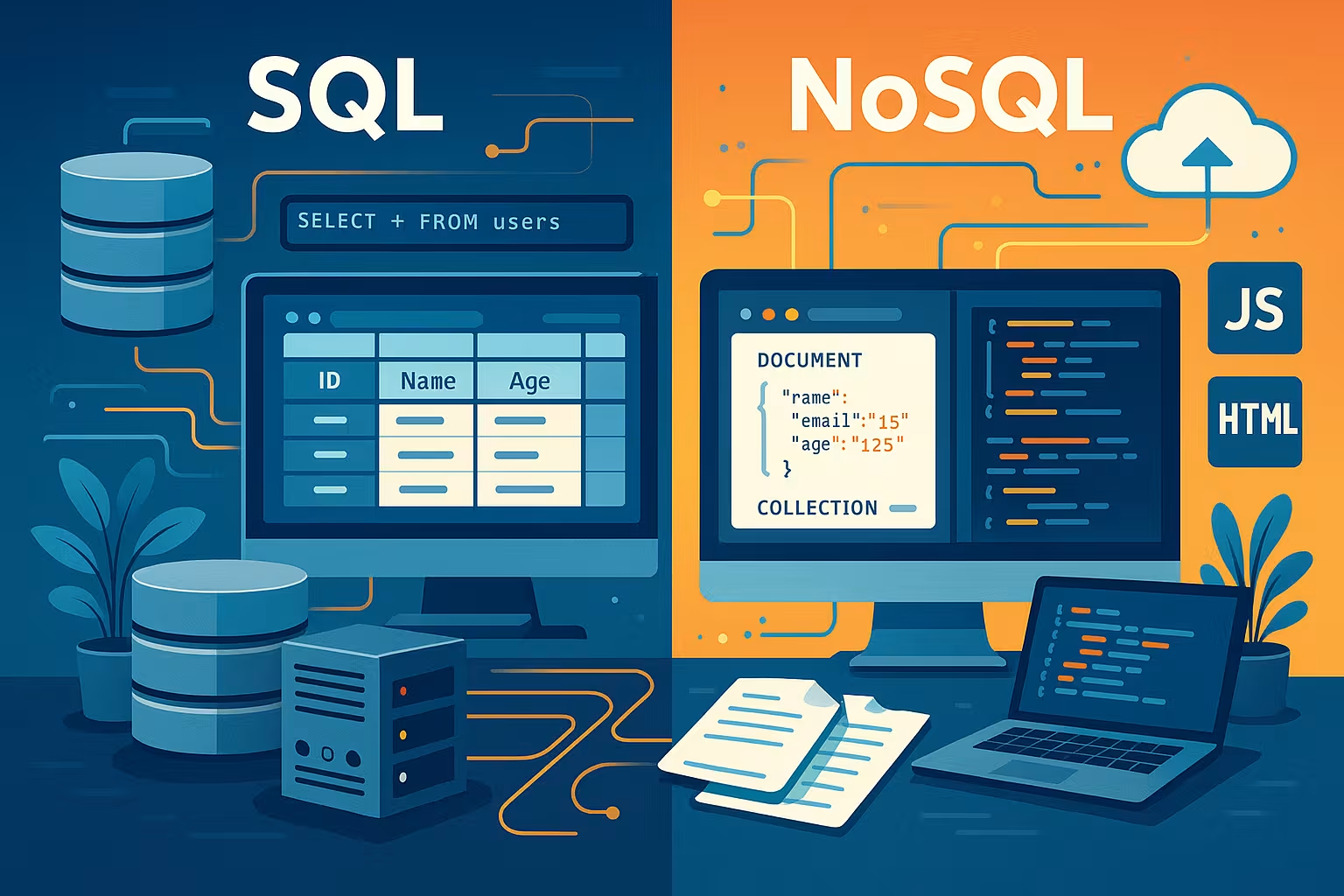
Typical application examples of SQL and NoSQL databases
The following table shows you which database architecture is better suited to certain scenarios:| Application scenario | SQL databases | NoSQL databases |
|---|---|---|
| Financial systems, accounting, ERP | ++ Transaction security | - Limited consistency |
| E-commerce, structured product data | ++ Scheme control | + Flexible catalogs |
| User profiles, social media, IoT | - Rigid scheme | ++ Customizable & scalable |
| Big data analyses, logs | - Performance limit | ++ High speed |
| Content management with familiar tools | ++ WordPress integration | + Suitable for dynamic content |

Making a conscious technical decision
Not every application needs transaction logic, but many benefit in the long term from the stability of a relational schema. On the other hand, dynamic NoSQL models give project teams more freedom for iterative product development. Depending on the data structure, it is worth making a well-founded decision - as described in this article on Introduction to database management systems summarized. The deliberate mix of performance, costs and maintenance strategy leads to a sustainable data solution in the long term.Example scenario: CMS with dynamic extension
A typical CMS (e.g. WordPress) uses SQL databases - a stable choice, especially thanks to the structured content. However, if additional modules or data sources (such as user interactions or API feeds) are to be integrated later, NoSQL components can efficiently handle these requirements. One of the most pragmatic solutions today: SQL for core functions and ACID-relevant content, NoSQL for high-performance enrichment and dynamic features such as trend analyses or cache management.
Reliability through hosting partners with experience
Secure operation depends not only on the database architecture, but also on the hosting environment. Services that integrate both SQL and NoSQL in a stable and high-performance manner provide web projects with freedom and future viability. Providers such as webhoster.de offer exactly this setup - including support, backups and performance tuning. Tip: With these optimization tips for SQL databases older applications can also be prepared for high loads without having to migrate at great expense.
Indexing and query optimization in SQL and NoSQL
If you want to manage data efficiently, you should take a close look at indexing techniques. In SQL databases, well-chosen indexes form the backbone for fast queries in heavily used tables. Primary keys, composite indices and additional unique constraints help to quickly locate data records and prevent duplicate entries. With NoSQL, on the other hand, indexing strategies are heavily dependent on the data model. In document-oriented systems such as MongoDB, for example, indexes are created specifically for fields that are often used in search queries or filters.The advantage of NoSQL is that dynamic data schemas allow fields to be added or removed flexibly, allowing index definitions to be expanded as required. However, the disadvantage is often somewhat higher maintenance costs for the indexes themselves, as unstructured data can be very diverse. Conscious planning of indexing is therefore essential in order to guarantee good response times even in highly scaling environments.
Sharding and partitioning in NoSQL environments
A core strength of many NoSQL databases is automatic or at least simplified sharding. This means that data is divided into smaller parts (so-called shards) and distributed to different servers. This horizontal partitioning ensures almost infinite scalability, as additional shards can simply be added as the data volume increases.Imagine you run a social media platform with millions of daily requests. With SQL systems, you would soon be forced to buy expensive high-performance servers to cope with the increasing load. NoSQL systems such as Cassandra or Apache HBase, on the other hand, automatically distribute the data fragments in the cluster so that new server nodes can absorb the load. This scalable approach is therefore particularly attractive when data volumes are growing exponentially and users are distributed globally.
However, clear guidelines are necessary: Not every data type is automatically suitable for sharding, especially with very complex relational structures. The architecture and network infrastructure also require special attention, for example to ensure a consistent replication setup.
Hybrid architectures in detail
In many modern projects, a pure SQL or pure NoSQL landscape is the exception these days. Hybrid architectures combine the advantages of both worlds: robust transaction security and relational integrity in SQL, paired with the flexibility and high scalability of NoSQL.For example, an e-commerce system can store the most important product and order data in a relational system that supports ACID transactions. At the same time, activities, logs or session data are stored in a NoSQL cluster to enable fast access to changing data structures. As a further variant, reporting databases or real-time analyses can be run in parallel to the live systems without affecting the performance of the core system.
It is important for a successful hybrid architecture that the interfaces are well defined. Microservices are ideal for mapping transactions in a dedicated SQL service, for example, and using NoSQL components for search queries, analytics or caching. A clean data exchange via APIs or messaging systems (e.g. RabbitMQ, Kafka) helps to decouple the systems from each other cleanly.
Practical project planning and possible sources of error
Especially in the planning phase, fallacies often arise when teams assume that NoSQL trends are "always better". In fact, an ill-considered choice can quickly lead to high operating costs, inconsistencies or development costs. It is therefore worthwhile to clearly define questions regarding data volumes, access characteristics and growth potential:- How often does the data schema change?
- Do I need real-time analyses or are batch processes sufficient?
- Are transaction security and ACID essential or does the system tolerate eventual consistency?
- What are the budget requirements for hardware and cloud resources?
You should also clarify in advance what future extensions or integrations could look like. A proof of concept is recommended as early as the planning phase in order to identify edge cases. Testing at an early stage avoids surprises during production.
Migration from SQL to NoSQL and vice versa: tips & tricks
Switching from an SQL system to a NoSQL database or vice versa is by no means trivial, but it happens time and again in practice. Reasons can include performance problems, changed business requirements or new project architectures. To plan a successful migration, the following steps should be considered:- Evaluate the data model: Which tables and fields can be easily transformed into document structures or key-value pairs?
- Data cleansing and normalization: Before the migration, it is worth removing legacy data to keep the new system lean.
- Step-by-step procedure: An incremental approach is often recommended, in which individual services or data records are migrated on a test basis.
- Testing and validation: Load tests and integration tests are mandatory to ensure that all dependencies work properly.
- Monitoring and log analysis: After the go-live, close monitoring is worthwhile in order to check performance and stability.
Performance tuning in production environments
Whether SQL or NoSQL - in practice, performance tuning is usually an ongoing process. With SQL databases, query optimization, index strategies and caching are the key. Tools such as EXPLAIN (MySQL, PostgreSQL, etc.) help to detect bottlenecks and inefficient joins.NoSQL, on the other hand, offers other levers. Here, the data model has a significant influence on performance. Are documents stored in such a way that frequently required data is located in a "chunk"? Is sharding organized sensibly so that individual servers are not overloaded? Then there are replication factors: Higher replication factors increase read speed and reliability, but can also reduce write performance.
Regardless of which system you use, regular updates, patches and effective monitoring ensure that performance problems are detected and rectified in good time.
Long-term maintenance and scaling: organizational aspects
In addition to the purely technical parameters, organizational issues should not be underestimated. Teams that do not have a solid knowledge of database management often underestimate the effort required for monitoring, backup or disaster recovery. The cost structure can also change rapidly if additional storage space, licenses or high-performance hardware become necessary.With NoSQL, where horizontal scaling is the be-all and end-all, you have to be aware that more servers not only mean more computing power, but also more administrative effort. Here, it is often worth using cloud platforms that offer automated provisioning and managed services. With SQL systems, on the other hand, you may be tied to a powerful but correspondingly expensive server.
In any case, good documentation of the data architecture and regular refactoring (of the schema or document structure) help to maintain an overview. This also allows adjustments to be made quickly in the event of growth and changes to project requirements.