Skip to content
In 2025, a direct comparison shows that NVMe hosting is not only faster than classic SSD web hosting - it is becoming the new performance foundation for demanding online projects. If you want to optimize loading times, serve more simultaneous users and ensure reliable performance in the long term, you should clearly opt for the more powerful NVMe technology.

Key points
- NVMe revolutionizes web hosting with significantly higher data transfer rates
- SATA SSDs achieve comparatively low IOPS and are sufficient for low-traffic sites
- Dynamic websites benefit in particular from NVMe due to lower latencies
- Price-performance with NVMe convinces from medium traffic or business-critical applications
- Web host selection should consider not only price but also technology, availability and support
SSD or NVMe: the technical comparison
Both types of storage do not have any moving parts, which makes them faster and more reliable than classic hard disks. The key difference lies in the interface: SSDs usually use the older SATA protocol, while NVMe communicates via the significantly faster PCIe interface.
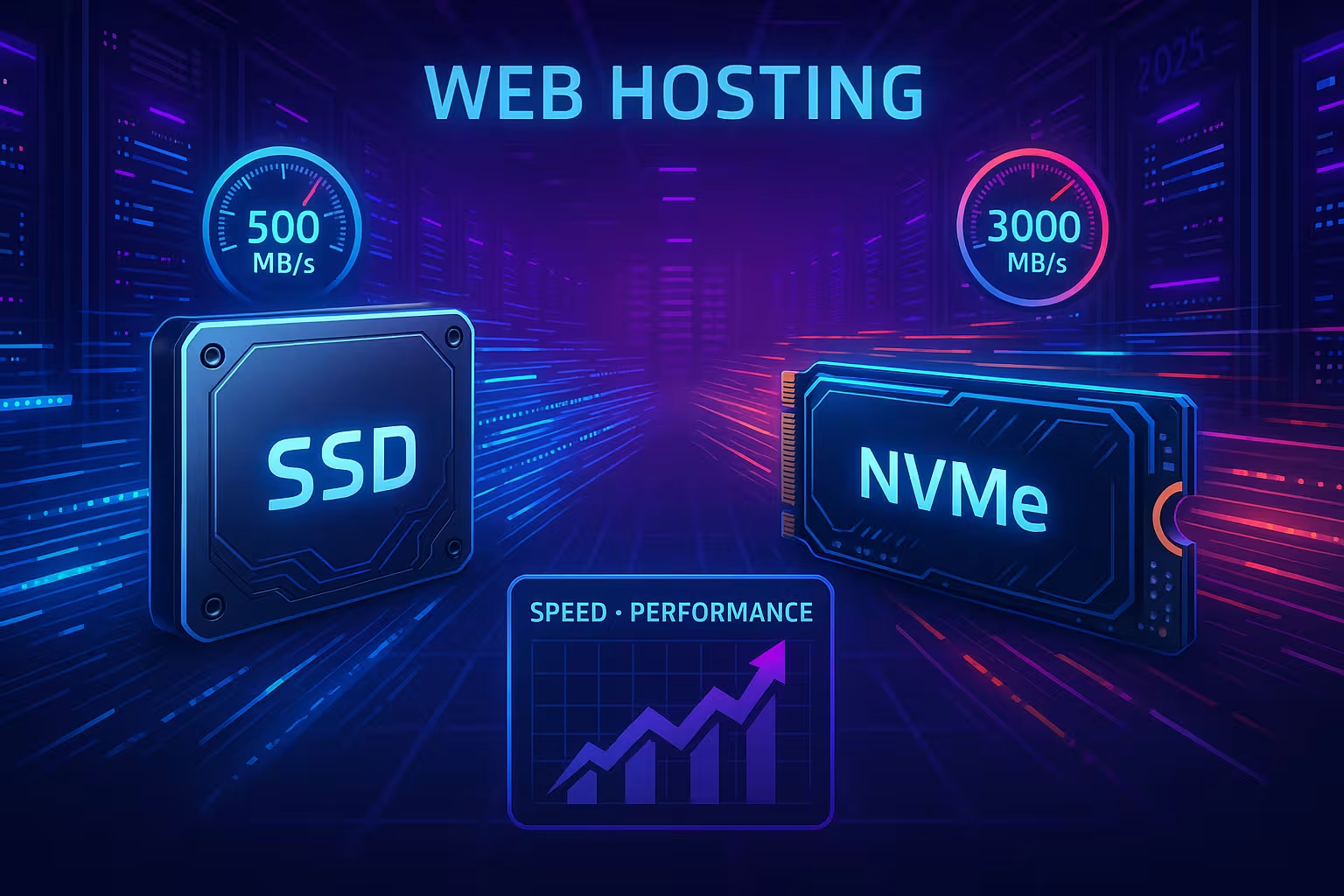
In everyday life, this means drastically higher transfer rates. NVMe SSDs achieve up to 7,500 MB/s - that's more than 13x faster than SATA SSDs. The number of simultaneous commands, known as queues, is also considerably higher. This means that NVMe storage can process significantly more parallel requests simultaneously - crucial for data-intensive web applications and highly frequented pages.
So if you are looking for future-proof and high-performance hosting solutions, you can't go wrong. NVMe Hosting can hardly be ignored. It should also be noted that NVMe is often more durable and less susceptible to bottlenecks due to its modern architecture. The direct data exchange with the PCIe bus means that the transfer is not only faster at peak times, but also more consistent, which means that constant performance is maintained even in sustained load scenarios. This makes NVMe particularly attractive for projects that require high availability and stable access speed.
In an increasingly networked web, in which microservices and container-based applications are gaining popularity, both fast data access and reliable networking are relevant. NVMe relieves the I/O area here and allows the respective processes to open, edit and save data almost in real time. This is a decisive advantage when operating Docker containers, Kubernetes clusters or other scaling applications, for example. This ensures future viability and remains flexible in the face of growing requirements.

Technical values at a glance: NVMe vs. SSD
The technical differences are clearly visible in the figures. The following table shows a comparison of the most important parameters:
| Criterion | SATA SSD | NVMe SSD |
|---|---|---|
| Max. Data transfer | ~550 MB/s | up to 7,500 MB/s |
| Latency | 50-100 µs | 10-20 µs |
| IOPS (4K random) | 100.000 | 500.000 - 1.000.000 |
| Parallel processes | 32/Command queue | 64.000/64.000 |
| Energy consumption | Medium | Low |
In addition to pure performance, energy efficiency is an important issue for many companies. NVMe SSDs are characterized by lower power consumption compared to SATA SSDs. Especially in large server farms with hundreds or thousands of SSDs, this can lead to considerable cost savings. Server operators therefore benefit twice over: on the one hand, they reduce the need for cooling, as heat generation is reduced, and on the other hand, they save on pure electricity costs. This conserves resources and contributes to more sustainable hosting - especially in times when energy-efficient data centers are increasingly in demand.
Another factor is the lower latency with NVMe, as every additional millisecond can make the difference between conversion rates or abort rates in the web hosting sector. While micro-lags sometimes occur with SATA-based SSD architecture, NVMe systems are better designed for simultaneous I/O operations thanks to their parallel structure. Especially for projects that address large databases and process many transactions in a short time, NVMe minimizes potential delays. The result is more even utilization, less waiting times and therefore a significantly smoother user experience.
NVMe hosting: relevance and benefits in everyday life
Every millisecond counts for visitors to a website. If the page is noticeably slow, users quickly bounce - especially with mobile access. Loading times of less than one second are considered optimal. NVMe hosting can deliver precisely such values, especially for CMS systems such as WordPress or web stores with many simultaneous accesses.
This not only improves the user experience: loading speed also has an impact on SEO rankings. Google prefers fast pages. In addition, NVMe queries in databases and session management can be massively accelerated. If you are interested in WordPress, you can find a detailed Optimization aid for performance.
Energy efficiency and lower heat generation are further arguments. Servers run more stably and at the same time cause lower operating costs. A real advantage - not only for large operators. In day-to-day operations, this is reflected above all in greater stability during traffic peaks. The risk of server overload is also reduced, as NVMe can process more simultaneous accesses without any loss of speed.
In addition, you should not underestimate the fact that the satisfaction of your own customers or visitors often correlates with shorter loading times. Anyone who is active in the e-commerce sector knows that every page view counts. A delay of just a few seconds can mean the difference between a user switching to a competitor or staying in your own store. In times when users are surfing on mobile systems, tablets and desktop PCs at the same time, smooth performance on all end devices is crucial.
For whom is NVMe really worthwhile?
The answer depends above all on the Website type and traffic level. Anyone running an online store or an active company portal needs short loading times - even during peak loads. This is where NVMe shows its strengths.
Developers, agencies or SaaS platforms require fast response times for API accesses and many simultaneous requests. Users who regularly use data-intensive CMS systems such as Magento or TYPO3 are also better off opting for NVMe directly. Here, the high IOPS rate leads to noticeably shorter waiting times when reading or writing content to databases. This means that complex pages and large product catalogs can be loaded and processed much faster.
Private blogs or simple web business cards, on the other hand, often do not require high-end performance. SSD hosting is sufficient in most cases - more information on this at SSD storage technologies in web hosting. Although these projects generally benefit from the speed of an SSD compared to an HDD, they are rarely so data-intensive that the price premium for NVMe is immediately worthwhile. However, anyone planning to continuously expand their site or incorporate more dynamic functions should consider switching to NVMe at an early stage to ensure long-term compatibility and performance.
Another aspect: projects in the area of streaming, video portals or media databases benefit from very high transfer rates. Although a CDN (Content Delivery Network) is often also used here, the main load still runs via the server. NVMe hosts can guarantee fast access and delivery times, especially for HD or 4K content. The high-bandwidth NVMe solution is a clear advantage for anyone planning to move towards virtual reality or 360-degree content.

Price differences and long-term perspective
NVMe hosting costs a little more: on average, tariffs are around 20-50 % over SSD offers. However, the added value, especially for traffic peaks, SEO rankings and customer loyalty, quickly amortizes the cost difference.
In particular, the continuously falling prices of NVMe server technology make it likely that SSD offerings will be displaced in the medium term. Anyone starting out today or planning a project with high growth will be much more future-proof with NVMe. In addition, hosting providers are constantly investing in their infrastructure in order to differentiate themselves through higher performance and better stability. NVMe is the current driving force, and modern providers often offer attractive entry-level offers to enable customers to switch cost-effectively.
From a business perspective, too, investing in NVMe often makes more sense if a project is designed for growth. Reduced loading times, greater user satisfaction and therefore better conversions are often in good proportion to the slightly higher monthly costs. This means that those who want to tap into new markets or attract international visitors can offer a professional user experience right from the start thanks to the increased speed.
Which provider offers the best NVMe hosting in 2025?
In the 2025 hosting comparison, the following in particular stand out webhoster.de The modern NVMe storage, excellent loading times, flexible scalability and data protection in accordance with GDPR make them the first choice.
| Place | Provider | Special features | Price/month |
|---|---|---|---|
| 1 | webhoster.de | NVMe, 24/7 support, 99.99% uptime, GDPR-compliant | from 1,99 € |
| 2 | Host-Europe | German support, SSD/NVMe optional | from 2,50 € |
| 3 | Strato | SSD/NVMe selectable, SSL included | from 2,90 € |
If you want to run a WordPress site under optimal conditions, the current WordPress hosting comparison 2025 find what you are looking for. In addition to purely technical data, factors such as support, backups and security features also play a role here. Good NVMe hosting is only really valuable if the provider also offers regular backups and can react quickly to problems if necessary. Fast SSDs are of little use if a web host is weak in terms of service and reliability.
Hosting providers also differ in terms of their availability and SLA promises. A high availability factor (e.g. 99.99%) is important to ensure that online projects do not suffer frequent outages. The update policy also plays a role: those who use new NVMe technologies promptly can rely on even higher speeds or improved security features. Anyone planning to host their project with the same provider for several years should therefore not only compare the costs, but also ensure that the provider is actively developing further.

When is SSD hosting still sufficient?
For websites with few visitors, passive content or simple HTML, a SATA SSD is often completely sufficient. This applies, for example, to project pages, portfolios or hobby pages.
However, as soon as dynamic content, login areas, search functions or user-dependent databases come into play, NVMe is usually the wiser choice. Medium-term growth also tends to speak against SSD. Anyone planning to integrate an online store into their website in the near future, for example, could quickly reach the limits of SD hosting. Especially when user numbers increase and product catalogs become more extensive, each additional database call will leave its mark on performance. NVMe, on the other hand, offers a reserve to better absorb sudden peaks.
Switching to NVMe can also make sense for small projects if the budget allows it. NVMe is a reliable partner, especially with regard to future extensions, such as the integration of comment functions, forums or automatic updates. If you already know that you want to expand your content further or are planning to provide more interactivity for users, you should at least check whether the hosting package offers NVMe options.
Some web agencies host several customer projects on one server as part of a reseller program. In this case, a higher basic performance often pays off if several websites receive large numbers of visitors at the same time. Even if individual customer websites have relatively little traffic, the total load quickly adds up. An NVMe server can provide significantly better "load distribution" before you reach the scaling limits.
Performance with an outlook: NVMe becomes the standard
If you look at technological developments, a clear picture emerges: NVMe replaces SSD as the leading hosting technology in high-performance setups. More and more providers are switching, customer expectations are rising.
At the same time, new web technologies such as AI-supported applications, real-time analyses and streaming rely on the fastest storage management - a classic SSD server would be overwhelmed here. NVMe also offers potential for use with new hardware, such as PCIe 5.0 or future PCIe 6.0 standards, which provide even more bandwidth. This not only enables faster reading and writing, but also improves latencies as the complexity of the application landscape increases.
More and more companies are also relying on containerization, microservices and virtualized environments in which data is continuously exchanged between different instances. This is where NVMe disks show their full strength, as they are better able to handle many parallel read and write operations. Whether extensive log analyses, machine learning on large data sets or the operation of highly scalable databases - all of this works much more smoothly if the central storage solution offers the highest possible I/O performance.
Over the next few years, NVMe is expected to become the new minimum standard - similar to how SSDs were compared to HDDs a few years ago. Just as HDDs were increasingly displaced back then, the classic SATA SSD market is also likely to shrink, while NVMe tariffs will become the flagship of many hosting providers. It is therefore worth considering the switch to NVMe at an early stage so as not to fall behind either your own performance or market expectations.
Summary: NVMe accelerates the web hosting of tomorrow
SSD may still be sufficient for small projects. However, anyone who values fast loading times, scaling and professional features will consistently rely on nvme hosting. The performance comparison clearly speaks in favor of NVMe, especially when it comes to user experience and dynamic content. The additional costs are already worthwhile for medium traffic - and in the long term, NVMe has no alternative anyway.
At the same time, company websites benefit greatly from the higher parallelism and reduced latencies. Sites with store functions, forums or extensive databases work much more efficiently if the storage architecture does not become a bottleneck. In practice, this means more orders, less waiting time for customers and an overall smoother online business process.
When choosing a hosting provider, it therefore makes sense not only to look at the basic price structure, but also to search specifically for NVMe offers. Especially in times when users decide within seconds whether to leave or stay on a site, performance is an invaluable competitive advantage. And as the technology continues to gain momentum, you will benefit from the change in the long term: NVMe is ready for the requirements of tomorrow - whether AI, complex cloud solutions or high-traffic applications.