Skip to content
In this article, I compare TCP vs UDP hosting in a practical way and show how protocol selection, latency and server setup have a measurable impact on performance and risk of failure. This will give you a clear overview of which workloads benefit from TCP benefit where UDP and how HTTP/3 builds the bridge with QUIC.
Key points
- TCP reliabilityOrdered delivery, error correction, flow control
- UDP speedNo handshake, low overhead, low latency
- HTTP/3/QUICUDP basis, no head-of-line blocking, TLS 1.3
- Hosting practiceRouting workload appropriately, monitoring, tuning
- SecurityWAF/rate limits, DoS protection, port hygiene
TCP and UDP briefly explained
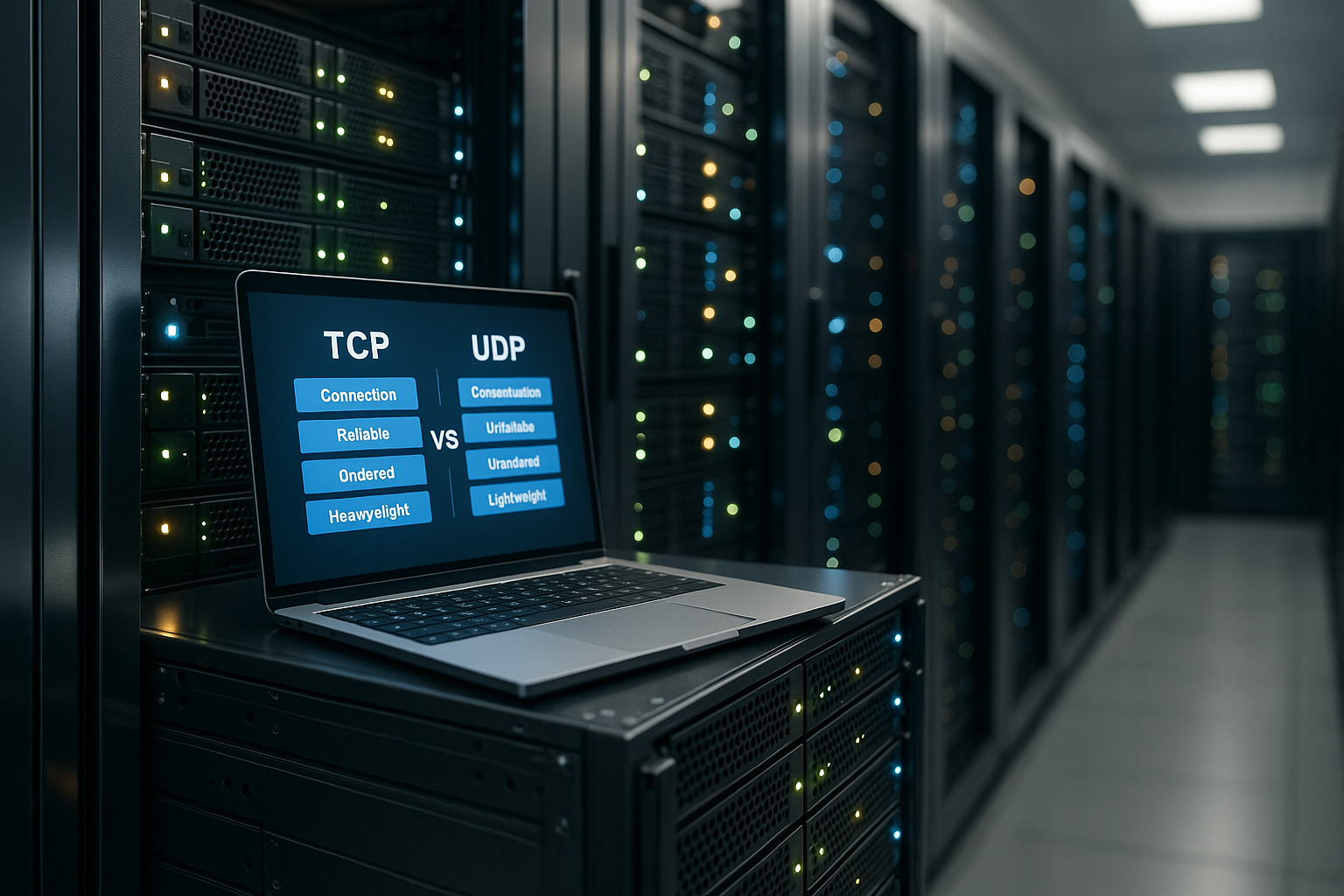
I start with the core: TCP works connection-oriented and relies on a three-way handshake before data flows. The protocol confirms packets, ensures sequence and requests lost segments again. This keeps integrity and consistency high, which is essential for web content and transactions. These guarantees cost time and bandwidth, but they prevent incorrect responses and broken assets. UDP takes a different approach and transmits without consultation, which lowers latencies and reduces jitter.
I often see misunderstandings: UDP is not “better” or “worse”, but serves a different purpose. Those who pay attention to minimal waiting times benefit from the lack of connections and the low overhead. However, there is a lack of feedback and a strict sequence; applications have to deal with losses. TCP dampens load peaks through congestion and flow control, while UDP uses the line unrestrained. These differences characterize every hosting decision for Latency and to the Throughput.
Which workloads are suitable for TCP?
I set TCP when freedom from errors has priority. Classic web hosting, APIs and dynamic pages require complete responses so that HTML, CSS, JavaScript and images load correctly. Email protocols such as SMTP, IMAP and POP3 must transmit and organize messages reliably. Databases, replication and backups also require consistency, because defective blocks cause expensive consequential damage. Even large file transfers benefit from the guarantees, as retransmits maintain end-to-end integrity.
Under high load, TCP brakes aggressively as soon as losses occur, thus protecting the network and server from overflow. This slows things down in the short term, but ensures stable response times over longer sessions. For stores, SaaS backends and portals, I secure transactions, shopping baskets and sessions in this way. In such scenarios, reliability counts more than the last millisecond. For real latency hosting I use other building blocks, but for transactional workloads there is no way around TCP.

Where UDP shines in hosting
I choose UDP, when response time and smoothness dominate. Live streaming, gaming and VoIP tolerate occasional losses as long as the stream runs without stuttering. Transmission starts immediately without a handshake, which is particularly noticeable with mobile clients. UDP avoids head-of-line blocking so that a lost packet does not block the entire flow. With multimedia content, this pays off with smooth playback and low delay.
DNS queries show the effect on a small scale: short messages, fast question-answer pattern, minimal overhead. Modern protocols go one better: QUIC combines the fast UDP basis with encryption and multiplexing, which is why HTTP/3 remains stable and fast even in the event of losses. At the same time, the lightweight design is easy on the CPU, which makes dense hosting setups more efficient. This saves resources and reduces latency for those offering real-time services. This profile is a perfect fit for streaming edges, game servers and interactive Apps.
Latency, throughput and jitter: what really counts
I measure protocols based on start time, latency, jitter and net throughput. UDP wins on startup because there is no handshake. TCP often achieves high peak rates in pure datapaths, but loses time due to retransmits and window adjustments. Head-of-line blocking affects streams in which individual losses slow down the entire flow. HTTP/3 on QUIC bypasses precisely this bottleneck and significantly accelerates retrievals despite packet loss.
I look specifically at congestion behavior because it increases the perceived Performance forms. A suitable algorithm for TCP Congestion Control significantly reduces latency peaks. UDP-based protocols place their flow control part on the application; this requires clean rate management, but brings more speed. In mixed networks, this balance delivers consistent door-to-door times. Measurements with iperf illustrate the differences well, especially in terms of jitter.
| Criterion | TCP | UDP | HTTP/3 (QUIC) |
|---|---|---|---|
| start time | higher (handshake) | very low | low (0-RTT possible) |
| Reliability | high, orderly | No guarantee | high, stream-based |
| Jitter | medium to low | very low | low |
| Overhead | ACKs/Retransmits | very slim | slim + TLS 1.3 |
| parcel losses | Blocks stream | App-tolerant required | no head-of-line |
| Typical services | Web, Mail, DB | DNS, VoIP, Games | modern websites |
Safety and operational safety in comparison
I always think security per protocol. TCP opens the door for SYN floods, which accumulate half-open connections and tie up resources. Countermeasures such as SYN cookies, connection rate limits and an upstream WAF counteract this. UDP brings risks through amplification attacks and reflection when services respond incorrectly. Strict rate limiting, a clean port policy and proxying mitigate these risks.
At the hosting level, I keep zones and policies tight. I separate critical TCP services from noisy UDP streams to prevent spikes from creeping into core systems. Logging and netflow analyses report anomalies before things go wrong. TLS 1.3 prevents QUIC/HTTP3 from being read, but DoS remains an issue; frontends that check requests at an early stage help here. This means that operations remain predictable even in the event of attacks and Reliable.
HTTP/3 and QUIC: efficient use of UDP
I enable HTTP/3 for modern sites because QUIC cleverly bundles UDP advantages. Multiplexing prevents blockages across streams, which means that individual losses do not hold up an entire page. 0-RTT measurably reduces start times for subsequent connections. This has a particularly positive effect on mobile radio links with changing conditions. For more context, take a look at HTTP/3 vs. HTTP/2 and immediately recognizes the practical differences.
I accompany conversions in stages, because not every client immediately speaks HTTP/3. Fallbacks to HTTP/2 or 1.1 remain important so that no traffic is lost. Monitoring checks success rates and time gains before I enforce HTTP/3 more strongly. CDNs with a good QUIC stack often deliver the best response times. Today, this layer is the spearhead for short Latencies.
Practice: Configuration and tuning without myths
I start tuning where it works quickly: buffer sizes, keep-alive and sensible timeout values. On the TCP side, modern congestion algorithms provide more even response times under load. TFO (Fast Open) saves round trips at the start, while TLS 1.3 shortens handshakes. On the UDP side, I pay attention to app-side rate control, forward error correction, packet sizes and sensible retries. These adjustments reduce jitter and smooth out curves in the Monitoring.
I only check kernel parameters specifically because blind maximization rarely helps. Measurements before and after adjustments show whether a change really works. Edge servers benefit from NIC offloading and CPU pinning if profiles justify it. A/B tests with real traffic provide the best decisions. Without metrics, tuning remains a guessing game; with metrics, it becomes a reliable Optimization.

Architecture decisions: Hybrid setup and CDN
I separate data paths cleanly: Transactional services travel via TCP, latency-critical streams via UDP/QUIC. Reverse proxies bundle TCP load, while edge nodes terminate UDP streams close to the user. This setup protects core systems and distributes load to where it is best processed. CDNs also help to shorten RTTs and offer packets closer to the end device. This allows responses to reach users with fewer hops and noticeably less jitter.
I plan failover clearly: If QUIC fails, HTTP/2 keeps the service running. DNS, TLS and routing need redundancies that can cope with failures. Logical separation of management, data and control channels creates an overview. Rights, rates and quotas remain strictly limited so that misuse does not trigger a conflagration. This architecture pays equal dividends in terms of availability and reliability in the event of high utilization and disruptions. Quality in.
DNS, UDP vs. TCP and DoH/DoT in practice
By default, I send DNS requests via UDP because short responses arrive there the fastest. For large records and ZONE transfers, DNS automatically switches to TCP, to avoid fragmentation and losses. On clients, I also use DoH/DoT to encrypt requests and make tracking more difficult. For setups that emphasize privacy, it's worth taking a look at DNS over HTTPS. This is how I combine speed with confidentiality and maintain control over paths.
I monitor the resolution chains because a slow DNS route neuters any further optimization. Caches in sensible places reduce RTTs and dampen peak loads. I keep response sizes lean so that UDP does not fragment. At the same time, I secure resolvers hard against amplification and open forwarding. This keeps the first step of every connection fast and thrifty.

Monitoring and testing: measuring instead of guessing
I rely on measured values, not gut feeling. iperf shows the raw power for TCP and UDP, Jitter profiles included. Web vitals measure real user experiences and uncover bottlenecks behind the protocol. Synthetic checks simulate paths and isolate latency components. Logs and metrics from proxy, web server and OS close the gap between wire and app.
I set up thresholds so that alarms fire for real problems. Dashboards show latency distribution instead of just averages, because outliers kill UX. Release checks compare versions before they go live. I use this toolbox to make quick corrections and introduce new protocols on a sound basis. This is how performance and Reliability together.
Cost and resource aspects in hosting
I always calculate protocol selection with costs. UDP saves overhead and can free up CPU cycles, making it cheaper to run dense hosts. TCP costs more administration, but causes fewer errors in applications, which reduces support time. QUIC/HTTP3 noticeably accelerates sales in stores if start times are reduced and interactions remain fluid. I put infrastructure prices in euros into perspective with the loading time gains and conversion rates achieved.
I therefore not only evaluate the raw throughput, but also the key figures along the entire chain. Fewer timeouts, more stable sessions and lower bounce rates often justify moderately higher operating costs. Where real-time is the priority, UDP bears the main burden and keeps nodes cheaper. Where consistency has priority, TCP pays off through lower error costs. On balance, this consideration lowers the Total costs.
Network reality: MTU, middleboxes and NAT
I take real networks into account, because they can cancel out protocol advantages. MTU and fragmentation limits UDP is harder: If a fragment is lost, the entire datagram is unusable. That's why I keep UDP payloads small, use path MTU tests and actively avoid IP fragmentation. PMTUD helps with TCP, but blackholes can still cause retransmits and timeouts; conservative MSS clamps and sensible packet sizes stabilize the route.
Middleboxes often treat UDP more restrictively than TCP. Firewalls track UDP with short inactivity timeouts; I send regular, light keep-alives to keep sessions open. NAT gateways can recycle ports quickly - I therefore plan sufficient source ports and short reuse times for QUIC. With changing networks (WLAN to mobile), QUIC's connection migration pays off, as connections can continue despite IP changes.
Containers, Kubernetes and Ingress for UDP/QUIC
In orchestrations I pay attention to UDP capability of the Ingress. Not every controller terminates HTTP/3 stably today; I often delegate QUIC to edge proxies that speak UDP natively, while TCP remains internal to the cluster. For UDP services, I use load balancer objects instead of pure NodePorts so that health checks, quotas and DSCP markings work properly. Critical is the conntrack capacityUDP flows generate states despite no connection - tables that are too small lead to drops under load. I help here with suitable timeouts and limits.
I also observe Pod affinities and CPU pinning for latency paths. QUIC benefits from consistent CPU locality (crypto, userland stacks). eBPF-based observability shows me jitter sources between NIC, kernel and application. Where services run mixed, I isolate noisy UDP workloads into separate node pools to protect TCP latencies from burst spikes.
Migration paths and 0-RTT: safe introduction
I roll HTTP/3/QUIC incremental out: First small percentages of traffic, clear success criteria (error rates, TTFB distribution, reconnects), then slow increase. 0-RTT accelerates reconnections, but is only suitable for idempotent requests. I explicitly block state-changing operations (e.g. POSTs with side effects) in 0-RTT or require confirmation on the server side to minimize replay risks. I rate session resumption tickets as short-lived and bind them to the device/network context so that old tickets offer less scope for attack.
Fallbacks I keep a strict record: If QUIC handshaking fails or UDP is filtered, the client falls back to HTTP/2 or 1.1. I log the reasons (version, transport errors) separately to uncover blockages in certain ASNs or countries. This makes migration a controlled learning process instead of a big bang.
Reduce global latency: anycast, edge and connection migration
I use Anycast for UDP front-ends to draw users to the nearest edge. Short round trip times smooth out jitter and reduce the load on backbone routes. For TCP services, I rely on regional endpoints and smart geo DNS strategies so that TCP handshakes do not cross oceans. QUIC also scores with Connection migrationIf the user switches from Wi-Fi to 5G, the connection is maintained thanks to the connection ID - content continues to load without having to renegotiate.
At transport level, I select the appropriate Congestion algorithms per region. In networks with a high bandwidth delay product, BBR often performs better, while CUBIC remains stable on mixed paths. The choice is data-driven: I measure p95/p99 latencies, loss rates and goodput separately by transport and region before changing defaults.
Measurement setup: reproducible benchmarks
I define benchmarks that reflect reality. For Raw paths I use iperf profiles (TCP/UDP), vary loss, delay and reordering with network emulation. For Web stacks I separate cold and warm starts (DNS, TLS, H/2 vs. H/3) and measure TTFB, LCP and time-to-first byte under loss. Synthetic checks run across different carriers and times of day so that load and congestion behavior become visible.
I document framework conditions: MTU, MSS, packet sizes, CPU frequencies, kernel versions, congestion control, TLS cipher and offloading settings. This is the only way to ensure that comparisons remain valid. I evaluate results not only using mean values, but also as distributions - p50, p90, p99 and „Worst 1%“. Especially in hosting, what counts is how stable the long tail remains.
Operational management: SLOs, degradation and fallbacks
I work with SLOs for reachability and latency (e.g. p95 TTFB, error rate per protocol). Error budgets give me room for experimentation (new QUIC versions, other timers). When budgets shrink, I switch back features, increase buffers or organize targeted relief via the CDN.
For degradation I have strategies ready for this: I reduce bit rates, frames or feature flags for UDP disruptions; for TCP backlogs, I shorten keep-alives or increase accept backlogs and activate waiting loops. I separate rate limits according to transport so that attacks or spikes on UDP do not hit TCP APIs at the same time. The principle of „safe fallback“: Users should achieve the goal, even if not every feature is active.
Practical examples: expected effects according to workload
Store frontendHTTP/3 noticeably reduces startup times for mobile users, especially under loss. p95 improvements are often greater than p50 because head-of-line blocking is eliminated. TCP remains set for checkout APIs to ensure consistency and idempotency. Result: faster interactions and fewer aborts in poor wireless conditions.
Streaming EdgeUDP-based protocols deliver smoother flows with low CPU load. With adaptive bit rates and packet-based error correction, playback is stabilized even with 1-3% loss. Clean rate and pacing management is important so that backbones do not overflow and jitter remains low.
Real-time collaborationMedia streams via UDP/QUIC, control channels and document sync via TCP. I prioritize DSCP for media packets and isolate them on the network side. If UDP fails, I switch back to redundant, lower quality via TCP so that communication is maintained.
GamingState updates via UDP, matchmaking/inventory via TCP. Anti-cheat and telemetry run separately so as not to mix spikes. On the server side, I keep tick rates and buffers strict so that latency jumps do not lead to rubberbanding.
Briefly summarized
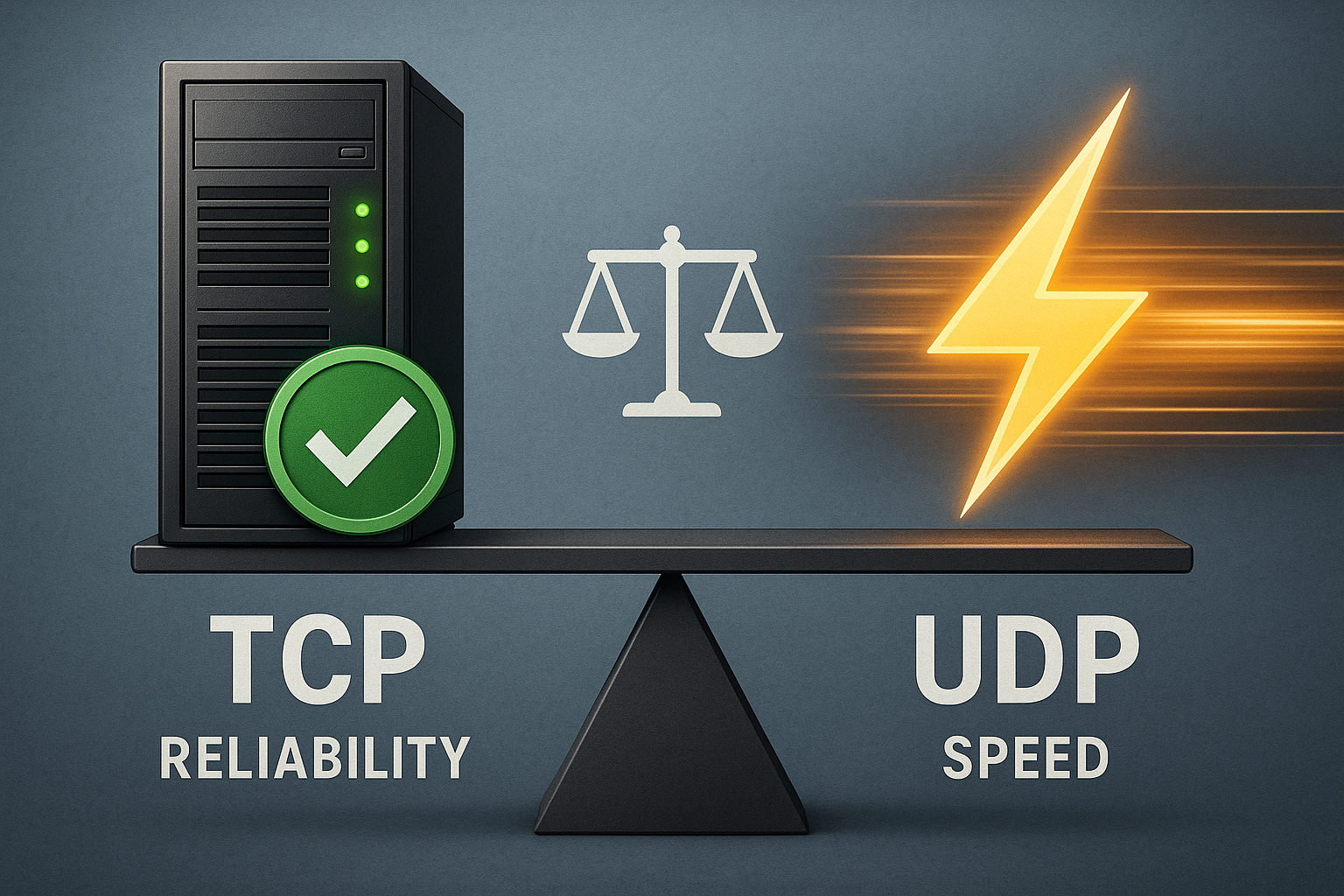
I choose TCP, when integrity, order and transactions count, and set UDP when delay and uniformity dominate. HTTP/3 on QUIC cleverly combines both and keeps pages nimble even when there are losses. With congestion strategies, rate control and clean routing, I get the best of both worlds. Security remains a top priority: WAF, limits and clean port policies secure operations. Assigning workloads appropriately reduces latencies, conserves resources and noticeably improves the user experience.