Skip to content
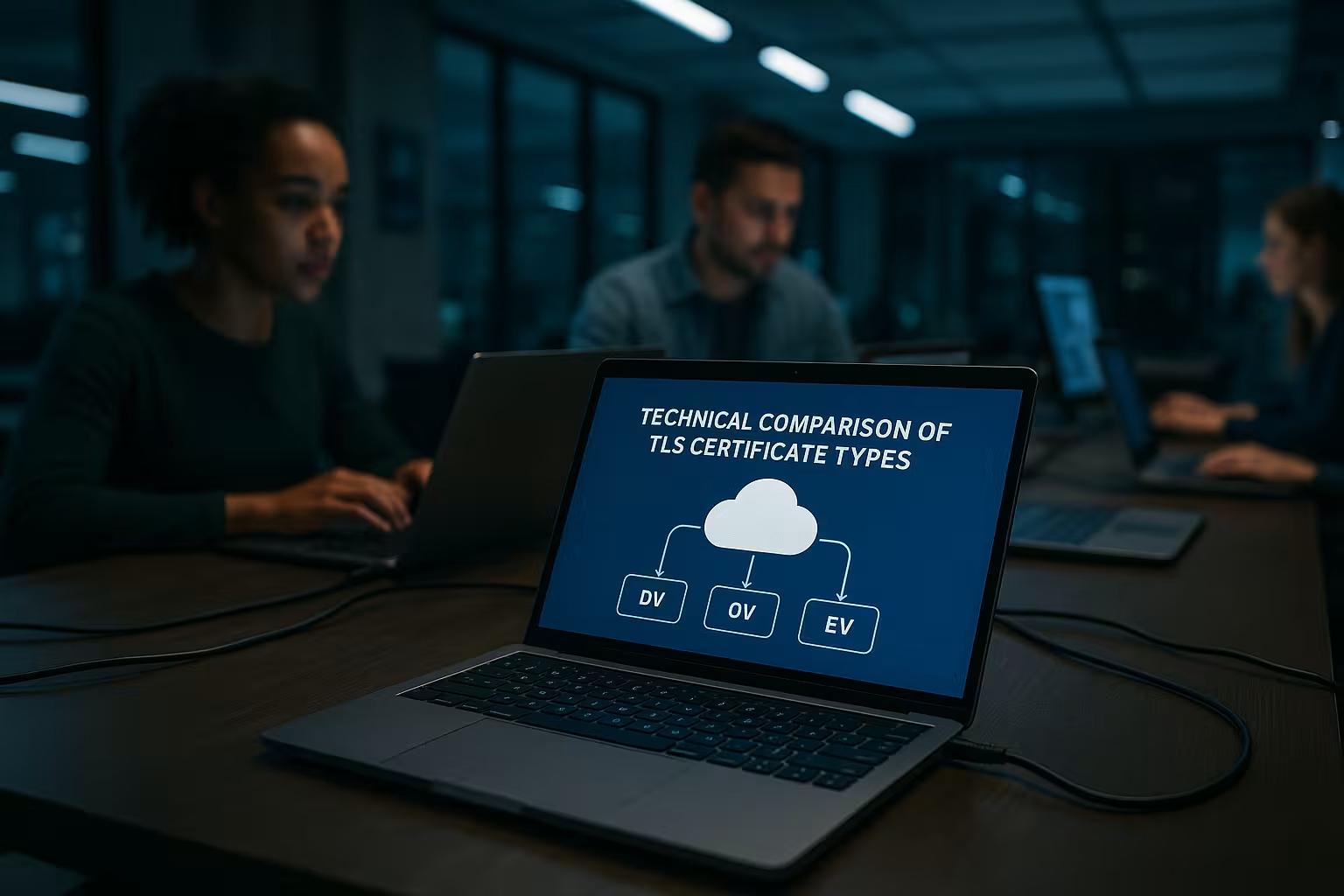
I compare DV, OV and EV certificates technically and practically so that hosting teams can choose the right tls certificates for identity, encryption and browser display. You can see at a glance how the depth of validation, issuing time, usage scenarios and level of trust differ.

Key points
I will summarize the following key statements so that you can immediately recognize the most important differences.
- ValidationDV only checks the domain, OV confirms the organization, EV carries out in-depth identity checks.
- TrustIncreases from DV to OV to EV; visible signals and guarantees strengthen user perception.
- UseDV for tests and blogs, OV for company and store sites, EV for banks and critical applications.
- ExpenditureDV in hours, OV in days, EV in days to weeks through additional tests.
- TechnologyOIDs and CA/browser policies determine how clients classify certificates.
What are TLS certificate types?
TLS certificates bind cryptographic key to identities and secure the data channel between client and server. A certification authority (CA) signs the certificate so that browsers can check the origin and trust the issuing chain. DV, OV and EV differ primarily in how strongly the CA identifies the applicant, not in the pure transport encryption. The encryption strength remains the same, but the identity statement behind the public key varies significantly. It is precisely this statement that influences risk, liability, user trust and ultimately conversion on productive websites. I'll show you why the right choice here can save you money. Money and support costs.
DV certificates: Domain validation in practice
DV certifies the Domain control via email, DNS or HTTP validation and is usually active within a few hours. This method is suitable for personal projects, staging environments and internal tools because it is quick to set up and the costs remain low. However, the identity behind the page remains unconfirmed, which phishing actors can exploit. I therefore use DV primarily where no personal or payment data is processed and visitors do not have to verify the brand or operator. For test systems, CI/CD pipelines and short-term deployments, DV provides a lean, functional Protection.
DV, OV, EV: briefly explained for everyday host life
Before I move on to the organizational level, I will clearly classify the three levels and look at their benefits in everyday hosting. DV provides fast transport encryption without an identity guarantee and stands for minimal effort. OV supplements the company check, which increases trust, brand protection and reliability. Finally, EV adds a comprehensive check, including additional evidence and callbacks. In hostings with customer portals, store systems or partner APIs, I decide depending on the risk, ticket volume and Trust, which level is necessary.
OV certificates: Organization Validation for business sites
In addition to the domain, OV checks the Organization itself, i.e. name, legal form, address and activity. These steps filter out fake identities more effectively and signal to visitors that a real company is behind the website. For company homepages, customer portals, store frontends and B2B APIs, OV provides a significant increase in trust. I choose OV when branding, customer support and compliance are paramount and a pure domain check is not meaningful enough. The additional effort in the exhibition pays off with fewer queries and a clearer Signal to paying customers.
EV certificates: Extended Validation for maximum identity security
EV raises identity verification to the highest level. Level and includes numerous additional checks such as commercial register data, phone number validation and callbacks. This process takes longer but eliminates many avenues of attack from brand abuse to social engineering. I use EV where misattribution or fraud can cause real damage: Bank front-ends, large marketplaces, payment sites and critical government services. The visible trust signals and proven legitimacy reassure users in sensitive transaction steps. Those who protect conversion in checkout flows or onboarding processes benefit noticeably from this Protection.
SSL hosting security: quick practical guide to selection
I choose certificate types based on data class, risk and support budget, not gut feeling. For blogs, info pages and previews, I use DV because I don't need an identity statement. For company websites, partner portals and stores, I use OV because the verified organization creates trust and reduces support requests. For highly sensitive transactions, I use EV to increase fraud barriers and provide decision-making security in the purchasing process. A structured approach keeps operations lean; if you want to go deeper into the setup, my short favorable SSL guide with a practical focus. This reduces downtime due to expiration dates and increases the Trust into your setup.
Technical differences and OIDs in the certificate
Technically, clients differentiate between DV, OV and EV via OIDs in the certificate fields that indicate the validation framework. DV typically uses 2.23.140.1.2.1, while OV uses 2.23.140.1.2.2; EV follows extended guidelines with additional validation features. TLS negotiation and cipher suites remain equivalent, but the identity statement changes fundamentally. Browsers and operating systems read the policy IDs and use them to control symbols, certificate details and warning logic. I check these fields after issuance and document them in the runbook so that audits and incident analyses have a clear track have
Key selection, performance and client compatibility
In cryptography, I separate the identity level from the key material. For broad compatibility, I go with RSA-2048 or RSA-3072 safe, for modern clients brings ECDSA P-256 clear performance advantages. In high-traffic setups, I therefore often use a dual stackECDSA leaf plus RSA fallback on the same domain so that old devices continue to connect while new ones take the faster turns. I activate TLS 1.3 with ECDHE and AES-GCM/ChaCha20-Poly1305 and deactivate static RSA key exchange. Session resumption accelerates handshakes; I use 0-RTT selectively for idempotent GETs.
For the CSR, I make sure that subjectAltName (SAN) contains all target FQDNs - the common name is no longer used by modern browsers for hostname checking. I secure private keys with strong ACLs or in the HSM/KMS; on edge nodes I use separate keys per deployment zone to limit blast radius and compliance risks.
Chain management and cross-signs
A large proportion of the connection problems stem from incorrectly constructed chains. I always install the intermediate chain recommended by the CA, keeping it short and consistent across all nodes. Cross-signatures help older stores (e.g. some Android versions), but increase complexity - here I test specifically on legacy devices. The server should Stack OCSP and do not have to reload CRLs; AIA fetching on the client side is slow and partially blocked. For chain changes (new intermediates/roots), I plan a rolling update and measure error rates in real user monitoring.
DV, OV, EV in direct comparison
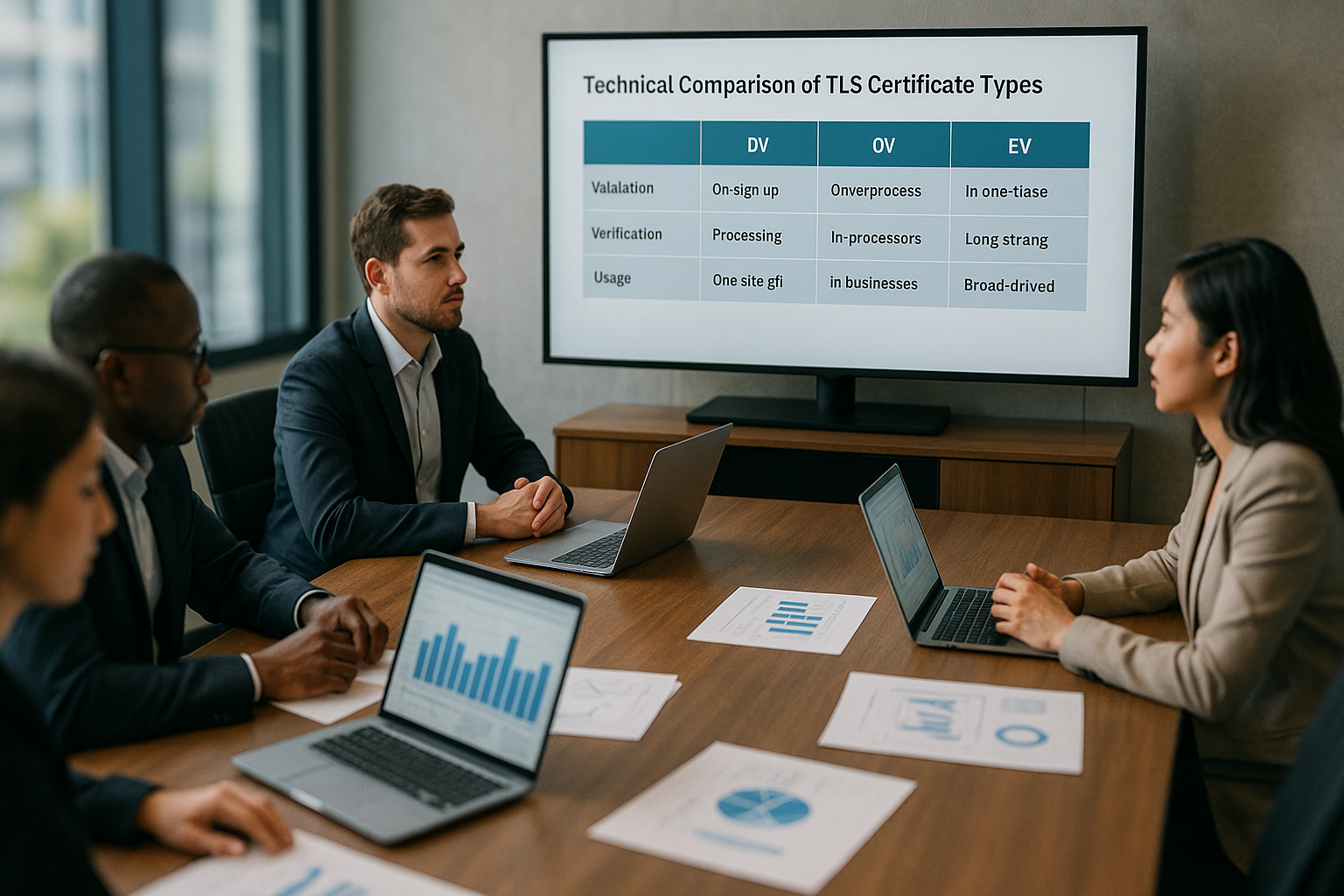
A compact comparison makes the selection tangible and shows how audit trails, cost class and issuing time differ from one another. Note: All three types encrypt to the same extent; the differences lie in identity, display and trust level. For BFSI, large stores and authorities, EV counts due to the strict verification. For the broad business landscape, OV provides the better ratio of effort and effect. DV remains the easy solution for test and content pages without personal data. Data.
| Feature | DP | OV | EV |
|---|---|---|---|
| Validation focus | Domain only | Domain + Company | Domain + company + extensive background check |
| Validation steps | Minimal (e-mail/DNS/HTTP) | Several checkpoints | Up to 18 individual steps |
| Exhibition time | Fast (hours) | Medium (days) | Longer (days to weeks) |
| Costs | Low | Medium | Higher |
| Identity guarantee | None | Corporate identity | Extended identity |
| Browser display | Standard lock | Standard lock | Extended trust mark |
| Suitable for | Blogs, Test, Staging | SMEs, company websites, stores | E-Commerce, Finance, Enterprise |
| Confidence level | Low | Medium-high | Highest |
Issuance, terms and operating costs
I often activate DV on the same day, while OV takes a few days and EV can take longer depending on callbacks and evidence. Costs increase with the scope of testing, This reduces the risk of identity fraud and support tickets regarding trust issues. Free versions usually run for 90 days and require automation, whereas paid certificates are often valid for 1 year. I plan renewals early, monitor expiration dates centrally and test deployments in staging to avoid failures. This routine reduces operational Risks and saves budgets.
Revocation strategy: OCSP stapling and must-staple
Revocation is often underestimated. I activate OCSP stapling, so that the server sends the current validity and the browser does not have to query the CA blocking. In particularly sensitive setups I use OCSP Must-Staple (TLS feature extension), whereby connections without a valid stack are rejected - but then the infrastructure must respond with high availability and stack intermediate layers (CDN, proxies) correctly. CRLs are only emergency anchors; in practice, they are large and slow. It is important to have a clear Key Compromise Plan with immediate revoke, new key and accelerated rollout.
Use wildcard, SAN and multi-domain sensibly
Wildcard certificates secure an entire subdomain cluster (*.example.tld) and save management effort if I have many hosts under one Domain operate. SAN/multi-domain certificates bundle several FQDNs in one certificate and are suitable for client or brand setups. I make sure that the scope matches the architecture and that there is no unnecessarily large attack surface. When deciding between wildcard and alternative, this condensed overview of Wildcard-SSL advantages. I also include SNI compatibility, CDN edges and proxy termination in the Planning in.

EV restrictions, IDN and homograph risks
An important practical point: EV wildcard certificates are not permitted. For broad subdomain coverage, I then choose OV/DV wildcard or segment the domains. For Internationalized Domain Names (IDN) I check the Punycode-and avoid the risk of confusion (homograph risks). SAN should only contain the FQDNs that are really needed - oversized certificates increase the attack surface and organizational effort. Internal host names or private IPs do not sign public CAs; for this I operate a Private PKI or use a managed service.
Browser display, phishing risks and user expectations
The lock symbol shows the Encryption but only OV and EV provide a confirmed identity behind the website. Users interpret these signals primarily in moments of high uncertainty, for example when paying. DV can be technically secure, but is of little help against brand impersonation and social engineering. With OV or EV, I enhance checkout routes and reduce abandonment because the verified identity creates trust. In security concepts, I therefore always use certificates together with HSTS, proper cookie configuration and clear Hints in the UI.
Important for expectation management: The previously prominent „green address bar“ for EV is no longer available in modern browsers. largely removed. Today, OV/EV differ mainly in certificate details and identity dialogs. This does not diminish the value of the deeper check - it just shifts the Visibility. In regulated environments, for audits or in enterprise policies, the reliable identity statement continues to count significantly.
Setup and automation without friction
I consistently automate issue and renewal via ACME, configuration management and monitoring so that no Expiration dates can be overlooked. For WordPress setups, a tutorial with automatisms speeds up the initial configuration and future renewals. If you want to simplify the start, use this introduction for Free SSL for WordPress and later transfer the pattern to productive instances. I also secure the private keys, limit rights and always check the complete chain trust after deployments. A clean pipeline saves time, reduces errors and strengthens the Compliance.
Controlling the exhibition: CAA, DNSSEC and ACME as a team
I secure the domain against unwanted issuance with CAA Records („issue“, „issuewild“, optionally „iodef“ for alerts). Increased for DNS-01 challenges DNSSEC the basis of trust. In ACME automation, I separate staging and production, rotate accounts, document rate limits and define who is allowed to trigger challenges. On shared infrastructures, I enforce per-tenant validation so that no customer can request certificates for another.
Public vs. private PKI and mTLS
Not every connection belongs in the public web PKI. For internal services, device identities or Client authentication (mTLS) I use a private PKI with short runtimes and automated issuance (e.g. via enrollment protocol). This separates the external effect (public DV/OV/EV for frontends) from internal trust paths, prevents uncontrolled growth in internal SANs and makes it easier to block compromised devices.
Monitoring, CT logs and go-live checklist
Today, all public TLS certificates end up in Certificate Transparency Logs. I monitor these entries to detect unauthorized exhibitions at an early stage. I also monitor expiration dates, OCSP reachability, TLS versions and cipher usage. A short checklist helps me before going live:
- CSR correct (SAN complete, no superfluous scope, correct company data for OV/EV).
- Key policy: secure generation, storage location, rotation, backup, HSM/KMS if necessary.
- Server config: TLS 1.3 active, secure cipher, no static RSA exchange, OCSP stapling on.
- Chain: correct intermediates, short chain, tests on legacy clients.
- Automation: Renewals tested, alerts in the event of failures.
- Security headers: HSTS (with caution during preload), secure cookies, clear UI instructions in the checkout.
Concluding overview
DV, OV and EV provide identical transport encryption, but differ greatly in Identity, effort and trust. I use DV for tests and content, OV for serious business appearances and EV for critical transactions. Those who use budgets wisely combine automation, monitoring and the right level of validation. This keeps certificates up to date, visitors feel secure and support teams answer fewer questions. With a clear decision matrix and documented processes, you can keep security, operations and customer experience in the lot.