Skip to content
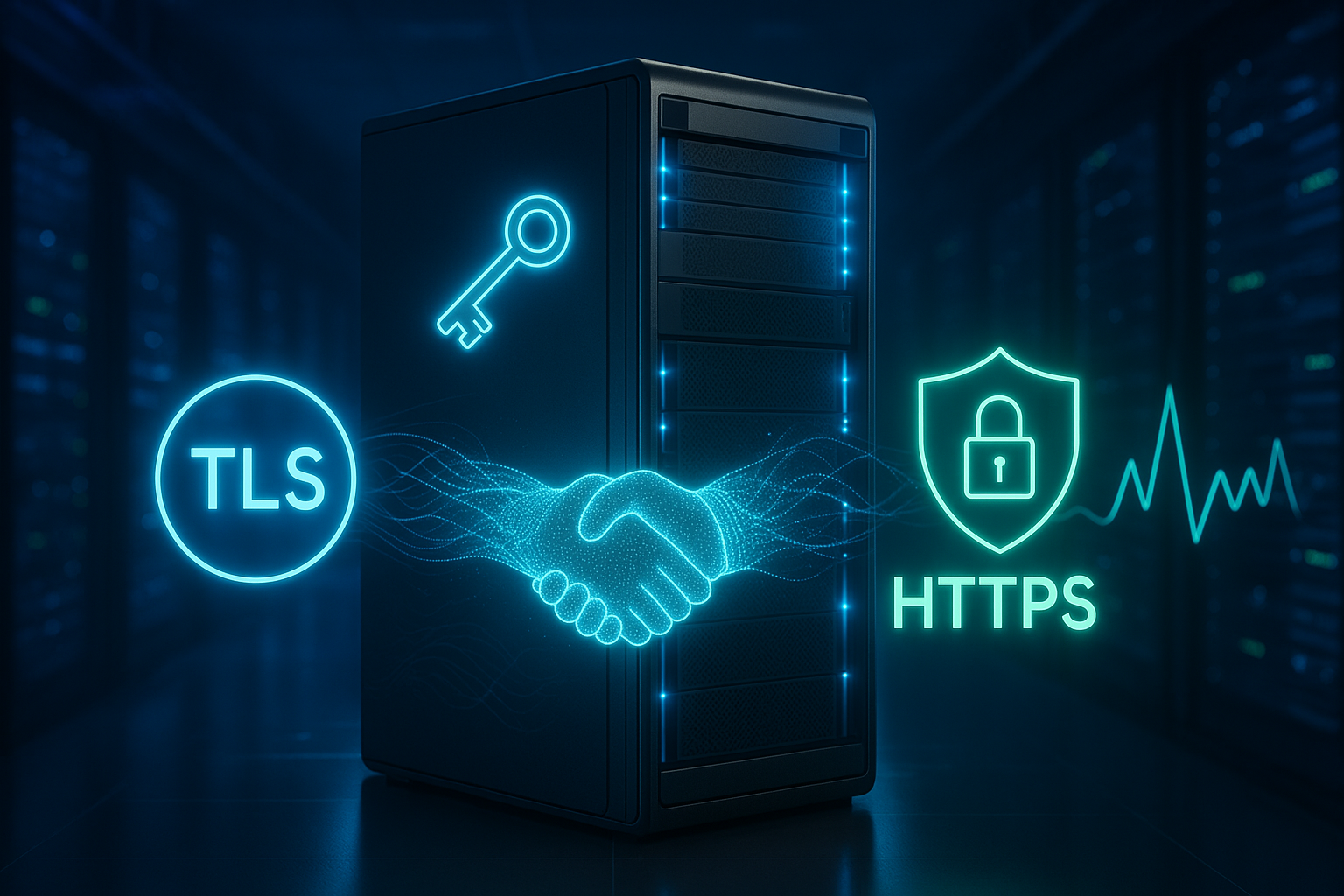
I show how TLS HTTPS in web hosting the Handshake, encryption and performance so that connections start quickly and securely. I also explain which server options speed up the setup, reduce the overhead and protect the integrity of the data at the same time.
Key points
For a quick overview, I will briefly summarize the core topics and highlight the most important ones Adjusting screws.
- TLS 1.3 shortens the handshake and reduces latency thanks to fewer round trips.
- OCSP Stapling and session resumption save requests and speed up reconnections.
- AES-NI and ChaCha20 provide the best symmetric encryption depending on the hardware.
- HSTS and clean redirects secure the connection without unnecessary detours.
- HTTP/2 and HTTP/3 bundle streams and bring speed to mobile networks.
What is the difference between TLS and HTTPS in web hosting?
I make a clear distinction between the terms: TLS is the security protocol, while HTTPS is the protocol for web content with the TLS layer activated. HTTP runs over port 80 and sends unprotected, HTTPS uses port 443 and activates the TLS layer. Encryption automatically. The aim of TLS is to ensure confidentiality, integrity and authenticity so that third parties cannot read or change data. Browsers use certificates to recognize the correct server and block errors with clear warnings. For operators, this means that without a valid certificate and a clean chain, they lose trust, conversions and ranking.

This is how the HTTPS handshake really works
At startup, the browser sends a client hello with supported versions, cipher suites and a Random value; This is how I prevent replay attacks. The server responds with Server Hello, selects a suite and provides its certificate and public key, whereupon the client validates the chain against trusted CAs. Both sides then agree on a shared session key via ECDHE, which is only valid for this connection and is known as the more symmetrical key protects the data stream. Finally, both parties signal „Finished“, test the encryption and switch to the protected channel. In TLS 1.3, this is done with just one RTT, which noticeably reduces delays per connection, especially on long distances and mobile networks.
Encryption: asymmetric meets symmetric
I combine asymmetric cryptography to Authentication and symmetric procedures for pure data transfer. The certificate binds the public key to the domain; the private key remains strictly on the server. With ECDHE, I generate new keys for each session and achieve perfect forward secrecy so that old recordings remain worthless. For the data stream, I typically use AES-GCM or ChaCha20-Poly1305 and choose depending on the hardware and load profile. If you want to delve deeper, you can find practical basics at Encryption techniques, while admins use FTPS securely for file transfers with the same TLS stack.

Performance: TLS 1.3, HTTP/2, HTTP/3
I activate TLS 1.3 first, because this version delivers fewer round trips, fewer legacy loads and faster handshakes. Together with HTTP/2, I gain time through multiplexing and header compression as multiple objects flow in parallel over one connection. HTTP/3 on QUIC further reduces handshake and packet loss on mobile networks and keeps connections open longer when roaming. Caching of certificate checks and clean keep-alive tie this together well. For specific tuning steps, I use guides such as „Optimize handshake and QUIC“, which I apply to my stack step by step.
Optimizations in hosting: OCSP, HSTS, redirects
I switch OCSP Stapling on the server so that the browser does not have to check the validity of the certificates itself. Session resumption with tickets significantly shortens reconnections and saves CPU time during peak loads. A correctly set HSTS header forces the client to use HTTPS and prevents downgrades or mixed content. I also ensure direct forwarding from http:// to https:// with a single 301-hop to save time. If you avoid messy cascades, you gain measurably, see „Configure HTTPS redirect correctly“ as a practical reminder.
Certificates: DV, OV, EV and ECC
For most projects, I only need a DV certificate, because the domain check is fast and automated renewal is reliable. OV and EV extend the identity check, which provides transparency in the enterprise environment but offers no speed advantage. For new setups, I prefer ECC keys, as they offer shorter keys and faster handshakes than classic RSA with the same level of security. A clean certificate chain including intermediate is important, otherwise there is a risk of a costly connection failure. I plan renewals early on and test deployments in staging before switching to production.

Using session resumption and 0-RTT safely
I activate session IDs or tickets so that returning clients without full Handshake can continue. This saves round trips and significantly reduces the CPU load per request. 0-RTT in TLS 1.3 accelerates the first request after resumption, but harbors replay risks that I mitigate with request design and server policies. I only allow critical actions such as POSTs with side effects after reconfirmation. This allows me to achieve speed for idempotent requests without sacrificing security.
Hardware and ciphers: AES-NI vs. ChaCha20
On x86 servers I use AES-NI, because hardware acceleration makes AES-GCM very fast. On devices without AES acceleration, such as some ARM systems, I choose ChaCha20-Poly1305, which delivers consistently high speed. I prioritize modern suites, deactivate legacy security such as RC4 and 3DES and maintain Perfect Forward Secrecy with ECDHE. Regular benchmarks with real user data show whether the priority matches the hardware. This keeps the connection secure without losing protection.

Monitoring and measurement of TLS performance
I measure Latencies and error rates continuously, because optimization without data remains blind. Important are time to first byte, number of handshakes per second and resumption rate. I separate cold start measurements (without cache) and warm start measurements (with resumption) to make real gains visible. I trace outliers back to their cause, such as faulty intermediates or blocked OCSP responders. The following table summarizes key differences that I regularly check in audits.
| Topic | TLS 1.2 | TLS 1.3 | Effect |
|---|---|---|---|
| Handshake-RTT | 2 RTT | 1 RTT | Less waiting time per connection setup |
| Cipher suites | Many options | Streamlined | Less negotiation, less CPU |
| Session resumption | PSK/Session ID | 0-RTT/PSK | Quick start for regular users |
| Forward Secrecy | Optional | Standard | Better protection for older recordings |
| HTTP stack | HTTP/1.1 & HTTP/2 | HTTP/2 & HTTP/3 | Multiplexing and QUIC advantages |
Safety hardening without loss of speed
I set HSTS with sufficient Max-Age, IncludeSubDomains and optional Preload, so that browsers connect strictly encrypted. Content security policy and upgrade insure requests eliminate mixed content that would otherwise reduce loading times and security. I avoid stapling errors by using correct intermediate chains and monitoring OCSP validity. I also limit weak protocols (TLS 1.0/1.1) and keep cipher priorities lean. This keeps the overhead low, the attack surface narrow and users receive their content quickly.

Configure SNI, ALPN and multi-domain hosting properly
I use SNI (Server Name Indication) to serve several certificates on one IP. This allows me to deliver the appropriate certificate depending on the host name and avoid incorrect assignments. About ALPN I negotiate the application protocol (h2/h3) in parallel so that clients switch to HTTP/2 or HTTP/3 without an additional roundtrip. Consistent ALPN configuration via load balancer, CDN and Origin is important, otherwise the client will fall back to HTTP/1.1 unnecessarily. For large multi-tenant stacks, I use wildcards and SAN certificates in a targeted manner, keep the chains short and distribute the hosts logically so that chain downloads remain small and the handshake starts quickly.
ECDSA and RSA in parallel: chain length, bytes and fallback
I put dual certificates (ECDSA and RSA) so that modern clients can use the more compact ECDSA signatures, while older devices remain compatible via RSA. This reduces the number of handshake bytes transmitted and speeds up signature verification. I make sure to use the Intermediate chains optimally (no duplicate intermediates, correct sequence) so that no additional retrieval is necessary. Where possible, I prefer ECC keys with 256 bits instead of large RSA keys with 3072/4096 bits, if the target client mix allows this. This is how I combine compatibility with speed.
Certificate management and automation without failures
I automate renewals with short Life cycles, I distribute new certificates early in staging and roll them out in stages. Private keys only remain on systems that really need them; I strictly encrypt backups. Ticket-Keys and certificate material in a planned and documented manner. Optionally, I mark certificates with „Must-Staple“ if my stapling monitoring is running reliably so that clients without fresh OCSP do not connect in the first place and I can effectively enforce revocations. I monitor certificate transparency logs to detect incorrect issuance at an early stage.
Ticket, session and key rotation in clusters
I share Session cache and ticket keys across all nodes (e.g. via Redis or Memcached) so that resumption also works behind the load balancer. I provide the rotation of the ticket keys with a generous overlap window so that active sessions are not aborted. I allow 0-RTT selectively for read requests; anti-replay windows and rate limits protect against misuse. For rolling updates, I plan the sequence so that resumption quotas do not collapse and the CPU load remains calculable.
TLS offloading, mTLS and origin protection
I consciously decide where to use TLS scheduledirectly on the app, on the ingress/load balancer or on the CDN edge. Offloading creates air on the app, but requires Security for Origin. Between Edge and Origin I use TLS again, ideally with mTLS, so that only authorized edges are allowed to connect. I store restrictive cipher suites for internal routes, activate keep-alive with appropriate timeouts and monitor resets to limit idle costs. In this way, data remains protected behind the edge without me wasting performance.
Fine-tuning: records, buffers and priorities
I consider TLS-Record sizes dynamic: small records for early rendering (HTML/CSS), larger records for throughput (images, files). I deliberately use or disable Nagle/TCP-CORK to avoid „tiny records“. For HTTP/2 I define meaningful Priorities (critical CSS/JS first) and watch QPACK/HPACK compression to keep header overhead low. On HTTP/3, I tune the congestion and stream limits so that connections run stably without generating head-of-line blocking. Important: I measure these fine adjustments against real clients, not just in the lab.
Compatibility and secure fallbacks
I hold TLS 1.2 is active as a fallback, but only with modern suites (ECDHE, AES-GCM/ChaCha20) and without insecure legacy. Older Android devices and embedded clients benefit from this, while modern browsers use TLS 1.3. I prevent protocol downgrades with TLS_FALLBACK_SCSV and tight cipher list. I document clear minimum requirements for email and API clients so that there are no surprises. This is how I maintain the balance between range and security level.
Troubleshooting: typical stumbling blocks in operation
I check for handshake errors first Time deviations on servers (NTP), followed by incorrectly sorted chains and SNI mismatch in VirtualHosts. If HTTP/2 fails unexpectedly, it is often due to a missing ALPN or an intermediate instance that does not pass on h2. If the latency suddenly increases, I look for expired OCSP stacks or blocked OCSP responders. Resumption drops are often caused by ticket key rotation or unshared caches. Logs for „no shared cipher“ or „unknown ca“ give clear indications of where the chain breaks.
Privacy and the future: ECH and post-quantum switches
I'll keep it. ECH (Encrypted ClientHello) so that host names no longer appear in plain text in the handshake. This strengthens privacy, especially in shared infrastructures. For the future I am planning Hybrid processes with post-quantum-capable modules where client support allows, but carefully test the impact on packet size and latency. The aim is to create smooth migration paths at an early stage without slowing down current users.
Outlook and SEO effect through HTTPS
I benefit twice over: HTTPS increases visitor trust and at the same time contributes to rankings. Modern protocols such as HTTP/3 keep connections more stable, especially in the event of packet loss and on the move. TLS 1.3 eliminates outdated components and reduces attack surfaces, making maintenance and audits easier. Combining performance with security increases conversion and reduces aborts. This means that TLS is not a burden, but a fast protective shield for every site.

Briefly summarized
I activate TLS 1.3, set ECC certificates, prioritize AES-GCM or ChaCha20 and secure with HSTS so that connections start quickly and reliably. OCSP stapling, session resumption and clean redirects reduce latency, while HTTP/2 and HTTP/3 increase throughput. Monitoring with a focus on handshakes, TTFB and resumptions shows where there is potential and which changes really work. With these steps, I achieve short loading times, strong encryption and stable rankings. This is how the https Handshake a starting advantage instead of a brake.