Skip to content
Web server queuing occurs when requests arrive faster than the server workers can process them, resulting in noticeable delays in request handling. I will demonstrate how queues can server latency drive up, which metrics make this visible, and which architectures and tuning steps I can use to reduce latency.
Key points
I will briefly summarize the key points and provide guidance on how to manage latency. The following bullet points highlight causes, metrics, and adjustments that are effective in practice. I will stick to simple terms and clear recommendations for action so that I can apply what I have learned directly.
- CausesOverloaded workers, slow databases, and network delays create queues.
- MetricsRTT, TTFB, and request queuing time make delays measurable.
- StrategiesFIFO, LIFO, and fixed queue lengths control fairness and dropouts.
- OptimizationCaching, HTTP/2, keep-alive, asynchrony, and batching reduce latency.
- ScalingWorker pools, load balancing, and regional endpoints relieve nodes.
I avoid infinite queues because they block old requests and trigger timeouts. For important endpoints, I prioritize fresh requests so that users see the first bytes quickly. This is how I keep the UX stable and prevent escalations. Monitoring allows me to detect early on if the queue is growing. I then adjust resources, worker numbers, and limits in a targeted manner.

How Queueing Shapes Latency
Queues prolong the processing time every request, because the server distributes them serially to workers. If more traffic arrives, the time until allocation increases, even if the actual processing would be short. I often observe that the TTFB skyrockets even though the app logic could respond quickly. The bottleneck then lies in worker management or in limits that are too tight. In such phases, it helps me to take a look at the thread or process pool and its queue.
I regulate throughput by configuring workers and queues in a coordinated manner. With classic web servers, optimizing the thread pool often has immediately noticeable effects; I will clarify the details of this in the Optimize thread pool. I make sure that the queue does not grow endlessly, but has defined limits. This allows me to terminate overloaded requests in a controlled manner instead of delaying them all. This increases the response accuracy for active users.
Understanding metrics: RTT, TTFB, and queuing delay
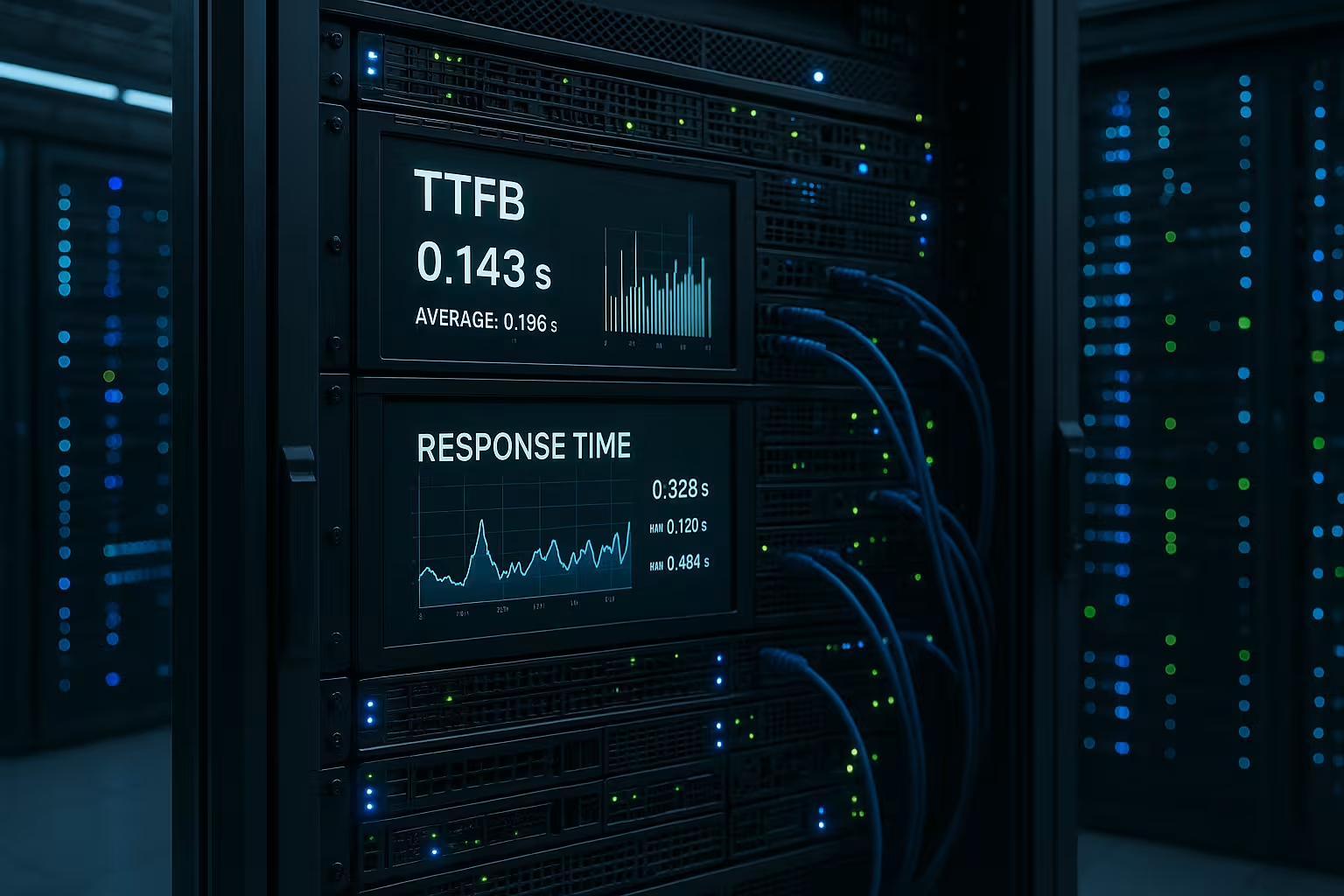
I measure latency along the chain to clearly separate causes. The RTT shows transport times including handshakes, while TTFB marks the first bytes from the server. If TTFB increases significantly even though the app requires little CPU, this is often due to request queuing. I also monitor the time in the load balancer and application server until a worker is available. This allows me to determine whether the network, the app, or the queue is slowing things down.
I divide the timelines into sections: connection, TLS, waiting for workers, app runtime, and response transmission. In Browser DevTools, I can see a clear picture for each request. Measurement points on the server round this off, for example in the application log with start and end times for each phase. Tools such as New Relic name the queueing time explicitly, which greatly simplifies the diagnosis. With this transparency, I plan targeted measures instead of scaling across the board.

Request handling step by step
Each request follows a recurring process, which I influence at key points. After DNS and TCP/TLS, the server checks limits for simultaneous connections. If too many are active, new connections wait in a Queue or break off. After that, attention turns to the worker pools that carry out the actual work. If they process long requests, short requests have to wait—which has a significant impact on TTFB.
I therefore prioritize short, important endpoints, such as health checks or HTML initial responses. I outsource long tasks asynchronously so that the web server remains free. For static assets, I use caching and fast delivery layers so that app workers remain unburdened. The sequence of steps and clear responsibilities bring calm during peak times. This reduces the waiting time noticeable without me having to rewrite the app.
Operating system queues and connection backlog
In addition to app-internal queues, there are OS-side queues that are often overlooked. The TCP SYN queue accepts new connection attempts until the handshake is complete. After that, they end up in the socket's accept queue (listen backlog). If these buffers are too small, connection interruptions or retries occur – the load peaks and causes cascading queuing in higher layers.
I therefore check the web server's list backlog and compare it with the limits in the load balancer. If these values do not match, artificial bottlenecks occur even before the worker pool. Signals such as list overflows, accept errors, or rapidly increasing retries indicate to me that the backlogs are too tight. Keep-alive connections and HTTP/2 with multiplexing reduce the number of new handshakes, thereby relieving the lower queues.
It is important that I don't just max out backlogs. Excessive buffers only shift the problem to the back end and prolong waiting times in an uncontrolled manner. A better approach is a coordinated combination of moderate backlogs, clear max concurrency, short timeouts, and early, clean rejection when capacities are scarce.
Choose queue strategies carefully
I decide on a case-by-case basis whether FIFO, LIFO, or fixed lengths are appropriate. FIFO seems fair, but can cause old requests to pile up. LIFO protects fresh requests and reduces head-of-line blocking. Fixed lengths prevent overflow by terminating early and providing the client with fast Signals send. For admin or system tasks, I often set priorities so that critical processes get through.
The following table summarizes common strategies, strengths, and risks in compact points.
| Strategy | Advantage | Risk | Typical use |
|---|---|---|---|
| first-in, first-out | Fair Sequence | Old requests run into timeouts | Batch APIs, reports |
| last in, first out | Respond to new inquiries faster | Older requests displaced | Interactive UIs, live views |
| Fixed cue length | Protects workers from overload | Early failure at peaks | APIs with clear SLAs |
| Priorities | Critical paths preferred | Configuration more complicated | Administrative calls, payment |
I often combine strategies: fixed length plus LIFO for UX-critical endpoints, while background tasks use FIFO. Transparency towards clients remains important: anyone who receives an early fail must have clear Notes including Retry-After. This protects user trust and prevents repeat storms. Logging allows me to see whether limits are appropriate or still too restrictive. This keeps the system predictable, even when load peaks occur.

Optimizations in practice
I'll start with quick wins: caching frequent responses, ETag/Last-Modified, and aggressive edge caching. HTTP/2 and Keep-Alive reduce connection overhead, which improves TTFB I relieve databases with connection pooling and indexes so that app workers don't block. For PHP stacks, the number of parallel child processes is key; how to set this cleanly is explained in Set pm.max_children. This eliminates unnecessary waiting times for available resources.
I pay attention to payload sizes, compression, and targeted batching. Fewer round trips mean fewer chances for congestion. I delegate long operations to worker jobs that run outside of the request-response cycle. This keeps the Response time short in the user's perception. Parallelization and idempotence help to make retries clean.
HTTP/2, HTTP/3, and head-of-line effects
Each protocol has its own stumbling blocks when it comes to latency. HTTP/1.1 suffers from few simultaneous connections per host and quickly creates blockages. HTTP/2 multiplexes streams on a TCP connection, reduces handshake load, and distributes requests more effectively. Nevertheless, TCP still carries a head-of-line risk: packet loss slows down all streams, which can cause TTFB to spike.
HTTP/3 on QUIC reduces this effect precisely because lost packets only affect the streams concerned. In practice, I set the prioritization for important streams, limit the number of parallel streams per client, and leave keep-alive as long as necessary, but as short as possible. I only enable server push in specific cases, because overdelivery during peak loads unnecessarily fills the queue. This allows me to combine protocol advantages with clean queue management.

Asynchrony and batching: cushioning the load
Asynchronous processing takes pressure off the web server because it shifts heavy tasks. Message brokers such as RabbitMQ or SQS decouple inputs from the app runtime. I limit myself to validation, acknowledgment, and triggering the task in the request. I deliver the progress via status endpoint or webhooks. This reduces Queueing at peak times and keeps front-end experiences smooth.
Batching combines many small calls into one larger call, which reduces the impact of RTT and TLS overheads. I balance batch sizes: large enough for efficiency, small enough for fast first bytes. Together with client-side caching, this significantly reduces the request load. Feature flags allow me to test this effect step by step. This is how I ensure Scaling without risk.
Measurement and monitoring: creating clarity
I measure TTFB on the client side with cURL and browser DevTools and compare it with server timings. On the server, I log the wait time until worker allocation, app runtime, and response time separately. APM tools such as New Relic name the queueing time explicitly, which speeds up the diagnosis. If the optimization targets network paths, MTR and packet analyzers provide useful insights. This allows me to identify whether routing, packet loss, or server capacity is the main cause.
I set SLOs for TTFB and total response time and anchor them in alerts. Dashboards show percentiles instead of averages so that outliers remain visible. I take spikes seriously because they slow down real users. I use synthetic tests to provide comparative values. With this Transparency I quickly decide where to make adjustments.
Capacity planning: Little's Law and target utilization
I plan capacities using simple rules. Little's Law links the average number of active requests with arrival rate and waiting time. As soon as the utilization of a pool approaches 100 percent, waiting times increase disproportionately. That's why I maintain headroom: target utilization of 60 to 70 percent for CPU-bound work, slightly higher for I/O-heavy services, as long as there are no blockages.
In practice, I look at the average service time per request and the desired rate. From these values, I derive how many parallel workers I need to maintain the SLOs for TTFB and response time. I size the queue so that short load peaks are absorbed, but p95 of the wait time remains within budget. If variability is high, a smaller queue plus earlier, clear rejection often has a better effect on the UX than a long wait with a later timeout.
I divide the end-to-end budget into phases: network, handshake, queue, app runtime, response. Each phase is assigned a target time. If one phase grows, I reduce the others through tuning or caching. This way, I make decisions based on numbers rather than gut feeling and keep latency consistent.
Special cases: LLMs and TTFT
With generative models, I am interested in the time to first token (TTFT). Queuing plays a role here in prompt processing and model access. High system load significantly delays the first token, even if the token rate is okay later on. I keep pre-warm caches ready and distribute requests across multiple replicas. This keeps the initial response fast, even when input variables fluctuate.
For chat and streaming functions, perceived responsiveness is particularly important. I deliver partial responses or tokens early on so that users can see immediate feedback. At the same time, I limit request length and ensure timeouts to avoid deadlocks. Priorities help to prioritize live interactions over bulk tasks. This reduces Waiting times during busy periods.
Load shedding, backpressure, and fair limits
When load spikes are unavoidable, I rely on load shedding. I limit the number of simultaneous in-flight requests per node and reject new requests early with a 429 or 503 response, accompanied by a clear retry-after message. This is more honest for users than waiting for seconds without any progress. Prioritized paths remain available, while less important features pause briefly.
Backpressure prevents internal queues from building up. I chain limits along the route: load balancers, web servers, app workers, and database pools each have clear upper limits. Token bucket or leaky bucket mechanisms per client or API key ensure fairness. To combat retry storms, I require exponential backoff with jitter and promote idempotent operations to ensure that retries are safe.
Observability is important: I log rejected requests separately so that I can see whether limits are too strict or whether abuse is occurring. This allows me to actively control system stability instead of just reacting.

Scaling and architecture: worker pools, balancers, edge
I scale vertically until the CPU and RAM limits are reached and then add horizontal nodes. Load balancers distribute requests and measure queues so that no node starves. I select worker numbers to match the number of CPUs and monitor context switches and memory pressure. For PHP stacks, I focus on worker limits and their relationship to database connections; I resolve many bottlenecks via Balancing PHP workers correctly. Regional endpoints, edge caching, and short network paths keep the RTT small.
I separate static delivery from dynamic logic so that app workers remain free. For real-time features, I use independent channels such as WebSockets or SSE, which scale separately. Backpressure mechanisms slow down rushes in a controlled manner instead of waving everything through. Throttling and rate limits protect core functions. With clear error returns clients remain controllable.

Stack-specific tuning notes
With NGINX, I adjust worker_processes to the CPU and set worker_connections so that keep-alive does not become a limiting factor. I monitor active connections and the number of simultaneous requests per worker. For HTTP/2, I limit the number of concurrent streams per client so that individual heavy clients do not take up too much of the pool. Short timeouts for idle connections keep resources free without closing connections too early.
For Apache, I rely on the MPM event. I calibrate threads per process and MaxRequestWorkers so that they match the RAM and the expected parallelism. I check start bursts and set the listen backlog to match the balancer. I avoid blocking modules or long, synchronous hooks because they hold threads.
With Node.js, I make sure not to block the event loop with CPU-intensive tasks. I use worker threads or external jobs for heavy work and deliberately set the size of the libuv thread pool. Streaming responses reduce TTFB because the first bytes flow early. In Python, I choose the number of workers for Gunicorn to match the CPU and workload: sync workers for I/O-light apps, async/ASGI for high parallelism. Max requests and recycle limits prevent fragmentation and memory leaks, which otherwise cause latency spikes.
In Java stacks, I rely on limited thread pools with clear queues. I keep connection pools for databases and upstream services strictly below the number of workers so that waiting times do not occur twice. In Go, I monitor GOMAXPROCS and the number of simultaneous handlers; timeouts on the server and client side prevent goroutines from binding resources unnoticed. The following applies to all stacks: set limits consciously, measure and adjust iteratively – this keeps queuing manageable.
Briefly summarized
I keep latency low by limiting the queue, setting workers appropriately, and consistently evaluating measurements. TTFB and queuing time show me where to start before I ramp up resources. Caching, HTTP/2, keep-alive, asynchrony, and batching reduce Response times Noticeable. Clean queue strategies such as LIFO for fresh requests and fixed lengths for control prevent tedious timeouts. Those who use hosting with good worker management—such as providers with optimized pools and balance—reduce server latency even before the first deployment.
I plan load tests, set SLOs, and automate alerts so that problems don't only become apparent during peak times. I then adjust limits, batch sizes, and priorities to real patterns. This keeps the system predictable, even when traffic mixes change. With this approach, web server queuing no longer seems like a black box error, but rather a controllable part of operations. This is exactly what ensures stable UX and peaceful nights in the long term.