Skip to content
Developer Hosting decides how quickly I get code from Git to production - with SSH, CI/CD, staging and monitoring without friction loss. I show in clear steps which Tools and workflows a hosting package must offer today to ensure that deployments run securely, reproducibly and measurably.
Key points
- SSH as direct access for automation and control
- Git with hooks for standardized deployments
- CI/CD for tests, builds, releases and rollbacks
- Staging for low-risk tests with real data
- Headless and containers for flexible architectures
SSH access: control without detours
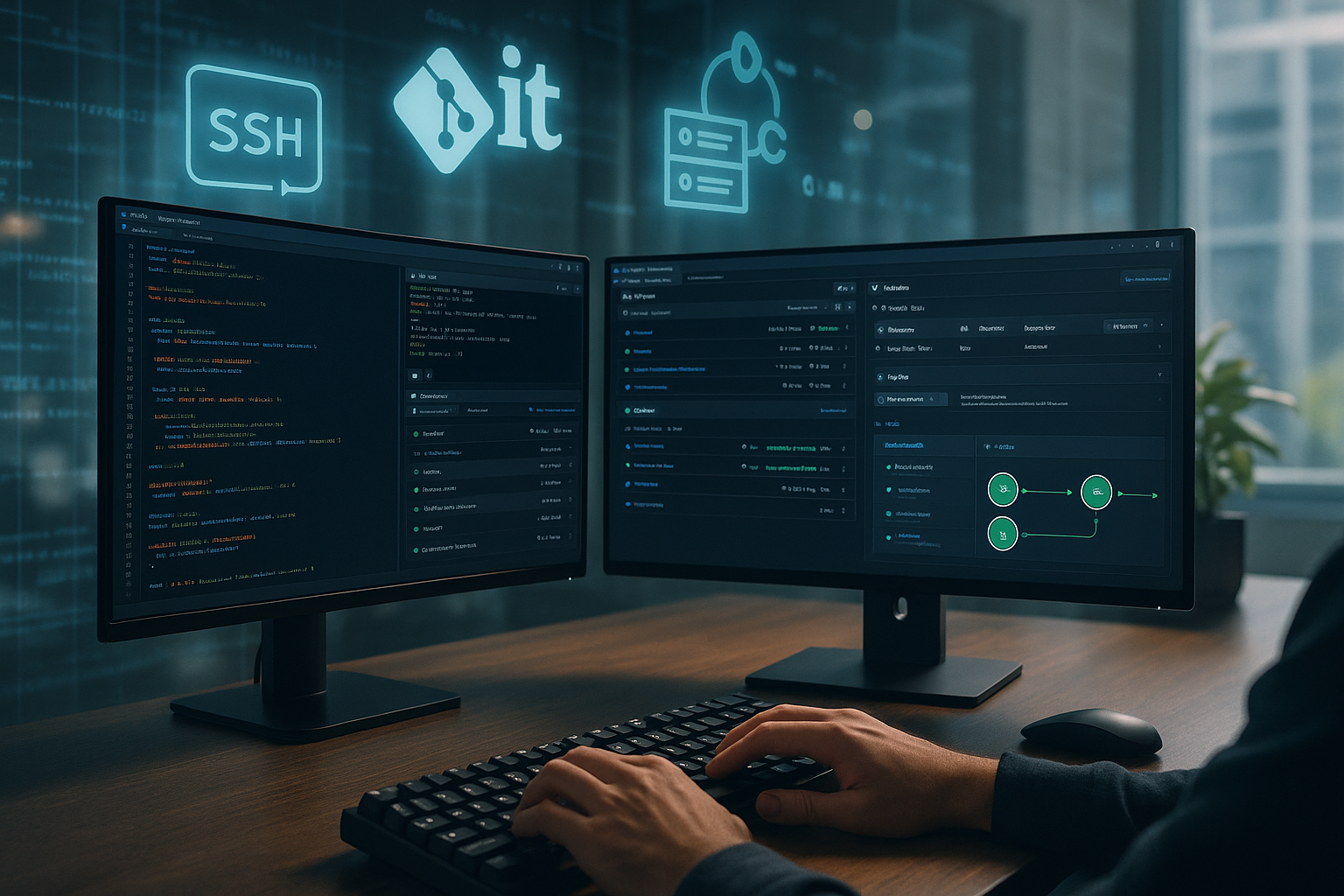
With SSH I work directly on the server, install packages, set environment variables and control processes without a GUI limit. I save time by scripting deployments, reading logs live and restarting services when releases require it. A plan with unrestricted access takes away the hurdles of cronjobs, maintenance and Automation. Every minute counts, especially when it comes to incident handling, so I check whether the provider delivers fast response times. If you want to get to know your options, you can find a good overview in this guide to SSH access provider.
Git integration: a workflow from commit to live
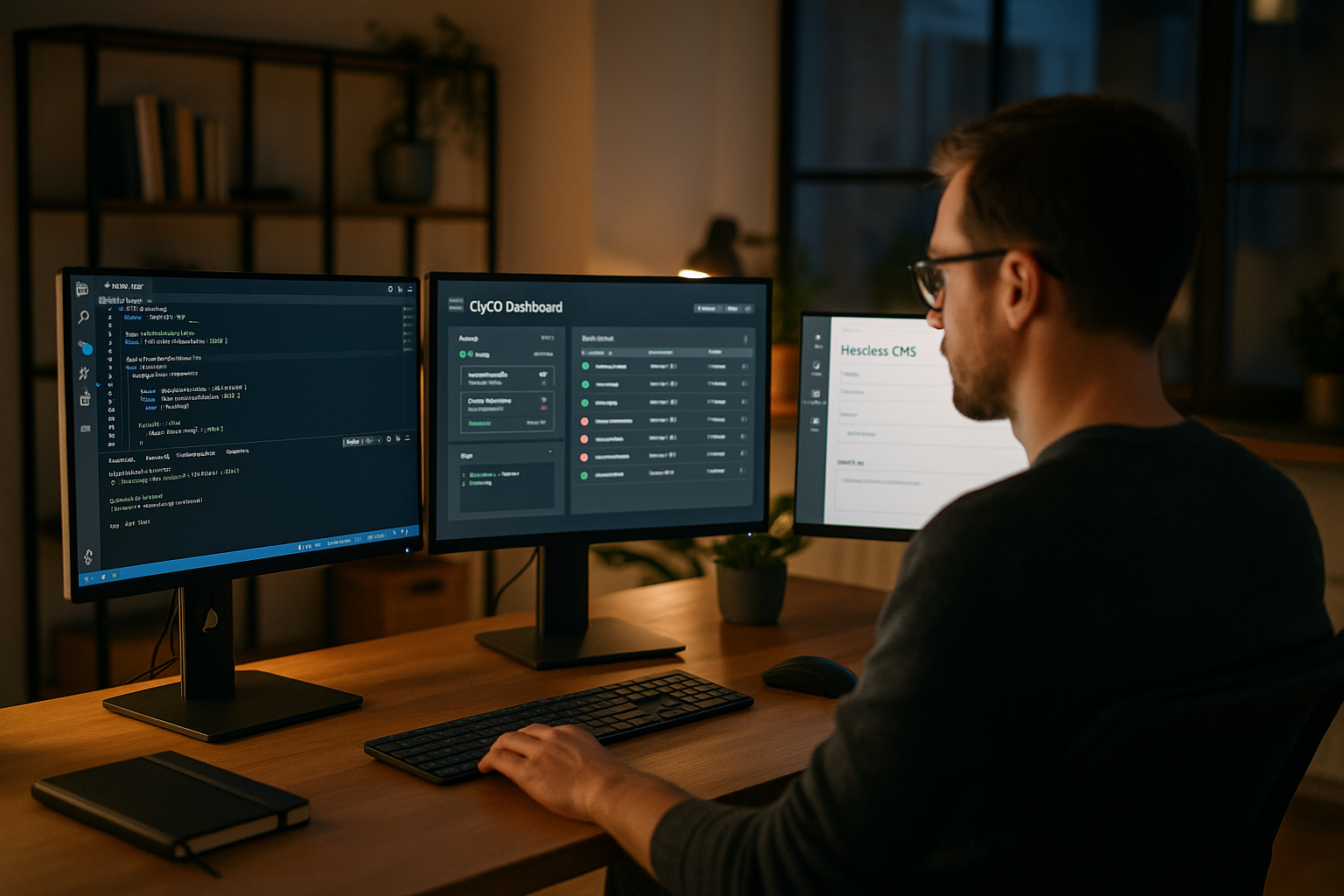
Without Git I give away repeatability and team focus in release processes. I push to a defined branch, Git hooks trigger tests and generate a fresh build artifact for the next release. This is how the file upload via FTP ends and I keep every step in Logs in a comprehensible way. I set symlinks for zero downtime: The new release is ready, a short switch activates it. I can quickly get to grips with errors because hooks automatically start a rollback if necessary.
CI/CD pipelines: tests, builds, releases and rollbacks
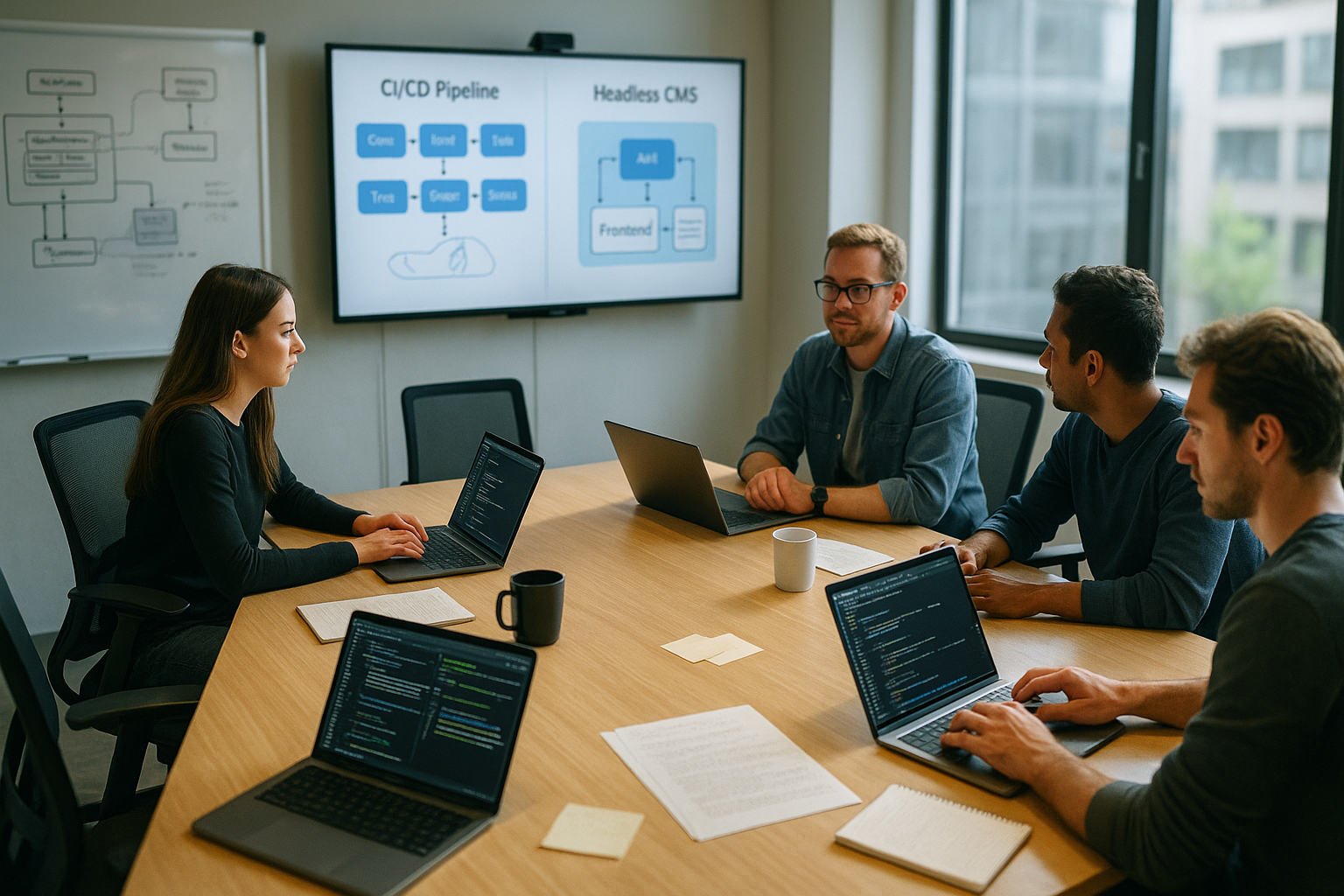
CI/CD takes manual work off my hands and reduces errors in Deployments. I first check code standards, start unit and integration tests and then build an artifact that is cleanly versioned. I then import migration scripts, update variables and set Symlinks for the new release. A health check evaluates the application; the version only remains online if it is successful. If something fails, I automatically roll back and analyze the pipeline logs step by step.
Staging environment: realistic testing before it counts
I check changes for Staging, which is configured in the same way as production so that I don't get any nasty surprises. This is where I measure performance, validate authorizations and check caching behavior under load. A provider that regularly mirrors backups of the live database to the staging instance saves me a lot of time in the Testing. This is how I test migration paths, API contracts and edge cases with real data sets. Then I decide for sure whether the version can go live.
Headless and JAMstack approaches: Think APIs first
With Headless I separate backend and frontend and deliver content as an API to web, mobile and other clients. I make sure that my hosting supports NVMe storage, up-to-date web servers and flexible language versions for Node.js, Python, Go or Java. For the frontend, I deliver builds statically and keep APIs protected via caching, rate limits and TLS. Containers make reproducible setups and short rollouts easier for me. If you want to delve deeper, take a look at this compact overview of JAMstack Best Practices.
Containers and Docker: the same environment everywhere
With Docker my environment remains consistent between local, staging and production. I define services for the app, database, cache and queue so that builds run reproducibly. I deploy updates as new images, test them in staging and roll them out with Tags in a controlled manner. I manage secrets and variables separately from the image so that no confidential data slips into the repository. This allows me to achieve fast rollbacks, horizontal scaling and short setup times for new team members.
Configuration and secrets: secure, auditable, repeatable
I separate Configuration strictly from the code and keep environment variables cleanly versioned per stage. Sensitive values (Secrets) belong in a dedicated secret store, not in .env files in the repo. I plan rotation and expiration dates, assign rights according to the least privilege principle and document which pipelines have access. For local development, I use placeholders or dummy keys; in staging, I set masking rules so that logs do not contain any personal data. This way, audits remain traceable and I minimize the risk of leaks in artefacts or containers.
Artifact and supply chain management
Builds become artifacts, which I sign, version and store in a registry. I pin dependencies with lockfiles, check license and security notices and keep immutable tags ready for each released version. My CI generates a software bill of materials (SBOM) or at least a package list so that I can react quickly to security notifications. I cache dependencies in the pipeline to reduce runtimes and define clear retention policies for artifacts and logs. This allows me to reproduce releases, debug specifically and document compliance requirements.
Comparison of common hosting options
I compare options by SSH, Git, pipeline support, databases, scaling and price in Euro. A shared plan with SSH and Git deploys is sufficient for smaller projects, while container hosting offers more flexibility for headless stacks. Managed cloud takes care of operational issues for me and delivers Monitoring ex works. The table outlines typical starting points and helps with the pre-selection. Prices are for guidance only, I check details directly with the supplier.
| Variant | SSH/Git | CI/CD | Databases | Scaling | Price from (€/month) |
|---|---|---|---|---|---|
| Shared hosting with SSH | Yes / Yes | Basis via hooks | MySQL/PostgreSQL | Vertical | 5-12 € |
| Managed Cloud | Yes / Yes | integrated | MySQL/PostgreSQL, Redis | vertical/horizontal | 20-60 € |
| Container Hosting | Yes / Yes | Pipeline flexible | freely selectable | horizontal | 30-90 € |

Security and monitoring: protection, insight, reaction
I plan safety in shifts: Firewall, DDoS protection, TLS certificates and hardening of services. I activate two-factor login, set keys instead of passwords and close unnecessary ports. I monitor the CPU, RAM, I/O and latencies so that I can react in good time. Alerts get. I check backups using a restore test, not just a status message. This allows me to identify bottlenecks early on and keep attack surfaces small.
Observability: Merging logs, metrics and traces
I build Observability as a fixed part of the pipeline: structured logs, metrics with labels and distributed tracing for service boundaries. Each request receives a Correlation ID, so that I can jump through the systems. I define alerts on SLOs (e.g. error rate, latency P95), not just CPU spikes. I adhere to log retention and PII redaction contractually and technically to ensure data protection. I regularly check dashboards against real incidents and adjust them so that signals don't get lost in the noise.
Databases and migrations: consistent and restorable
I am planning Migrations as comprehensible steps with clear up/down scripts. I achieve zero downtime through forward- and backward-compatible changes (add columns first, then rearrange code, clean up later). Connection pools and read replicas decouple read load from write transactions, and I cleanly intercept caches with expire strategies. I fill staging with masked Production data for GDPR-compliant testing. For larger releases, I measure query plans and index effectiveness under load before switching.
Release strategies: Blue-Green, Canary and Feature-Flags
I minimize risk with Blue-Green-Deployments: Two identical stacks, one traffic switch. For sensitive changes, I roll over Canary percentage and monitor metrics before increasing. Feature flags decouple code delivery from activation; I can activate functions for teams, regions or time windows. I plan database changes in a flag-compatible way and wait with destructive steps until flags are stable. This keeps rollbacks simple because I just flip the switch and don't redeploy frantically.
Edge, CDN and caching: fast and cost-efficient
I combine CDN for static assets with intelligent API caching. ETags, cache control and version hashes (Cache busting) prevent old assets after releases. For APIs, I use short TTLs or stale-while-revalidate to cushion load peaks. I carry out image transformations (formats, sizes) before the CDN or at the edge to keep the Origin lean. Important: Purge strategies and deploy hooks that automatically invalidate the relevant paths after a release.
Costs and governance: scalable planning
I optimize costs technically and organizationally: I tag resources, track budgets per project and set Alerts on outputs. I define autoscaling with clear min/max limits and reasonable cooldowns so that load peaks do not generate infinite instances. RPO/RTO I make a binding agreement: how much data loss is tolerable, how quickly must the system be back online? I document tariff limits (IOPS, bandwidth, RAM) so that the team knows when an upgrade is necessary. I include staging and monitoring in the financial planning - not just the app servers.

Network, access model and compliance
I reduce the attack surface through private Networks, security groups and well-defined ingress/egress rules. Admin access runs via bastion or VPN with MFA, service-to-service communication via internal DNS names and TLS. RBAC/IAM finely regulates who is allowed to change deployments, backups or secrets. I keep audit logs centrally and store them unalterably for an appropriate period of time. For EU projects, I pay attention to data location, encryption at rest/in transit and document processing directories.
Infrastructure as code: Avoiding drift
I describe the infrastructure as code so that environments reproducible are. Changes are made via pull requests, reviews and automated validation. I detect drift with regular plans and comparisons; I correct deviations promptly. I reference sensitive parameters (passwords, keys) from the secret store, not from the IaC file. This way, reality matches the repository and new stacks are ready in minutes.
Runbooks, on-call and chaos exercises
I write Runbooks for typical faults: Database full, queue jammed, certificate expired. An on-call plan with escalation paths ensures that someone can respond at night. After incidents, I hold postmortems without assigning blame and derive specific improvements. From time to time, I simulate failures (e.g. cache down) to test alerts, dashboards and team routines. This is how resilience is practiced, not just documented.
Scaling: grow without rebuilding
I plan from the start with Scaling, so that load peaks do not lead to downtime. Vertically I push more resources into the plan, horizontally I multiply instances behind a load balancer. Caching, read replicas and asynchronous Cues relieve the app under Peak. I keep an eye on costs because flexible cloud tariffs can rise quickly in euros. This compact overview is worthwhile for team workflows Hosting for development teams.
Support and documentation: quick advice counts
When a service hangs, it counts Time more than anything else. I pay attention to response times and support in my language so that I can solve problems without detours. Good instructions, API references and examples shorten my time. Debug-cycle enormously. An active forum or knowledge base helps when I adapt a pipeline at night. This keeps releases predictable and I don't lose hours on trivial stumbling blocks.
Practical workflow: Rolling out Node.js cleanly with PostgreSQL
I start locally with a feature branch and suitable Tests, push changes and let a hook trigger the pipeline. The pipeline installs dependencies, checks linting and executes unit and integration tests. After a green status, it builds an artifact, places it in a versioned Release-directory and executes migration scripts against staging. A health check confirms stability before Symlinks goes live with the new version. In the event of an error, an automatic rollback takes effect and I specifically read the logs of the failed stage.

Purchase criteria: the checklist in words
For SSH I check whether Root-functions are available, key management works and cronjobs are freely configurable. With Git, I need branch deploys, hooks and access to build logs without restrictions. In CI/CD, I expect levels for tests, build, migration, health check and Rollback. Staging must be production-compliant, including database version, PHP/node version and caching layers. Security, monitoring, backups and realistic euro prices round off my decision.
Briefly summarized
I concentrate on SSH, Git, CI/CD, staging, containers and headless because they accelerate workflows and reduce risks. Standardized processes avoid manual errors and provide clear logs for quick root cause analysis. With reproducible builds, solid tests and controlled rollouts, the application remains reliably available. Scaling, monitoring and Backups ensure growth without having to rebuild the architecture. If you check these criteria, you will find developer hosting that noticeably simplifies the code flow.