Skip to content
Web hosting for portfolios determines the speed, security and impact of your work online. I will show you in compact form which hosting options deliver performance, how you can deliver media efficiently and expand your portfolio sustainably.
Key points
I summarize the following key points as guidelines for strong portfolio hosting.
- PerformanceNVMe storage, caching and high uptime for fast presentations
- SecuritySSL, GDPR-compliant location, automatic backups
- Flexibility: Scalable tariffs, staging and WordPress options
- UsabilityBuilder, templates, clear administration
- SEOImage optimization, clean structure, stable loading times

Clarify the goals and requirements of your portfolio
Before I determine the budget or provider, I define Goals and scope of my website. I check how many pages, galleries and videos will go online and how big the media collection will be. I often plan a protected section for customer appointments, which password-features and roles. If the project grows later, I need extensions such as a blog, store or appointment booking. This clarity points me in the right technical direction: storage size, bandwidth, computing power and reliable Security.
Sharpen audience, content map and domain strategy
I record who I am addressing: new customers, existing customers or agencies. This results in a Content map with start page, categories, project pages, contact and press area if applicable. Each page has a clear goal (contact, download, request). For the domain I pay attention to Brand fitshort spelling and international readability. I use subdomains for experiments or customer areas (preview.meinedomain.de), subdirectories for languages (de/en) or series. This keeps my website structured, expandable and easy to navigate.
Suitable hosting types for portfolio sites
For very slim pages it is often sufficient Shared Hosting, as long as images are optimized and caching is active. With many hits and larger media, I do better with premium packages, because dedicated resources keep the loading time in the Handle. If I rely on WordPress, Managed WordPress makes everyday life easier with updates, caching and staging. Professional groups with lots of images - such as photography - benefit from performance packages with NVMe, HTTP/2/3 and solid CDN-connection. If you want to delve deeper, take a look at the compact Hosting for photographers and compares the requirements with your own project.
Alternative architectures: Static, headless and Jamstack
I check whether a static setup makes sense: Generated HTML pages load extremely quickly, security risks are reduced. For more complex presentations, a Headless-approach: Content in the CMS, output via a front-end framework. Jamstack combines CDN-first delivery, build pipelines and caching at the Edge. Advantage: outstanding performance and scaling. Disadvantage: more technical know-how. I decide according to the team, budget and desired Flexibilitywhether classic CMS stacks or modern build workflows are a better fit.

Modern features that really drive portfolios forward
I pay attention to features that make my everyday life noticeably relieve. A drag-and-drop builder and good templates let me place content quickly. Staging environments save me during redesigns because I can test innovations without risk and only go live if they are successful. switch. Automatic backups provide support in case a plugin goes wrong or I make a mistake. Integrated optimizations, WebP output and intelligent image processing help with image load. Scaling - Here it is worth taking a look at the compact Guide to image hosting.
Teamwork, versioning and smooth deployments
I rely on clear WorkflowsRoles and rights separate content, design and technology. Git or backup-based versioning keeps changes traceable, staging serves as a safety net. I use WP-CLI or build scripts to automate deployments, empty caches in a targeted manner and perform rollbacks in minutes. Cronjobs take care of routine jobs (image resizing, sitemap updates). The result: less friction, more Speed when publishing - without jeopardizing the live page.
Compare technical criteria: the adjusting screws
I compare hard facts because they are about Speedstability and data protection. Uptime from 99.9 % is common, very good providers deliver 99.99 %. NVMe storage with the latest PHP, OPcache and server-side cache accelerates noticeably. A location in Germany strengthens DSGVO-conformity and reduces latencies in the DACH region. 24/7 support in German shortens response times if something goes wrong.
| Criterion | Recommended standard | 1st place: webhoster.de |
|---|---|---|
| Uptime | > 99.9 % | 99,99 % |
| Storage | SSD / NVMe | NVMe storage |
| Data protection | EU-DSGVO compliant | Server in Germany |
| Support | 24/7, German-speaking | Phone & live chat |
| Flexibility | monthly cancelable | monthly cancelable |
Targeted improvement of Core Web Vitals
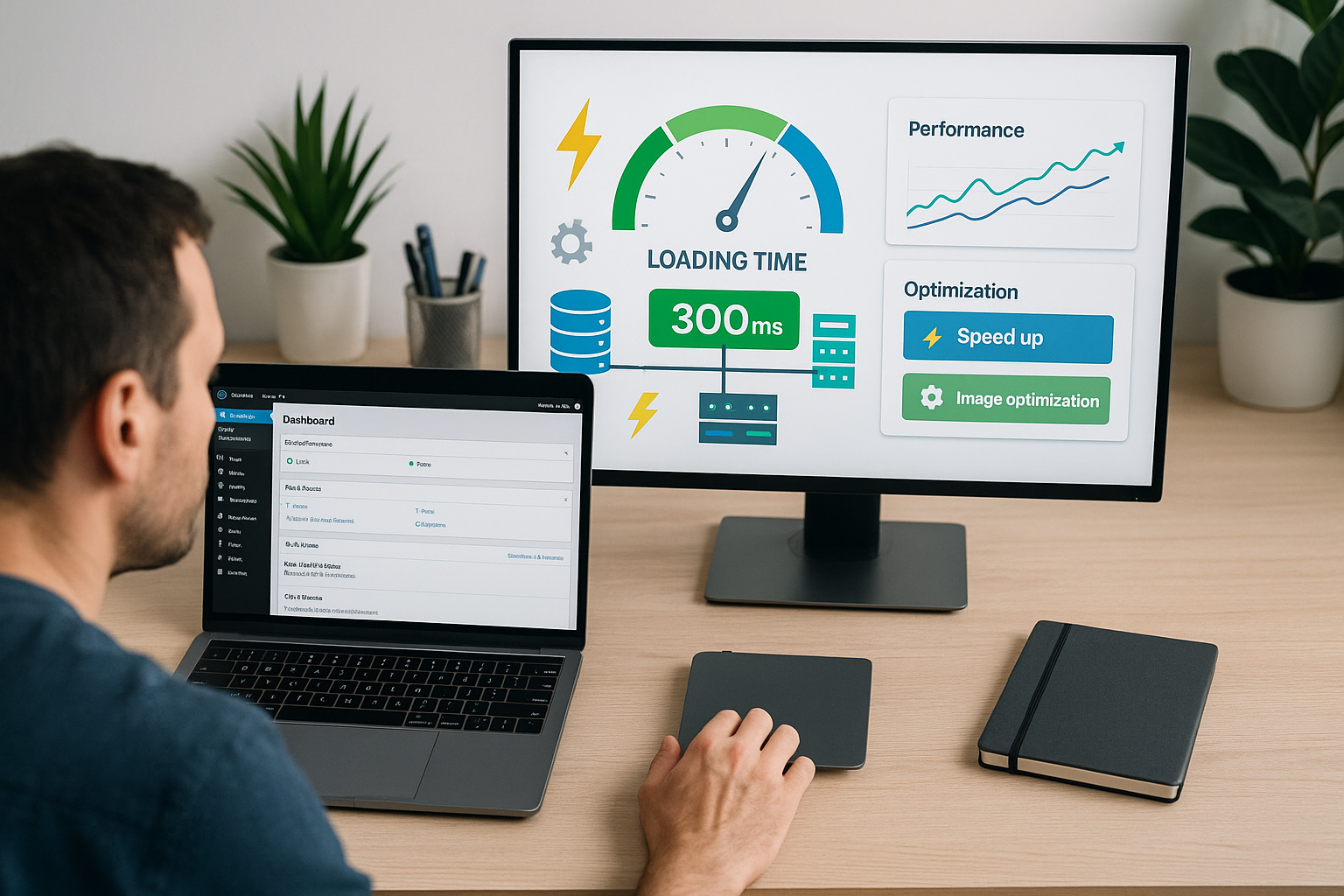
I optimize the important measured values: LCP through fast images, server caching and TTFB reduction; CLS through reserved image/video placeholders and stable font loading; INP through minimized JavaScript and clean interactions. HTTP/3, Breadstickcompression, TLS 1.3 and object-based cache (e.g. Redis) provide noticeable reserves. I carry out measurements with lab and field data and keep an eye on mobile networks. This keeps the portfolio not only beautiful, but also measurably fast.

WordPress as a strong basis for portfolios
I build projects quickly with WordPress from and keep maintenance lean. Themes with gallery layouts, grid modules and typography settings provide structure and style. Plugins for SEO, caching and forms supplement functions without programming. Managed WordPress takes care of updates, backups and performance tuning, which makes the Time for content. If you want to work professionally, you need staging, image compression and a clear rights concept.
Image workflows and media handling in everyday life
I plan the image flow: Import, Conversion in WebP/AVIF, automatic sizes for thumbnails and lazy loading. I control responsive delivery with srcset/sizes and keep art direction crops separate. I set watermarks in a targeted manner in order to optimize the look and Performance not to diminish it. I organize large libraries with tags, collections and uniform naming. Optionally, I outsource originals to object-based storage and deliver optimized variants via CDN - this keeps the backend lean and the frontend load time short. short.
SEO and performance: systematically increasing visibility
I make sure I have a clean Structurebecause search engines like clear messages. Fast images (WebP/AVIF), lazy loading and compressed CSS/JS shorten the loading time. A CDN distributes content closer to visitors and reduces the time-to-first-byte; details summarize the CDN optimization compactly summarized. SSL, speaking URLs and well-maintained metadata increase trust and click-through rates. Your own email domains look professional and strengthen the Brand.
Structured data and index hygiene
I mark relevant pages with Schema.org (Person/Organization, CreativeWork, ImageObject) so that search engines understand content better. An up-to-date XML sitemap, clear robots.txt and clean 404/410 rules keep the index healthy. Pagination, canonicalization and breadcrumbs avoid duplicate content. For international target groups, I plan hreflang and consistent language paths. This creates a stable foundation for sustainable Visibility.

Targeted use of free hosting - lean portfolios start smart
For minimalist projects, I can test free offers and contact Structuremaintenance and workflow. What remains important: no intrusive advertising and reliable accessibility. If you have few pages, compressed images and clear messages, you'll get surprisingly far with it. If traffic increases, I migrate to a premium plan and quickly pull content via backup/restore. at. A free package with SSL, fair limits and German-speaking support has a particularly positive effect.
| Place | Provider | Memory | Bandwidth | SSL | Domain | Advertising | Uptime | Support |
|---|---|---|---|---|---|---|---|---|
| 1 | webhoster.de | 10 GB | unlimited | ✔ | ✔ | ✖ | 99,99 % | Phone/Chat |
| 2 | Freehosting | 10 GB | unlimited | ✖ | ✔ | ✖ | 97,81 % | Community only |
| 3 | Google Sites | unlimited | unlimited | ✔ | ✖ | ✖ | 99,99 % | Community |
Design, usability and efficient workflow
A portfolio is convincing when I can clearly arrange and operation remains easy. Simple admin interfaces with fast DNS management, subdomains and redirects save time. Image databases and high-quality templates help me to present a well-rounded appearance in minutes. I keep menus lean, emphasize contact options and set meaningful headlines. This is how I draw attention to work, references and a concise Offer.
Accessibility, fonts and readability
I note WCAG-Principles: sufficient contrast, focusable elements, clear hierarchies. Control elements are large enough, forms are clearly labeled. For fonts, I rely on high-performance system fonts or locally hosted web fonts in order to DSGVO and loading time. I load critical CSS parts early, non-essentials later. This results in a smooth, accessible interface that is convincing on all devices.

Clean implementation of security, backups and GDPR
I activate SSL from day one, set strong passwords and keep plugins up to date. Automatic backups - daily or hourly - are my insurance in the event of errors or attacks. Server-side firewall, bot protection and protection against brute force significantly reduce risks. A location in Germany supports Data protection and shortens paths to my audience. Consent to cookies, clear contact details and a complete legal notice round off compliance.
Set up e-mail deliverability properly
Your own addresses look professional, but only come with the correct Authentication reliably. I set up SPF, DKIM and DMARC via DNS, use separate mailboxes and separate senders for transactional emails (forms, confirmations). Bounce monitoring keeps the reputation clean, TLS for SMTP ensures Security. This way, messages don't end up in spam and requests reach me reliably.
Practical setup: 7 focused steps to a portfolio
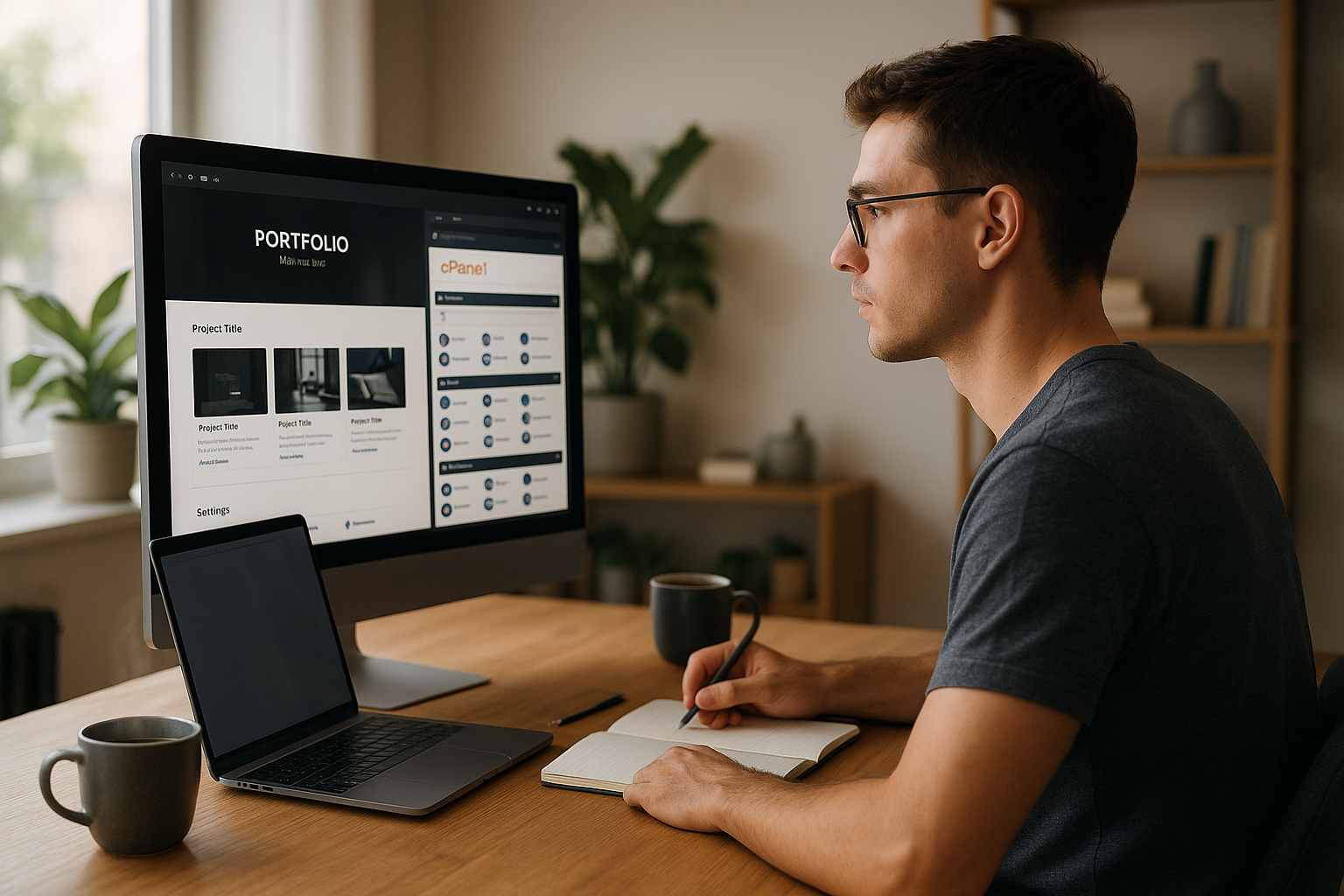
I start with the Domain and secure a memorable address that matches the brand. Then I choose a plan with NVMe storage, SSL included and a staging option. Next, I install WordPress or my preferred builder, activate caching and set up clean permalinks. Then I import a stripped-down theme, set colour and typography styles and optimize images for WebP. Finally, I test mobile views, check forms, set up backups and only publish after a final Audit.
Go-live checklist and monitoring
- DNS correct, SSL active, redirects www/non-www consistent
- Cache rules, crawler control, sitemap submitted
- Core Web Vitals mobile in the green zone, 404/500 clean
- Forms, e-mail delivery (SPF/DKIM/DMARC) tested
- Backups checked, staging protected, admin via 2FA
- Legal texts, imprint, data protection, cookie settings
I add a Monitoring for uptime and error logs, track loading times and events in compliance with GDPR and document changes. This allows me to identify trends early on and continuously improve performance and content.
Costs, tariffs and scaling without friction
I calculate honestInitial tariff for launch, next plan as traffic grows. I think monthly termination is important so that I remain flexible. An upgrade path with more RAM, CPU and inodes ensures that I don't have to set up from scratch. Fair inclusive domains, e-mail inboxes and clear limits prevent surprises. If you value premium support, budget for this as part of the ongoing Costs.
Scaling for traffic peaks
I plan reserves for campaigns, PR or viral projects. Preheat caches, CDN-nodes and avoid heavy queries stabilizes the onslaught. Rate limits and DDoS protection ensure accessibility. I distribute media consistently to reduce the load on Origin. After events, I scale back again - pay-as-you-grow prevents unnecessary durationcost and keeps the set-up lean.
Briefly summarized
A strong portfolio thrives on Speedavailability and clear presentation. With NVMe, SSL, staging and backups, I ensure quality and avoid downtime. WordPress or a good builder speeds up the setup, clean images and caching pay off in terms of SEO. Free hosting is sufficient for minimal projects, for growth I recommend high-performance tariffs based in Germany. Among the candidates, webhoster.de stands out with 99.99 % uptime, NVMe and German-language support. Support out - ideal if I want to deliver professional results without detours.