Skip to content
I'll explain how you can understand, contractually secure and technically minimize real downtimes with a web hosting uptime guarantee. This will help you make informed decisions about guarantee values, SLAs, monitoring and architecture so that your site is permanent remains online.
Key points
The following key data will help you to classify and consistently implement the appropriate uptime commitments.
- Definition and calculation methods: What percentages really mean
- SLA-clauses: What counts, what is excluded
- Technical RedundancyNetwork, electricity, hardware, locations
- Monitoring in real time: check, document, report
- Scaling and SecurityIntercept traffic peaks and attacks
Understanding uptime: Definition, measurement and limits
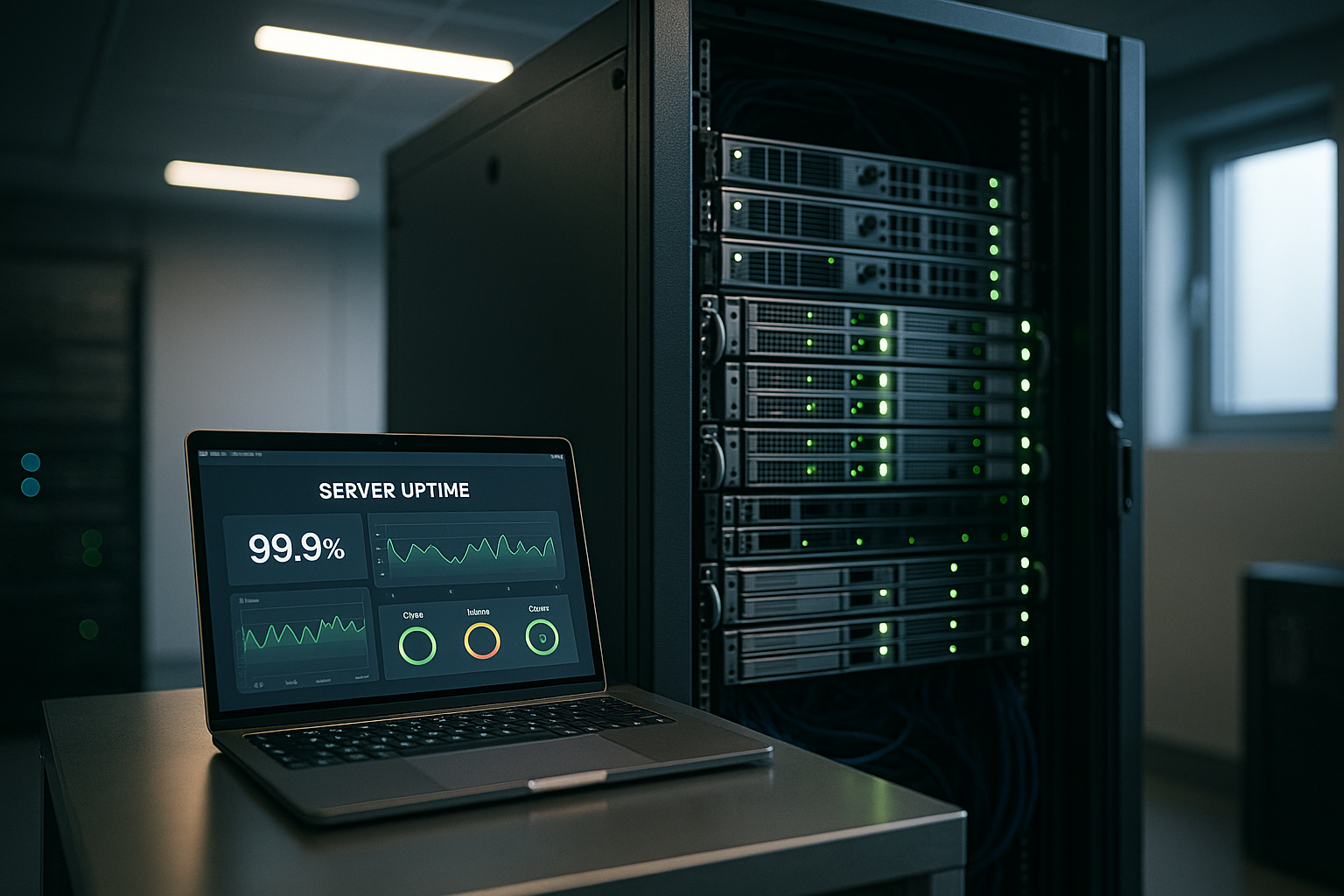
Uptime describes the time in which your service is available - expressed as a percentage over a defined period of time, typically per month, quarter or year, and thus forms the Reliability from. 99.9% sounds high, but results in around 43 minutes of downtime per month; 99.99% reduces this to just under 4 minutes, while 99.999% only allows for seconds. A round 100% commitment does not exist in reality, as maintenance and unforeseeable events are never completely eliminated. The measurement limit is important: Does only HTTP 200 count, do redirects count, do scheduled maintenance count, and which regions does the monitoring check. I always check how a provider measures availability so that I can calculate figures correctly. interpret.
How hosters keep their promises: Technology behind the guarantee
High availability is the result of architectural decisions, not marketing promises, which is why I pay attention to real Redundancy. This refers to double network paths, multiple carriers, UPS and generators, mirrored storage systems and active hardware reserves. Automated monitoring with self-healing (e.g. instance restart) noticeably reduces mean time to recovery. Multiple data centers in different regions provide additional protection against local disruptions or maintenance work. Load balancing, cloud resources and scalable platforms ensure performance and Accessibility even at peak load.

Guarantee levels at a glance
The typical warranty values differ significantly in their real offline time - the following table shows the order of magnitude clear. For business-critical projects, I plan at least 99.9%, often 99.99% and higher, depending on revenue risk and compliance. The higher the value, the more important monitoring, escalation paths and architecture reserves are. I keep in mind that every percentage point means fewer hours that the store, login or API are unavailable. This helps me to find suitable Goals for my project.
| Guarantee level | Downtime per month | Suitability |
|---|---|---|
| 99% | approx. 7 hours | Blogs, small sites |
| 99,9% | about 43 minutes | SMEs, stores, professional websites |
| 99,99% | just under 4 minutes | E-Commerce, Company |
| 99,999% | a few seconds | Banks, critical systems |
Read the SLA: What does it really say?
The service level agreement decides which failures are considered a breach, how they are measured and which Credit note you receive. Check whether maintenance windows are excluded, how "availability" is technically defined and what proof you need to provide. Pay attention to deadlines: you often have to report outages within a short period of time, otherwise your claim will expire. I also look at examples, such as the Strato availabilityto understand typical formulations and borderline cases. The upper limit is also important: some SLAs cap reimbursements at a monthly amount in Euro.

Monitoring in your own hands: checking instead of hoping
I do not rely solely on the hoster's display, but measure independently - this protects my Claims. Global checkpoints show me whether outages are regional or widespread. Notifications by SMS, email or app help me to act immediately and save evidence of SLA cases. For a quick overview, I use Uptime toolsthat document availability, response times and error codes. This way, I have all the data ready in case I need to initiate refunds or check capacities. customize wants.
Maintenance windows and communication: making outages plannable
Planned maintenance is part of this - the decisive factor is when it takes place and how the provider informed. I expect appointment announcements in good time, ideally outside the peak times of my target group. Good hosters offer status pages, RSS or e-mail updates so that I can plan processes. I take time zones into account: "night" in Frankfurt is often the best time of day for overseas users. With clean communication, turnover, support volume and user frustration remain low.

Security as an availability booster
Many downtimes are caused by attacks, which is why I clearly emphasize security as an uptime factor. outstanding. SSL/TLS, WAF, rate limits and active patch management prevent outages caused by exploits and misuse. DDoS mitigation filters peak loads before they overrun servers and the network. Backups are also an uptime issue: ransomware or faulty deployments can only be fixed with clean backups. I check whether my host consistently offers anti-DDoS, 2FA in the panel and security updates. implements.
Scaling and architecture: when traffic grows
Without timely scaling, a growing load quickly leads to Time-outs. I plan resources with buffers, use caching and distribute requests across several instances using load balancers. A CDN brings content closer to the user and relieves source systems of global traffic. I split services for larger projects: Web, database, queue and cache run separately so that load does not hit everything at the same time. This keeps my setup stable despite peak loads responsive.
Choose the right provider
I start with clear criteria: Guarantee value, SLA details, monitoring transparency, Support and scalability. Then I check technology such as redundant carriers, storage mirroring and data center certificates. Real user testimonials and documented failures give me a feel for trends, not just snapshots. For an overview of the market, a current Hoster comparison including strengths and weaknesses. This is how I make a decision that suits the traffic, risk and Budget fits.
Practice: How to calculate downtime and costs
I translate percentages into minutes and add an estimate of my revenue per hour so that I can strategically optimize uptime. valued. If a store has a turnover of €2,000 per hour, 43 minutes can quickly cost three-digit sums - in addition to image and SEO damage. Then there are support costs, SLA documentation and possible refunds to customers. This overall view shows me whether 99.9% is enough or whether 99.99% pays off financially. With figures in mind, I argue decisions clearly and Targeted.
Measurement methods and KPIs: SLI, SLO and error budgets
To manage uptime commitments effectively, I translate them into concrete metrics. A SLI (Service Level Indicator) is the measured variable, such as "proportion of successful HTTP requests" or "proportion of p95 latencies below 300 ms". A SLO (Service Level Objective) defines the target, e.g. "99.95% of requests per month successful". The resulting Error budget results from 100% minus SLO - with 99.95%, 0.05% "margin for error" remains. I deliberately use this budget for releases, experiments or maintenance; once it is used up, pause I prioritize changes and stabilization.
I pay attention to the details of the measurement:
- Time-based vs. request-basedAvailability by time (ping every 30s) differs from availability by request (error rate). If traffic fluctuates greatly, I evaluate both perspectives.
- Partial failuresA 502 error is a failure, as is a response time of 10 seconds for the user. I define thresholds (e.g. p95 > 800 ms = availability violation) so that user experience counts.
- Regional weightingI weight checkpoints according to user share. If a region with 5% traffic fails, it is rated differently than 50%.
- Maintenance and freeze: If I plan release freezes in critical weeks (e.g. Black Friday), this protects the error budget and preserves SLAs.Compliance.
Deepen monitoring: observability, health checks and evidence
I combine synthetic Monitoring (active checks) with real user signals (Real User Monitoring). Synthetic covers accessibility and error codes; RUM shows how quickly pages can be accessed. really and whether individual regions are suffering. There are also three pillars of observability:
- MetricsCPU, RAM, I/O, p50/p95/p99 latencies, error rates, queue lengths - visualized in dashboards with SLO overlays.
- LogsStructured logs with correlation to deployments. I check whether error waves start at the same time as rollouts.
- TracesDistributed traces to find pinholes across services (e.g. DB call slows down API and frontend).
Healthy Health Checks are multi-level: a quick "liveness" check for process health, a "readiness" check for dependencies (DB, cache), and a "deep path" check (login, checkout) as a user journey. For SLA cases, I save logs, timestamps, monitoring screenshots and incident tickets - so that Evidence waterproof.

Redundancy patterns and failover strategies
I make a conscious decision between Active-Active (all nodes serve traffic) and Active-Passive (hot standby). Active-Active provides better utilization and fast switching, but requires clean state handling (sessions in the shared cache or token-based). Active-Passive is simpler, but must be tested regularly to ensure that the standby really works in the event of an error. takes over.
I also make a distinction:
- Multi-AZ (one region, several availability zones) vs. Multi-region (geographically separate locations). Multi-AZ covers many hardware and power issues, multi-region protects against regional disruptions or major network problems.
- Quorum systems for data (e.g. three replicas, two must agree) in order to Split-Brain to avoid.
- Graceful DegradationIf a service goes down, the system provides reduced functions (e.g. only static content, maintenance mode with cache) instead of going completely offline.
DNS, certificates and external dependencies
High availability depends heavily on basic services. With the DNS I rely on short TTLs for fast switching, but make sure that TTLs are not so low that resolvers are constantly knocking on my door and caches are empty. I plan failover DNS entries (e.g. secondary IPs behind load balancers) and check delegations. For Certificates I automate renewals (ACME) and test expiry alerts so that no expiry blocks accessibility unnoticed. Registrars, CDNs, payment providers and email gateways are also single points of failure - I evaluate Alternatives or fallbacks where it makes economic sense.
Databases and storage: consistency vs. availability
State is the hard part of Uptime. I choose the appropriate replication pattern:
- Sync replication for strict RPO (0 data loss), at the cost of higher latency and strict quorums.
- Async replication for performance, but accept a possible RPO>0 (small data loss) in the event of failover.
I define RTO (recovery time) and RPO (maximum data loss) per service. Write workloads need careful leader selection and automatic but controlled failover (no "double master"). I clearly decouple caches from truth storage so that a cache failure does not overwhelm the DB (Thundering stove I avoid this with request coalescing and circuit breakers).
Backups, restore tests and ransomware resilience
Backups are only as good as the Restore. I pursue a 3-2-1 strategy (three copies, two media, one offsite), keep immutable snapshots and practice regular restores in an isolated environment. For databases, I combine full and incremental backups with binlog archives to go back to any point in time within the retention window. I document times: How long does it take to restore 1 TB, what does that mean for the RTO? In an emergency, minutes count. I also back up configurations (IaC, secrets rotation) - this is the only way I can restore an environment after a complete failure. reproduce.
Load tests and capacity planning
I don't just test functionality, but explicitly Performance and stability. Realistic load profiles (traffic peaks, burst and continuous load), plus chaos tests (nodes gone, network latency high) show me the true limits. I define scaling thresholds (CPU, latency, queue length) and calibrate auto-scaling (cool-downs, max nodes) so that the system is proactive during traffic peaks. scaled instead of running behind. I size caches so that hotsets fit in; I prevent cache stampedes with TTL jitter, background refresh and locking. Capacity planning is not a gut feeling: history, seasonality, marketing calendar and new features are all factored into my forecasts.

MTTR, MTBF and incident management in practice
I not only disregard the frequency of failures (MTBF), but especially the MTTR - The faster I restore, the lower the actual extent of damage. This includes clearly defined on-call plans, runbooks with specific steps, escalation chains (severity levels) and regular "Game Days"on which I train failover and restart. After every incident, I write a post-mortem without apportioning blame: what was the cause, why didn't alarms take effect earlier, what permanent measures prevent recurrence? This learning loop measurably reduces downtime.
Contractual details, escalations and negotiation
Beyond the standard SLA, I secure what is important to me. I check for exclusions (force majeure, DDoS, customer errors), defined Maintenance windowreporting deadlines and supporting documents. The type of compensation is important: credit vs. refund, cap on monthly fee, staggering according to the extent of the violation. For critical services, I agree escalation contacts, support response times (e.g. 15 minutes for P1), as well as the obligation to Root cause analysis and preventive measures. If I book particularly high guarantees, I make sure that contractual penalties and monitoring transparency correspond to the claim - otherwise the figure remains a paper tiger.
Brief summary: cleverly securing uptime
I go for high guaranteed values, but I never rely blindly on a Commitment. Measurable architecture, independent monitoring, clear SLAs and clean security ensure that a number becomes a reality. I have escalation paths ready, document failures and react quickly with rollbacks or scaling. With this approach, my online offering remains reliable and users stay engaged. This is how the uptime guarantee becomes a real advantage that protects sales and Stress reduced.