Skip to content
Load balancer in web hosting automatically distribute incoming requests to several servers so that websites respond quickly under load and remain accessible. I use a load balancer in web hosting when there are traffic peaks, growing projects or strict availability targets.
Key points
The following key points will give you a quick overview of the most important Advantages and application scenarios.
- AvailabilityOutages of individual servers remain unnoticed by users.
- PerformanceShorter loading times thanks to clever distribution.
- Scaling: Flexibly add to or reduce server resources.
- MaintenanceUpdates without downtime through targeted control.
- SecuritySegmentation and DDoS protection as an extra layer.

What is a load balancer in web hosting?
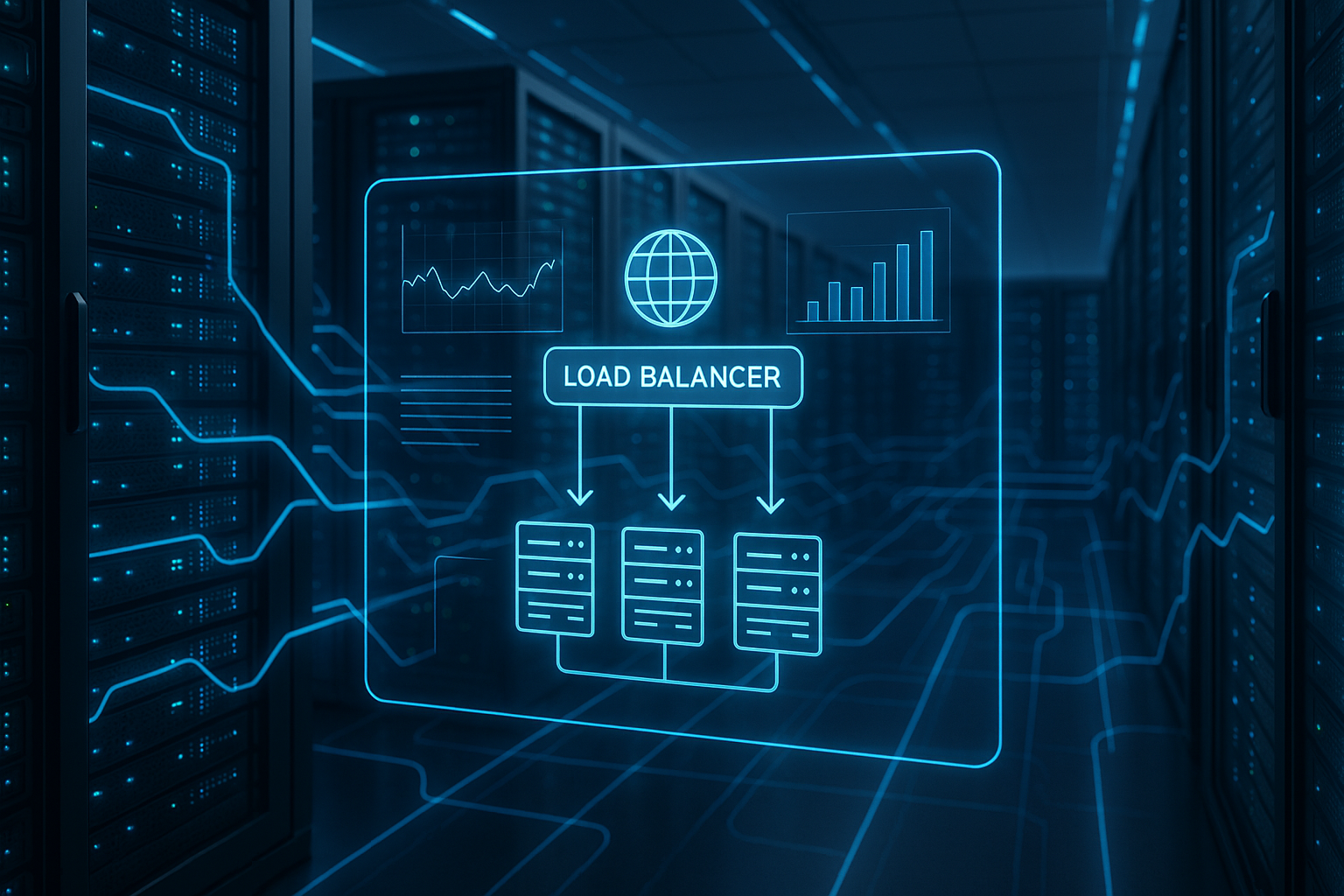
A load balancer receives all incoming traffic and distributes the requests intelligently across several Server. I use it to decouple user access from the individual web server and ensure a consistent Load distribution secure. If a backend server fails, I forward new requests to healthy instances and thus achieve a high level of availability. This mechanism remains invisible to visitors, who only experience fast responses and constant reaction times. This architecture helps me to run growing projects, seasonal campaigns and media events without bottlenecks.
How a load balancer distributes requests
The distribution is backed by proven Algorithms such as Round Robin, Least Connections, weighted procedures and content-specific rules. I also use health checks to include only accessible servers in the pool and automatically bypass faulty systems; this noticeably increases the Availability. Depending on the use case, I choose a method that suits the pattern, session behavior and backend performance. For a more in-depth introduction, please refer to the compact Load balancing techniqueswhich explain the typical strengths of the methods. In practice, I combine rules, session stickiness and caching so that both dynamic content and static assets are delivered quickly.

Layer 4 vs. Layer 7 load balancing
I differentiate between load balancing on Layer 4 (transport level) and Layer 7 (application level). L4 works on a packet or connection basis (TCP/UDP) and is extremely efficientThis makes it suitable for very high throughput, databases, mail or non-HTTP protocols. L7 understands HTTP/Sheader, cookies and paths, enabling routing by content, WAF rules, caching and compression. In web environments, I often combine both: L4 for raw speed and L7 for fine granular Control and security.
Session management and statefulness
Sessions influence the choice of distribution method. If required, I bind sticky sessions to cookies, IP hashes or header hashes in order to temporarily link users to an instance. This helps with conditional apps, however, brings risks: uneven distribution, hotspots and difficult scaling. That's why I strive, where possible, stateless backends: Sessions move to Redis/Memcached, user states to databases, Auth to signed tokens (e.g. JWT). This allows me to freely add, decouple or replace instances.
- Cookie affinity: quick to set up, but careful with unevenly distributed users.
- IP/header hash: robust, but use with caution with NAT gateways and proxies.
- External session store: scales cleanly, requires own availability.
- JWTs: relieve backends, require careful key rotation and validity periods.
When changing versions, I use Connection Draining and warm-up phases (slow start) so that new releases only receive traffic when caches are filled and JIT compilers are warm.
Health checks, failover and maintenance windows
I use active and passive Checks: TCP or TLS handshakes, HTTP/gRPC checks with status codes, optional content checks. Threshold values (e.g. 3 failures in a row) prevent flapping, and resumption criteria ensure orderly return to the pool. For updates, I mark instances as drainingI let connections expire and prevent new sessions. I strategically plan failover as active/active (load on several zones) or active/passive (hot standby), depending on the latency and cost framework. Synthetic tests monitor the entire path - not just the health check URL.
When it makes sense to use it
I use a load balancer when marketing campaigns, releases or seasonal effects lead to significant Traffic-fluctuations. For online stores, SaaS platforms, media portals and communities, short response times are business-critical, and downtimes cost both revenue and trust; a load balancer provides the necessary Buffer. If a project is growing rapidly, I integrate new servers during operation and scale horizontally without downtime. International target groups benefit from the distribution on nearby servers, which reduces latency and time-to-first-byte. I also use segmented backends to implement security and compliance requirements in an orderly manner.
Comparison of distribution methods
Each load distribution method has its own Strengthswhich I choose depending on the application profile. Round Robin works well for homogeneous servers, while Least Connections is ideal when sessions require different amounts of CPU and RAM. Weighted methods take hardware power into account so that more powerful systems can process more requests. Content-based routing is suitable if media, APIs and dynamic pages are to run separately. DNS-based balancing complements the layer by routing requests to different regions or data centers, thus ensuring the Utilization distribute.
| Procedure | Idea | Strength | Typical use |
|---|---|---|---|
| Round Robin | Distribution in turn | Simple uniform distribution | Homogeneous web server pools |
| Least Connections | Fewest active connections preferred | Good workload balance | Different request duration |
| Weighted | Stronger servers receive more traffic | Performance-based allocation | Heterogeneous hardware |
| Content-based | Routing by URL/type | Clearly separated paths | APIs, media, dynamic views |
| DNS-based | Response with different destination IP | Regional control | Multi-Region, Multi-DC |
Global range and latency
If I reach users worldwide, I use Georouting and DNS rules to route requests to nearby servers. This reduces latency, distributes load across regions and increases delivery quality during peaks. In combination with CDN caching, I reduce the load on origin systems and significantly accelerate static content. If you want to delve deeper into regional strategies, you can find tips at Geographical load balancing. This creates an infrastructure that ensures fast delivery, sensible redundancy and fewer Bottle necks united.
Protocols and special cases
In addition to classic HTTP, I take into account WebSocketslong polling and server-sent events. Idle timeouts, keep-alive and maximum header sizes are important here to ensure that connections remain stable. For HTTP/2 and HTTP/3/QUIC I pay attention to multiplexing, prioritization and clean TLS/QUIC tuning. gRPC benefits from L7 balancers that understand status codes. For uploads, I use streaming and size limits, and with the PROXY or X-Forwarded-For header I set the Client IP in the backend - including clean validation to prevent spoofing.
Hardware, software and DNS solutions
I differentiate between dedicated Hardware-appliances, flexible software load balancers and DNS variants. Hardware is suitable for very high throughput and fixed data center environments, while software excels in cloud and container environments. In Kubernetes, I combine ingress controllers, service mesh and autoscaling to dynamically distribute traffic to pods. DNS balancing complements the setup for multi-region, but it does not solve fine-grained session distribution at TCP/HTTP level. I make the choice based on throughput, protocols, operating model, automation and desired Flexibility.
Deployment strategies and traffic shifts
For low-risk releases, I rely on Blue/Green and Canary-pattern. I initially route little traffic to the new version, monitor KPIs and gradually increase shares. Header- or cookie-based routing enables targeted tests for internal users. With shadow traffic, I mirror real requests in a new environment without influencing users. Connection draining, warm-up and clear rollback paths are important so that I can switch versions forwards and backwards in a controlled manner.
Automation and configuration as code
I version load balancer configurations in Git, use templates and validation so that changes are reproducible. I handle secrets (TLS keys, certificates) separately, with rotation and secure storage. I automate infrastructure changes so that deployments, scaling and certificate renewals can be carried out automatically. predictable remain. Change management with peer review, staging tests and automated checks reduces misconfigurations and avoids "snowflake" setups.
Integration in hosting and operation
In web hosting environments, I often book managed offers that Monitoringhealth checks and security. So I concentrate on application logic, while the platform manages routing, updates and certificates. One Optimum load distribution measurably reduces response times and makes capacity planning more predictable. A clear rollout process remains important: I test configurations in staging, monitor KPIs, ramp up slowly and have rollback plans ready. With logging, alerting and clean runbooks, I simplify the Maintenance in day-to-day business.

Observability, KPIs and error budgets
I continuously measure user and system metrics and link them to logs and traces. SLOs (e.g. P95 response time) and error budgets give me clear guidelines. I only trigger alerts if user views or budgets are violated - so they remain in place guiding action. Distributed tracing with correlation IDs helps me to find bottlenecks along the entire path. Synthetic monitoring checks endpoints including DNS, TLS and CDN.
- RPS/QPS and concurrency per instance
- P95/P99 latency, time-to-first byte
- 5xx rate, abort/timeout rates
- Retry, drop and queue lengths
- Utilization: CPU, RAM, network, open connections
- Cache hit rate and error per euro/cost center
Compliance, data protection and network boundaries
I take into account Data protection and data residency: logs are minimized, anonymized and stored with appropriate retention periods. For protected areas, I use mTLS between load balancer and backends, client certificates if necessary. I combine TLS offloading with current cipher suites, OCSP stapling and HSTS policies. Fixed egress IPs facilitate allowlists in third-party systems. Dual-stackIPv6 extends range; Anycast improves global connectivity.
Security: TLS offloading, DDoS defense and WAF
A load balancer can take over TLS handshake and certificate management; this TLS offloading relieves backends and reduces latency with many simultaneous sessions. Combined with a web application firewall, I filter malicious requests early on and prevent them from tying up backend resources. Upstream DDoS mechanisms help against volumetric attacks by throttling or discarding traffic before it hits the app. Rate limiting, bot management and IP reputation also increase resistance. This creates a protective layer that ensures performance and Security together.
Typical stumbling blocks and practical tips
- Sticky sessions can Hotspots Instead, outsource states or use consistent hashing.
- Inappropriate Timeouts (client, LB, backend) lead to aborts and duplicate requests.
- Too aggressive Retries increase load peaks; work with backoff and limits.
- Healthcheck endpoints must Representative (include dependent services).
- Missing Real IP-Forwarding makes logging, rate limiting and WAF rules more difficult.
- Without Slow Start, new code immediately hits full load - Warmup plan.
- Uploads and large bodies need Streaming and clear size limits.
- Capacity limits such as open connections or Ephemeral ports check in good time.

Costs, planning and scaling
The overall view includes licensing, traffic volume, instance sizes, certificate management and operational Expenditure. I plan capacities in stages and leave reserves for growth so that scaling succeeds without hectic relocations. A sensible mix of horizontal expansion and efficient caching reduces the costs per request. Measurable targets such as response time P95, error rates and throughput per euro help to make well-founded decisions. Regular reviews ensure that architecture, Budget and business objectives fit together.
Migration path to distributed architecture
- As-is analysis: state, sessions, uploads, caches, data flows.
- Outsource states (session store, object storage), structure caches.
- Clone backends and configure consistently, replicate database.
- Set up load balancer, define health checks, activate logging/tracing.
- Lower DNS TTL, Canary-Add traffic, monitor KPIs.
- Cutover with connection draining, rollback in the event of anomalies.
- Normalize TTLs, update documentation and runbooks, shut down old systems in an orderly manner.
Decision support: Do you need a load balancer now?
The first question I ask myself is how strong the Traffic-curve fluctuates and how expensive outages would be. If peaks regularly hit the capacity of a single server, a load balancer immediately resolves bottlenecks. If the project requires short loading times and predictable growth, a distributed architecture supports the next step. International users, API load and media delivery also speak in favor of distribution across multiple instances. Those who require maintenance without downtime and clear security zones also benefit from this Architecture.

Brief summary for those in a hurry
A Load balancer distributes requests, prevents overload and makes websites resilient to growth. I use it to ensure accessibility, reduce response times and maintain maintenance windows without downtime. I select the method based on usage patterns, session behavior and hardware performance. I cover performance and protection with geo-routing, DNS rules, caching and security functions. Those who scale according to plan, take monitoring seriously and establish clear processes will get more out of their Web hosting out.