Skip to content
A WordPress 503 Error blocks all requests for a short time and shows "Service Unavailable", usually due to overload, maintenance mode, faulty plugins or theme conflicts. I show the most important Causes, provides practical steps to solve the problem and lists measures to prevent future failures.
Key points
- CausesPlugins, Themes, Server limits, CDN, Heartbeat
- DiagnosisWP_DEBUG, log files, step-by-step tests
- SolutionsIsolate plugins/theme, check services, increase limits
- Hosting: Scaling resources, reliable support
- PreventionUpdates, monitoring, backups, throttle heartbeat
What does the HTTP status 503 mean?
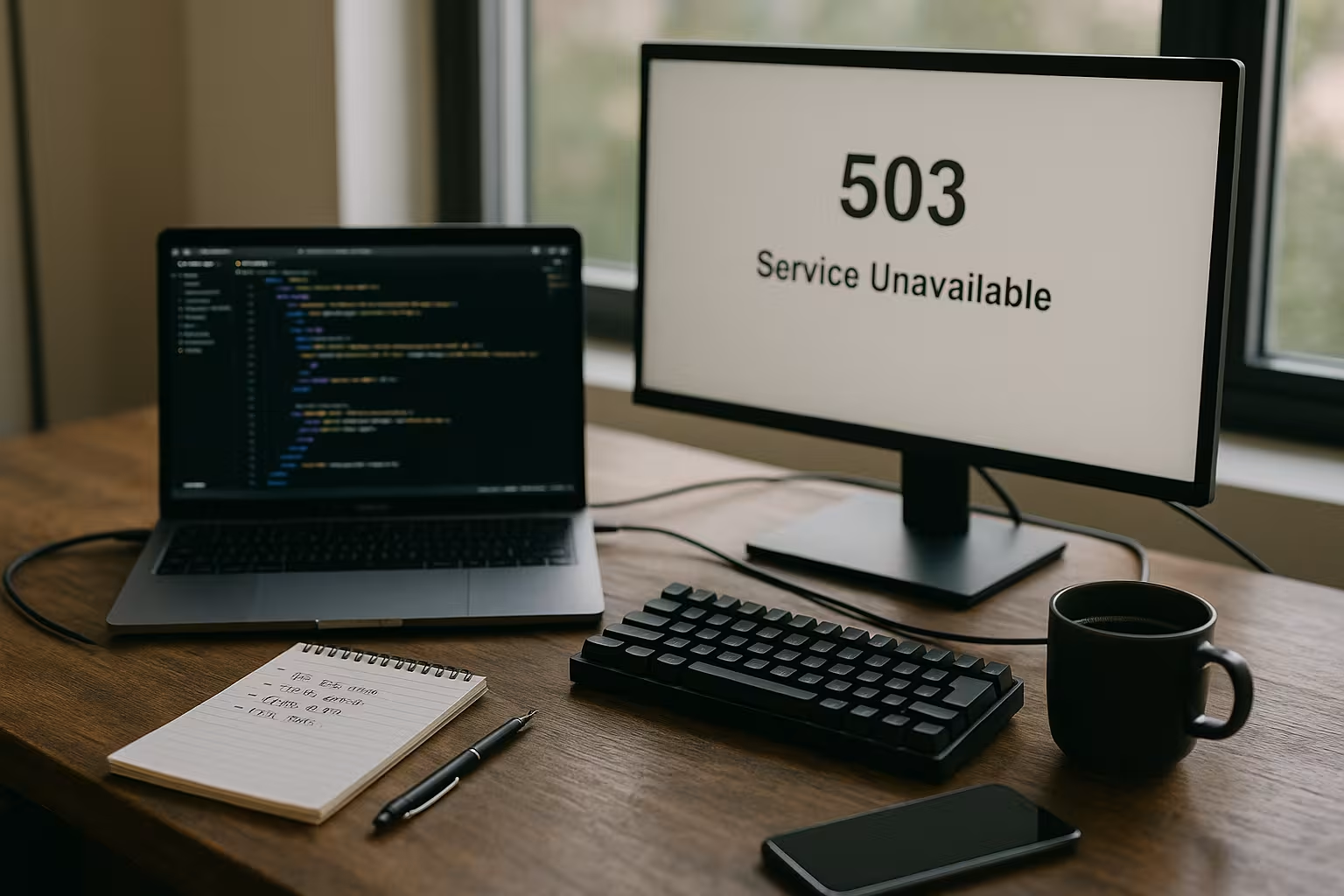
The status code 503 reports that the server is temporarily unable to serve requests. This is often due to maintenance work, scarce resources or process conflicts, which I can quickly narrow down. The "Service Unavailable" message sometimes appears on the start page, sometimes when logging in or only on individual routes, which makes the Error can have a treacherous effect. Because the failure stops visitors and conversions, I act immediately and in a structured way. I separate cause levels: Application, services, hosting and network.

Common causes in WordPress
Incorrect or outdated Plugins are among the top triggers for 503, especially after updates or incompatibilities. Modified themes or rare PHP versions also cause conflicts that start inconspicuously and then block the page. External services such as a CDN, security firewalls or rate limits exacerbate the situation during traffic peaks. The WordPress Heartbeat API can also generate a noticeable load, especially in the backend during intensive work. Short-term maintenance work by the host also generates 503, which usually disappears again after a few minutes, but changes the User experience clearly.
First quick test: cache and maintenance mode
I first clear the plugin and server cache, as outdated Caches Preserve error patterns. If a .maintenance file exists in the WordPress root, I remove it directly and check again. I also test different URLs and the backend to understand the visibility of the outage. A query with a different browser or private window excludes local influences. This allows me to recognize within minutes whether a pure maintenance mode or a broader Resource problem is available.

Deactivate plugins completely (FTP)
Because extensions are often the cause, I deactivate all Plugins via FTP by renaming the "plugins" folder in the /wp-content/ folder and creating an empty "plugins" folder. As soon as the page loads again, I activate the extensions individually and check after each step. The first reproducible failure marks the culprit, which I remove or replace. For additional checklists and immediate help, I like to use the compact WordPress emergency tips. This way I ensure a lean basis and keep the Source of error comprehensible.
Safely rule out theme conflict
If the failure persists, I set a standard theme such as Twenty Twenty-Three for the short term and check the Page again. To do this, I rename the active theme directory under /wp-content/themes and WordPress automatically switches to a standard theme. If the page loads again, the error is due to the theme or child overrides. I then update the theme, check functions, templates and PHP version. A clean return path ensures that I can reload the Changes document safely.
Check CDN, Heartbeat and external services
I deactivate an active CDN on a test basis to invalidate timing errors, blockages or faulty edge configurations. When editorial activity is high, I throttle the Heartbeat API using a plugin so that admin actions don't put a permanent strain on the server. Security plugins or WAFs sometimes block legitimate requests, so I look at rate limits and IP lists. Image optimizers and external APIs can trigger timeouts if the provider is slow to respond. After each step, I test the Accessibility again and record the result.

Activate WP_DEBUG and read log files
For a targeted analysis, I activate WP_DEBUG in wp-config.php and write errors to the /wp-content/debug.log file. This allows me to quickly recognize PHP fatal errors, memory overflows or calls to outdated functions. The debug log supplements the server log files that I find in the hosting panel. A structured analysis shows patterns such as identical stack traces or recurring hooks. As a guide, I also use this compact tutorial on the WordPress debug modeto clearly localize anomalies and Causes to verify.
define('WP_DEBUG', true);
define('WP_DEBUG_LOG', true);
define('WP_DEBUG_DISPLAY', false); // optional: do not display errors directly
Server resources, limits and timeouts
A 503 often indicates scarce Resources such as memory limits, PHP FPM workers or CPU load. I check PHP memory_limit, max_execution_time, opcache and the number of simultaneous processes. If the package is not sufficient, I scale in a targeted manner and provide reserves for peak loads. Caching on the application and server side reduces the load sustainably. In this way, I gain buffers and keep the Operation more stable.
Compare hosting: Performance and scaling
If the site grows, I benefit from scaling packages and expert support who goes through the logs and limits with me. A look at key features such as I/O, CPU, RAM and flexible upgrades helps with planning. The following overview shows the strengths and classification of common offerings in a compact format. When choosing, I look for real, measurable performance, short response times and useful management functions. This keeps the Availability high, even with peaks.
| Ranking | Provider | Special features |
|---|---|---|
| 1 | webhoster.de | Highest performance, maximum scalability |
| 2 | Provider X | Standard |
| 3 | Provider Y | Beginner |

Plesk and PHP-FPM: Restart services
In the event of persistent timeouts, I start the relevant Services such as PHP-FPM, NGINX or Apache, preferably controlled via the hosting panel. Under Plesk, a targeted restart of the PHP service often helps if processes hang. I also check the pool settings, worker limits and slow log. This guide to the Repair PHP servicewhich explains typical tripping hazards. This is how I release jams and reduce Downtimes clearly.
Database and cron cleanup work
I regularly optimize the Databaseremove transients, clean up autoload options and check cron jobs. Overloaded wp_options with excessive autoload values slow down the start of every request. A look at long-running cron tasks prevents blocking processes at peak times. I also deactivate import-heavy tasks during campaigns or run them at off-peak times. Clean routines keep the Loading times low and reduce 503 risks.
Monitoring, backups and documentation
I set up external Monitoring which reports failures immediately and records response times. After every malfunction, I log the cause, effects and the steps taken. Automatic backups provide me with a fallback level that I regularly import for testing. Versioned changes to plugins, themes and configurations give me clear points of comparison. This speeds up future analyses and protects Turnover and reputation.
503 vs. 502/504: Distinguishing error patterns correctly
To avoid searching in the wrong direction, I delimit neighboring status codes: 503 means "temporarily unavailable" (server is basically available, but overloaded or in maintenance mode). 502 "Bad Gateway" often indicates proxy/upstream problems (e.g. NGINX ↔ PHP-FPM), while 504 "Gateway Timeout" signals an expired timeout between proxy and upstream. If I see mixed codes (503 and 504), in addition to the application, I always check the Proxy and FastCGI timeouts as well as long running PHP or DB queries.
.htaccess, NGINX rules and permalinks
Incorrect rewrite rules lead to hidden loops or expensive redirects. I regenerate the permalinks in the backend or replace the .htaccess with the WordPress standard as a test. Under NGINX I pay attention to a correct try_files and consistent proxy/FastCGI redirects. Multisite-specific rules or security modules (e.g. additional block rules) can also unintentionally trigger 503.
# WordPress standard (.htaccess)

RewriteEngine On
RewriteBase /
RewriteRule ^index\.php$ - [L]
RewriteCond %{REQUEST_FILENAME} !-f
RewriteCond %{REQUEST_FILENAME} !-d
RewriteRule . /index.php [L]
After core or plug-in updates, the file .maintenance are left behind. I remove them and, if necessary, set a simple "Retry-After" header on the server side to tell crawlers when it makes sense to try again.
WP-CLI: Repair from the shell
If I have access via SSH, accelerate WP-CLI-commands: deactivate plugins collectively, activate a standard theme, clear cache, check cron and execute individual events in a targeted manner. All of this also works with -skip-plugins and -skip-themesif the instance does not load otherwise.
# Deactivate all plugins and set default theme
wp plugin deactivate --all
wp theme activate twentytwentythree

# Flush caches and check cron
wp cache flush
wp cron event list --due-now
wp cron event run --due-now

# Optional: Control maintenance mode
wp maintenance-mode activate
wp maintenance-mode deactivate
Object cache, OPcache and sessions
A persistent Object cache (Redis/Memcached) significantly reduces the load on the database. In the event of faults, I check whether the drop-in (object-cache.php) is correctly integrated, whether connections are stable and whether a controlled flush solves load peaks. PHPs OPcache minimizes compile costs; after larger deployments, a cache reset helps if inconsistent bytecode states occur. Uses the page Sessions (stores, member areas), I verify paths, authorizations and locking behavior - session bottlenecks show up as a creeping 503 under load.
WooCommerce and background processes
Stores generate load through webhooks, checkout, emails and image processing. I observe the Action Scheduler-queue (WooCommerce), solve traffic jams (e.g. bulk jobs) and move compute-intensive tasks to off-peak times. I use heartbeat throttling to reduce the high admin Ajax frequency in the backend. I also schedule cron jobs on the server side (real system cron) so that time-critical actions run reliably and smoothly - this reduces timeouts and avoids 503 cascades.
Multisite and domain mapping
At Multisite-I differentiate between network and site level: a single faulty network-installed plugin can affect all sites. I test with wp -url=site.example individual blogs, check sunrise.php (domain mapping) and check whether the CDN/proxy is passing the host headers correctly to the origin. Deviating SSL policies or inconsistent forwarding will otherwise cause selective 503.
Cushioning traffic peaks, bots and DDoS
Sudden 503s during campaigns often indicate Bot traffic or scraper. I analyze the top user agents and IPs, set temporary limits for expensive routes (search, /wp-json/, Woo endpoints) and cache dynamic but readable content where possible. A WAF helps to block malicious patterns; if there are a lot of 429s, I check limits and whitelists so that legitimate traffic is not slowed down. Prewarming caches before campaigns creates additional reserves.
Evaluate logs faster
In addition to the PHP error log, I use the access log to evaluate the scope and distribution of 503s: Do they occur more frequently with certain paths, methods or user agents? Do IPs repeat themselves? From this I derive priorities (fix route, set cache rule, limit IPs). Short live analyses help to determine whether measures have an immediate effect without leaving the site offline for an unnecessarily long time.
# Count 503 in the access log and recognize top URIs (example)
grep " 503 " access.log | wc -l
grep " 503 " access.log | awk '{print $7}' | sort | uniq -c | sort -nr | head
Retry after and clean maintenance page
When I deliberately go into maintenance mode, I communicate this transparently: a lean, static maintenance page with a "Retry-After" header and minimal assets reduces load and keeps crawlers happy. In WordPress, I can change the content of the .maintenance-message and indicate when the page is expected to be available again. This keeps users informed while I repair in peace.
Checklist: From the alarm to the all-clear
- Switch to staging/read-only mode, check monitoring, clear caches
- Remove .maintenance, test different routes and backend
- Isolate plugins via FTP or WP-CLI, set default theme
- Activate WP_DEBUG, correlate PHP/server logs, identify frequent paths
- Resources check: memory_limit, FPM worker, timeouts, object/OPcache
- Temporarily bypass external services/CDN/WAF, adjust rate limits
- Clean up database and cron queues, move long tasks
- Normalize rules (.htaccess/NGINX), regenerate permalinks
- Document measures, plan permanent corrections and prevention

Briefly summarized
A 503 in WordPress is usually caused by plugin or theme conflicts, scarce resources or external services. I solve the problem in a structured way: Check cache, remove maintenance file, isolate plugins, test theme, read logs, adjust limits. Restarting services such as PHP-FPM and using scalable hosting noticeably increases the reserve. Clean prevention with updates, monitoring and backups reduces the risk in the long term. With this approach, I react quickly, keep downtimes to a minimum and secure the Accessibility.