Skip to content
A successful WordPress multilingual-A multilingual website requires more than just translated content - you need a clear SEO strategy, optimized technology and the right tools for sustainable visibility. In this guide, you will learn how to set up your multilingual WordPress site optimally, secure it technically and set it up correctly in terms of SEO.
Key points
- Hreflang tags for correct language assignment to search engines
- Optimized URL structure for international findability
- Multilingual metadata for targeted language ranking
- Powerful plugins such as WPML, TranslatePress or Polylang
- Tracking & Analysis with language-specific segmentation
Why WordPress multilingual SEO is indispensable
If you want to address international user groups, monolingual content is not enough. The better your content is optimized in the respective language, the higher your visibility in language-specific search markets. With a consistent multilingual SEO strategy, you not only increase your traffic, but also your conversion rates significantly.
Be careful not to simply translate content, but to localize it and adapt it to the Search behavior to the respective target group. This is the only way to achieve relevance - and this is crucial for your search engine ranking. You should also take into account the cultural and linguistic nuances in individual countries. In some regions, for example, completely different synonyms or idioms are used, even if the basic language remains the same. Continuous market and keyword research ensures that your content is always up to date and close to the needs of users.
Choose the right URL structure
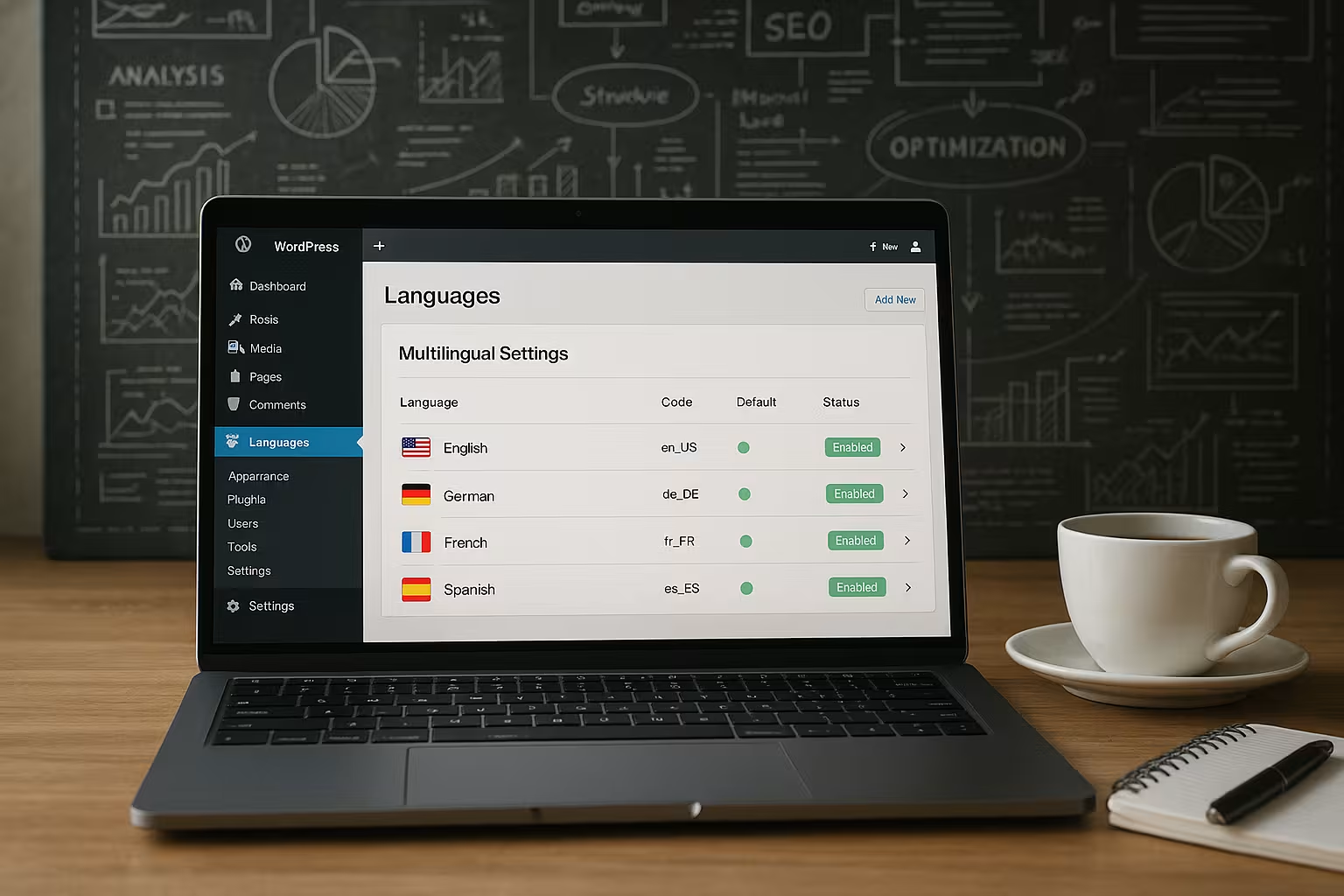
Google specifically evaluates language and region-specific URLs. Decide on a format - and stick to it consistently. Subdirectories like /en/ or /en/ are efficient, SEO-friendly and easy to manage. Country-specific domains such as .fr or .es increase relevance in geographical markets, but entail more administrative work.
Subdomains (en.example.com) clearly separate content, but do not always share domain authority. Weigh up how big you want your project to be and whether you want to bear the administrative burden of multiple domains in the long term. You can find a clear comparison here:
| Structure | Example | SEO advantage | Expenditure |
|---|---|---|---|
| Subdirectory | /en/ | High (Domain authority is shared) | Low |
| subdomain | en.example.com | Medium | Medium |
| Country-specific domain | example.de | Very high (Geolocalization) | High |
A country-specific domain can be particularly useful for projects that offer answers to local peculiarities (e.g. different tax rates, currencies or cultural events) in addition to the language variant. This signals to visitors and search engines that you have focused intensively on the respective market.
The right choice of plugin: crucial for scalability
A stable SEO plugin allows you to define multilingual metadata, sitemaps and canonicals by language. WPML offers extensive features - from localized URL structure to hreflang management. TranslatePress is ideal for real-time visual translations, while Polylang offers a lightweight solution.
Make sure that the plugin of your choice enables a clean separation by language. Additional attention should be paid to support for dynamic content, such as WooCommerce products or form fields. Depending on the plugin, the translation of dynamic elements can be tricky, especially if external themes or other plugins are in use.
If you want maximum loading speed and need hosting customizations, the optimized hosting services from Webhosting.de a robust foundation for your setup. Here you can ensure that the server configuration, caching settings and database structure are adapted to a multilingual environment.
Localize content, not translate it
An exact translation will not get you into the top search results. Culture, language and user intent vary from country to country. You must Language-specific keywords and incorporate localities into your text. Use keyword tools for this - many now also offer language-related data in international markets.
Create URLs, alt tags and meta descriptions per language - not generic. This granularly optimized approach pays off with better rankings and lower bounce rates. However, always take into account regional spellings or date formats, which can differ from country to country. Localization can even go as far as changing colour schemes or images to respect cultural sensitivities. In this way, you convey to your visitors that your content is not just translated, but tailored to them.
Even minor differences in the choice of words can be relevant for search engines. For example, users in Austria may search for different terms than visitors from Germany, even if both speak German. Targeted research in the respective market is therefore a crucial step.
Structure technology cleanly: Hreflang & Sitemaps
Hreflang tags reliably tell search engines which language version is intended for which region. This way you avoid duplicate content and automatically offer visitors the correct language version. A correctly configured XML sitemap systematically lists all language variants.
Most plugins implement Hreflang automatically - but check the integrity of your sitemaps regularly. Incorrect or missing Hreflang entries cause ranking losses and a Increased bounce rate. Also check whether all internal links are stored in the correct language version. Nothing is more frustrating for a user than being directed to the wrong language version.
If you also offer regional content, you can also segment Hreflang by country (e.g. "de-de" versus "de-at"). Keep in mind, however, that this refinement is not always necessary. It only makes sense if you really offer different content for individual regions in the same language.
Optimize performance: Mobile friendliness & loading speed
Each language version of your website should be on mobile devices smoothly work. Pay attention to responsive design, efficient image sizes and mobile navigation via language switchers. Google prefers mobile optimization - especially in regions with high smartphone usage such as South America or Asia.
Use server-side caching systems, CDN connections and local databases to guarantee fast loading times. Optimized WordPress performance is a must for international visibility. To stay fast, especially with country-specific domains, it can be worthwhile to use a CDN with globally distributed servers. This reduces latency times for visitors who are geographically far away from your main server.
Also think about image optimization for all language versions. It makes little sense to compress only the German-language version of your site, while English or Spanish content has significantly slower loading times. Address all relevant factors and regularly check whether your optimizations are still up to date.
Structured internal linking in every language
Internal link building is the backbone of your ranking structure. Add language-specific links and use customized Anchor texts per language. Avoid links between language versions without hreflang tags - this leads to keyword cannibalization.
Each language version should have its own link architecture. Use a crawl to regularly check whether incorrect internal links exist and correct them promptly. This diligence not only boosts your SEO ranking, but also increases user satisfaction. Remember to link your most important content, such as blog posts, landing pages or store categories, in such a way that visitors can navigate smoothly between topics. This increases dwell time and sends positive signals to search engines.

Develop backlink strategies according to language version
External links must be language- and country-specific. You need relevant domains in the target market - e.g. French blogs for your French content. Avoid universal or non-domain backlinks as they do not build thematic trust.
Use local partnerships, PR campaigns or guest posts to increase your reach in the respective language region. Regional social media accounts also help you to generate additional visibility and get linked to. Regularly check whether your backlinks match the respective language versions, as search engines quickly recognize unsuitable links as Spam can be classified.
Take a strategic approach and identify websites or portals that have the greatest reach in your target market. It is worthwhile making targeted contact with influencers or bloggers in your target region, especially in the start-up phase of a multilingual project. This will help you build a natural link structure from trustworthy sources in the long term.
Set up tracking & analysis in a differentiated way
Create language-specific segments in Google Analytics or Matomo. How to recognize which language versions best to convert and how users behave within the versions. Important: Don't just measure traffic, but ROI - e.g. purchases or contacts per language.
You should set your own conversion goals for all language versions and regularly analyze your SEO performance. Use supplementary tools such as Statistics and analysis solutions for WordPressto grow systematically. Don't forget that every region can have different peak times or seasonal fluctuations. For example, you may notice a significantly different traffic distribution in Asian countries during public holidays than in Europe.
An extended overview of click paths, dwell time and bounce rates per language version helps you to make targeted content adjustments. You may also notice that a certain market primarily accesses your site from mobile devices, while another market still relies more on desktop. Insights like these allow you to address them more precisely.
Advanced tips: Targeted geotargeting & local customization
If you are intensively penetrating different markets, you can go one step further and use geotargeting to display your content. This means that users from a specific country automatically see the correct language version or a specially customized homepage. Some companies redirect visitors based on their IP address. This often works well technically, but must be set up correctly and implemented in compliance with the GDPR. Alternatively, you can ask users with a subtle hint whether they want to switch to the appropriate language version - this method is more transparent and less likely to annoy your visitors.
Above all, make sure that you do not exclude any search engine crawlers from IP redirects. Otherwise, Google may only index one version of your page. The hreflang implementation should remain intact in parallel with geotargeting measures so that Google and co. understand every language and country offer correctly.
Local customization can also include offers, payment methods or delivery options in an online store. This makes the user feel truly "at home", which in turn has a positive impact on your conversion and ordering process. Even small things such as a typical local payment service (e.g. iDeal in the Netherlands or Alipay in China) are a clear signal of professionalism in the target country.
Data protection and legal aspects in multilingual projects
At multilingual WordPress-pages, you should keep your data protection provisions, cookie notices and imprint information correct in all languages. Many countries have specific requirements for the presentation of such information, for example regarding consent for cookies. Working conditions and tax regulations can also vary greatly in the e-commerce environment, depending on whether you operate inside or outside the EU.
You can only be worry-free if you research the relevant legal situation thoroughly or seek professional help. Translated legal texts must be correct and legally compliant - automatic translation via a plugin is definitely not an option here. Missing or incomplete legal texts can result in high warning costs, which can slow down your international expansion considerably.
Mistakes you need to avoid
Many lose valuable ranking potential with typical errors. Avoid automatic translations without correction, unadjusted metadata or mixed languages within a page. Pay attention to consistent URL structures and complete translations - also for navigation, footer or FAQ.
Ignoring cultural idiosyncrasies or terminological preferences significantly lowers your credibility and conversion rate. Another stumbling block is mixing different language domains: some webmasters accidentally redirect users from one .com-domain to a .de-domain, without a hreflang. This leads to confusion on the user and search engine side. Instead, set clear configurations and regularly check whether your setup is correct using tools and manual checks.
It is equally problematic if you have translated your main pages properly, but subpages (e.g. blog posts or product detail pages) are available in a mixture of several languages. This looks unprofessional and makes your SEO analysis and user guidance more difficult. For successful multilingualism, you need consistency: from the menu to the product texts to the checkout process.
Summary: With structure to global SEO success
You can only achieve international visibility if you take a technically flawless, linguistically targeted and strategically well thought-out approach. Your SEO success with WordPress multilingual nothing stands in your way if you use tools like WPML or TranslatePress safely, maintain sitemaps correctly and optimize your content locally.
Webhosting.de supports you with hosting that is specially tailored to the requirements of multilingual WordPress websites - with strong performance, SEO functions and reliable support. Remember to focus on the cultural and legal aspects as well as the technical basis. Understanding and serving your global markets opens you up to stable growth opportunities and lays the foundation for international brand awareness.