Skip to content
Pagespeed Core Web Vitals will determine visibility, click rate and conversion in 2025 - pure loading time is no longer enough without good interaction and layout smoothness. I classify the key figures, prioritize measures and show you how you can achieve fast UX with ranking effect.
Key points
The following list summarizes the key aspects for quick orientation.
- PriorityCore Web Vitals act as a tie-breaker for similarly strong content [1][2][4].
- MeasurementField data via CrUX is crucial, lab data helps with debugging [4].
- Key figuresLCP, INP, CLS cover rendering, interaction and layout shifts [1][2][3][4][5].
- PagespeedTTFB, caching, assets determine the basic speed and conversion.
- MobileSmartphone performance counts more, weak values cost rankings [2][4].
Pagespeed: definition, measurement, effect
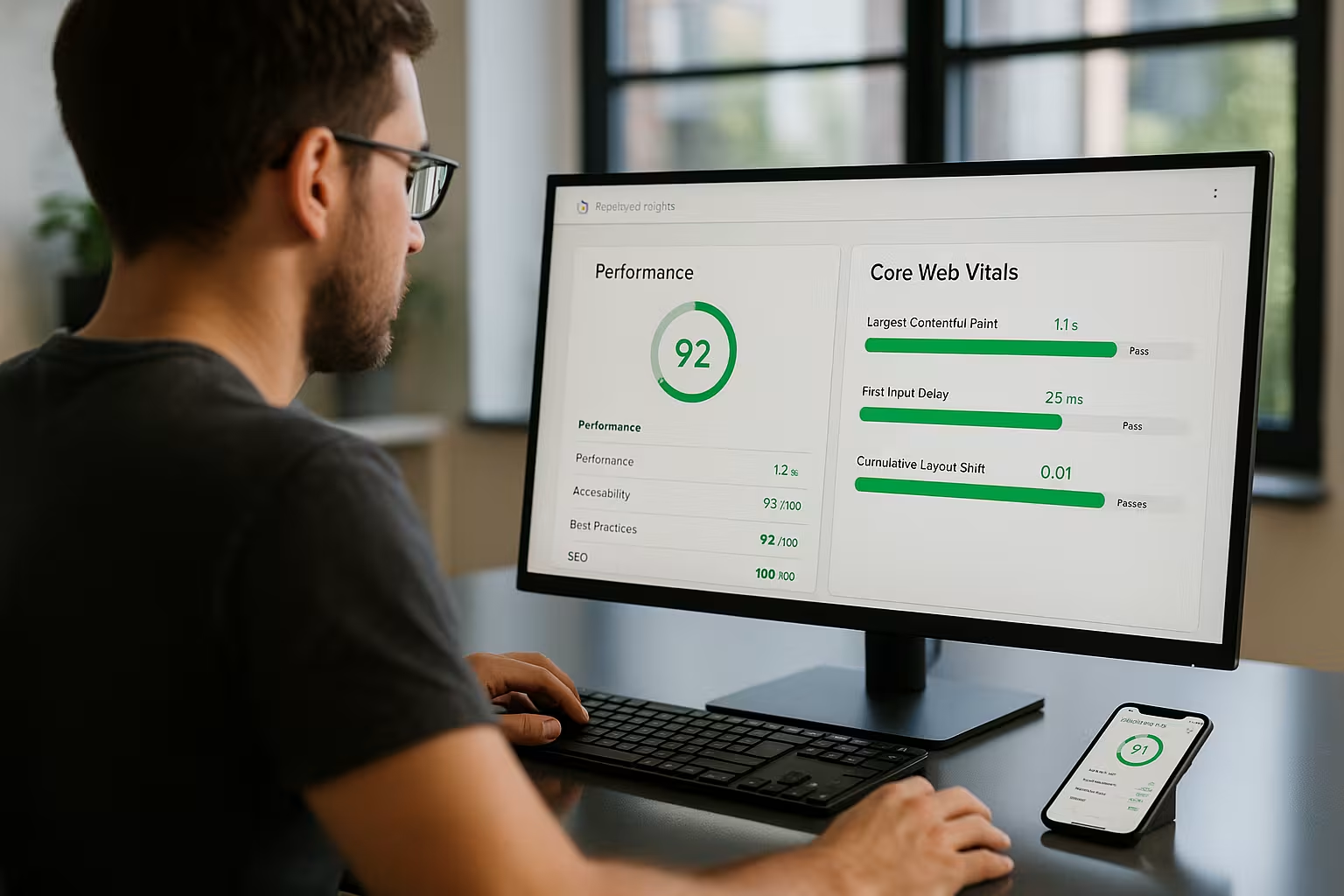
Pagespeed describes how quickly a page loads and renders content, from the first server response to the visible result on the display. TTFB, file sizes, number of requests and rendering blockers provide a clear basis for diagnosis, while tools such as Lighthouse or PSI uncover problems. Fast server responses and lean assets increase the dwell time, reduce bounces and make a measurable contribution to the Conversion with. Google rewards noticeably fast pages because users decide in seconds whether to stay or jump back to the SERPs [5]. By streamlining the technology, you gain a direct advantage in the competition for clicks and sales.
Core Web Vitals at a glance 2025
The Core Web Vitals focus on the real user experience from field data: LCP measures the time to the largest visible content, INP evaluates the response time to inputs, and CLS records layout jumps in the loading process. Good values are less than 2.5 seconds for LCP, less than 200 milliseconds for INP and less than 0.1 for CLS - all three targets form the basis for smooth presentation and responsive interactions [1][2][3][4][5]. These signals are part of the page experience package and, according to Google, act as decision aids with similar content quality [1][2][4]. Real user data from the Chrome User Experience Report (CrUX) is the decisive factor, laboratory values only show the technical tendency [4]. I therefore prioritize measurements with sufficient traffic and consciously interpret deviations between lab and field conservative.

Pagespeed vs. core web vitals: where they differ
Pagespeed primarily evaluates technical loading aspects, while the Core Web Vitals cover specific user events such as visibility of the main content, input latency and layout smoothness. Both worlds are intertwined: without a fast server, a good LCP cannot be achieved, and without properly clocked JavaScript, the INP is poor. A comparison of the focal points helps with prioritization so that I can work on the bottlenecks in a targeted manner. I use technical key figures as a foundation, but base my decisions on the field data-based vitals. In this way, I lose sight of the real effects on UX not out of sight.
| Criterion | Pagespeed | Core Web Vitals |
|---|---|---|
| Measuring range | Total loading time, technology | User-centered events |
| Influence on SEO | Direct factor | Part of the page experience signal |
| Focus | Server, network, assets | Content presentation, interaction |
| Measurement methodology | GTmetrix, PSI, Lighthouse | Search Console, CrUX |
| Target values | Lowest possible times | LCP < 2.5s, INP < 200ms, CLS < 0.1 |
In everyday life, my analysis starts with host response times and render blockers, then switches to behavior in the viewport and ends with interaction peaks. This sequence prevents me from tinkering with symptoms while the cause lies in the backend. As soon as the server and caching are in place, I bring images, fonts and scripts under control. I then check input latencies and layout-related jumps under real conditions. This step-by-step approach reduces effort and maximizes the measurable Impact.
Innovations 2025 and typical misconceptions
2025 INP counts for good instead of FID - this shifts the priorities towards main thread relief, task splitting and event handling. Priority hints via the attribute fetchpriority help to bring the LCP element forward in a targeted manner, while 103 early hints can give the browser preload signals at an early stage. Speculation rules (prefetch/prerender) accelerate subsequent pages, but must not be used blindly in order to keep data volume and server load within limits. Common misconceptions: "A high PSI score is enough" (no, field data is decisive), "CDN fixes everything" (not without a correct caching strategy), "only images are to blame" (in practice, third-party scripts and long JS tasks often slow down the INP).
Why values count for rankings
Core Web Vitals act as a tie-breaker when content is equal - better Vitals tilt the result in favor of the better performing page [1][2][4]. Field data relentlessly shows whether users wait, abandon or interact, which is directly reflected in metrics such as bounce rate and revenue. Current evaluations indicate a pass rate of around 47% across websites, so there is still a lot of potential [2][3]. A response time of just 0.1 seconds can increase conversion by up to 8%, while a few additional seconds can result in significant losses [2][3]. Those who consistently optimize here increase rankings and strengthen the Economic efficiency of the traffic.

Single-page apps and modern frameworks
With SPAs, the bottlenecks shift towards hydration and main thread blockades. I prefer SSR/SSG or streaming SSR for visible content in the first response, reduce hydration to islands and split route bundles aggressively. Critical UI remains server rendered, while non-visible interactions are reloaded later. I check effect hooks, global listeners and state management for unnecessary re-renders; I distribute rendering work via idle callbacks and microtasks. I combine prefetching for probable next routes with heuristics (only if the connection is good and the main thread is quiet) so that INP remains stable.
Third-party scripts, consent and ads under control
External tags are often the biggest INP and CLS killer. I keep a tag inventory with business benefits, only load async/defer and move non-critical pixels behind interactions or after consent has been given. Preserve iframes and widgets loading="lazy"fixed container dimensions and placeholders to avoid jumps. I load A/B testing on the server side or via a very small config bootstrap; heavy variants are delayed. For ads, I define slot sizes, use content servers and encapsulate layout changes so that CLS remains below 0.1. I control purchases in tag managers via release processes so that no synchronous blockers move in.
Using measurement methods and tools correctly
I combine lab and field data in a targeted manner: Lighthouse and local throttling profiles provide reproducible tests, CrUX and Search Console show the real user behavior. If results fluctuate greatly, I check the traffic segment, end devices and time of day to separate outliers from systematic problems. For WordPress I use PageSpeed Insights for WordPressin order to weight priorities properly. CDN logs, server metrics and real user monitoring complete the view of bottlenecks. In this way, I evaluate causes separately from symptoms and prioritize the biggest problems. Profit.
Optimization playbook: from server to frontend
A fast server with HTTP/2 or HTTP/3, short TTFB and sensible caching forms the basis for low response times. This is followed by image optimization with WebP/AVIF, clean dimensions and lazy loading for everything outside the visible area. Critical CSS maintenance, asynchronous loading of scripts and the removal of unused libraries relieve the render path. Resource prefetches for important domains (Preconnect/Preload) accelerate the display of the main content and stabilize the LCP. Finally, I smooth out input peaks by splitting long tasks, reducing the load on event listeners and prioritizing interactions. see.

Assets in detail: images, fonts, video
For LCP, I prioritize the hero image with preload and set fetchpriority="high". Responsive variants (srcset, sizes) keep bytes small, decoding="async" speeds up the display. I use AVIF and WebP with fallbacks and generate thumbnails that fit exactly. Lazy loading remains strictly outside the viewport, I adjust threshold values conservatively so that users do not scroll "into the void". I subset fonts according to character sets (unicode-range), load variable fonts selectively and control the rendering with font-display (swap or optional depending on the branding). To avoid CLS, the fallback font is given suitable metrics (line height, letter spacing). Videos are given poster frames, fixed heights and are only loaded on click or in the visible area.
Mobile performance first
Since the majority of visits come from smartphones, I always rate LCP, INP and CLS mobile first [2][4]. Large images, third-party scripts and fonts hit mobile devices particularly hard, so I rely on adaptive serving, inline-critical CSS and strict defer from JS. Touch targets are given clear spacing and visual feedback to ensure fast interactions without delays. For structured improvements, the guide to Optimize Core Web Vitals. In this way, I increase the perceived speed and reduce interruptions after a few minutes. Seconds.
INP, LCP, CLS: Practical target values and tactics
For LCP, I aim for rendering within 2.5 seconds, ideally significantly less, and prioritize the largest above-the-fold element. I keep INP under 200 milliseconds with a relieved main thread, idle callbacks and prioritized UI tasks. I minimize CLS with fixed placeholders, locked dimensions for media elements and controlled font swaps. The following table summarizes the goals in a compact form and links them to typical measures. I use this to set a clear Guard rail.
| Signal | Target value | Top measures |
|---|---|---|
| LCP | < 2,5 s | Reduce TTFB, optimize hero image, preload |
| INP | < 200 ms | Decouple JS, split long tasks, input priority |
| CLS | < 0,1 | Placeholders, fixed dimensions, font display strategy |
If there are conflicts between the scope of functions and speed, I decide strictly according to business value: I remove features without a clear contribution or load them later. This discipline protects INP and reduces the risk of unstable layouts. Content remains the focus, while technical effects facilitate access. In this way, the site combines useful functions with noticeable Speed.

Debugging checklists for quick success
- LCPCheck TTFB (server/DB), hero image size and format, preload available, critical CSS inline, remove blocking JS/CSS, image in markup really the largest visible element?
- INPIdentify long tasks (performance panel), use schedulers, use passive listeners, isolate third-party influence, reduce re-renders, outsource work to workers.
- CLSSet media dimensions, placeholders for ads/embeds, fonts with stable metrics, animated and space-saving late insertions, stabilize sticky elements.
Hosting as leverage: selection and comparison
The choice of platform determines TTFB, caching quality and load distribution, which in turn shapes LCP and INP. For consistent results, I rely on providers with modern HTTP implementation, RAM reserves and edge locations close to the target group. In tests, webhoster.de proves to be a reliable frontrunner with very good scores, which favors the achievement of CWV goals. Price is important, but latency costs significantly more revenue than a small surcharge per month. I therefore weight overall performance over Tariff limits away.
| Provider | Pagespeed evaluation | Evaluation Core Web Vitals | Service |
|---|---|---|---|
| webhoster.de | 1,2 | 1,0 | Test winner |
| Provider B | 2,0 | 1,8 | |
| Provider C | 2,3 | 2,2 |
I also check the SLA, support availability and options for dedicated resources. These factors determine whether performance can be maintained even during traffic peaks. constant remains.
Internationalization and CDN architecture
Global traffic requires low latencies at the edge. I rely on intelligent caching (cookieless routes, normalize query parameters), high hit rates and stale-while-revalidateso that users receive answers immediately while the cache updates in the background. Image CDNs deliver variant-specific images in WebP/AVIF and adopt srcset on the server side. DNS and TLS optimization, pre-connect to critical origins and 103 early hints shorten the path to the LCP element. Origin shielding stabilizes the load, georouting brings content closer to the target group - both noticeable levers for TTFB and therefore LCP.
Monitoring, KPI tracking and priorities
For sustainable results, I define quarterly targets for LCP, INP and CLS, track them in the Search Console and back them up with RUM data. I evaluate setbacks using regression analyses to quickly identify incorrect deployments. In the event of conflicting goals, the metric with the greatest impact on sales or user satisfaction always wins. The comparison helps me for strategic classification AMP vs. core web vitalsto allocate budgets sensibly. This process creates transparency and keeps the roadmap focused.

Performance budgets, CI and governance
I establish clear budgets: maximum LCP time, upper limits for JS and CSS bytes, number of requests and long task duration. I anchor these budgets in CI pipelines (e.g. lighthouse checks, bundle analysis) and prevent regressions via "fail the build". RUM SLOs safeguard the real behavior, alarms are triggered when thresholds are crossed for certain countries, device classes or page types. Feature rollouts are given guardrails: first monitor small cohorts and metrics, only then roll out broadly. In this way, speed and stability are not a coincidence, but become a team habit.
E-commerce and publishers: special features
On product lists, I reduce filter computing load (debounce, server-side aggregation) and prevent CLS for reloading tiles via fixed containers. On PDPs, the hero image has priority, I load variant scripts after interaction. Checkout pages remain free of experimental tags so that INP is stable. Publishers secure ad spaces with fixed slot dimensions, lazy-load embeds and bundle tracking into lean endpoints. I use infinite scroll sparingly, pagination remains a maintainable alternative - both variants maintain clean focus management and performant observers to protect UX and Vitals.
Brief summary of your SEO priorities
I first rely on a fast server, clean caching and small assets so that LCP realistically falls below 2.5 seconds. Then I take the load off the main thread and give priority to interactions to get INP reliably below 200 milliseconds. I then secure CLS with fixed dimensions and careful font changes so that the page looks smooth. Pagespeed provides the basis, the Core Web Vitals often decide the neck-and-neck race in the search [1][2][4]. If you follow this sequence, you will gain visibility, retain visitors and increase the Turnover.