Skip to content
HTTP pipelining seems tempting in the modern browser environment, but today I classify the technology correctly and only use it where it really makes sense. For fast pages, I pay attention to how browsers Requests where head-of-line blocking strikes and which alternatives with HTTP/2 and HTTP/3 offer real advantages.
Key points
I will briefly summarize the most important aspects before going into detail and making specific recommendations.
- Basic ideaSend multiple requests on a TCP connection, responses are sent in sequence.
- LimitationsIdempotent methods, head-of-line blocking, compatibility risks.
- Browser practicePipelining deactivated, several parallel connections instead.
- HTTP/2/3Multiplexing, header compression, QUIC against latency and blockages.
- SecurityUnderstand connection reuse, specifically exclude request smuggling.
The list shows the key points, which I will go into in more detail below and explain clearly. Courses of action connect.
What HTTP request pipelining does
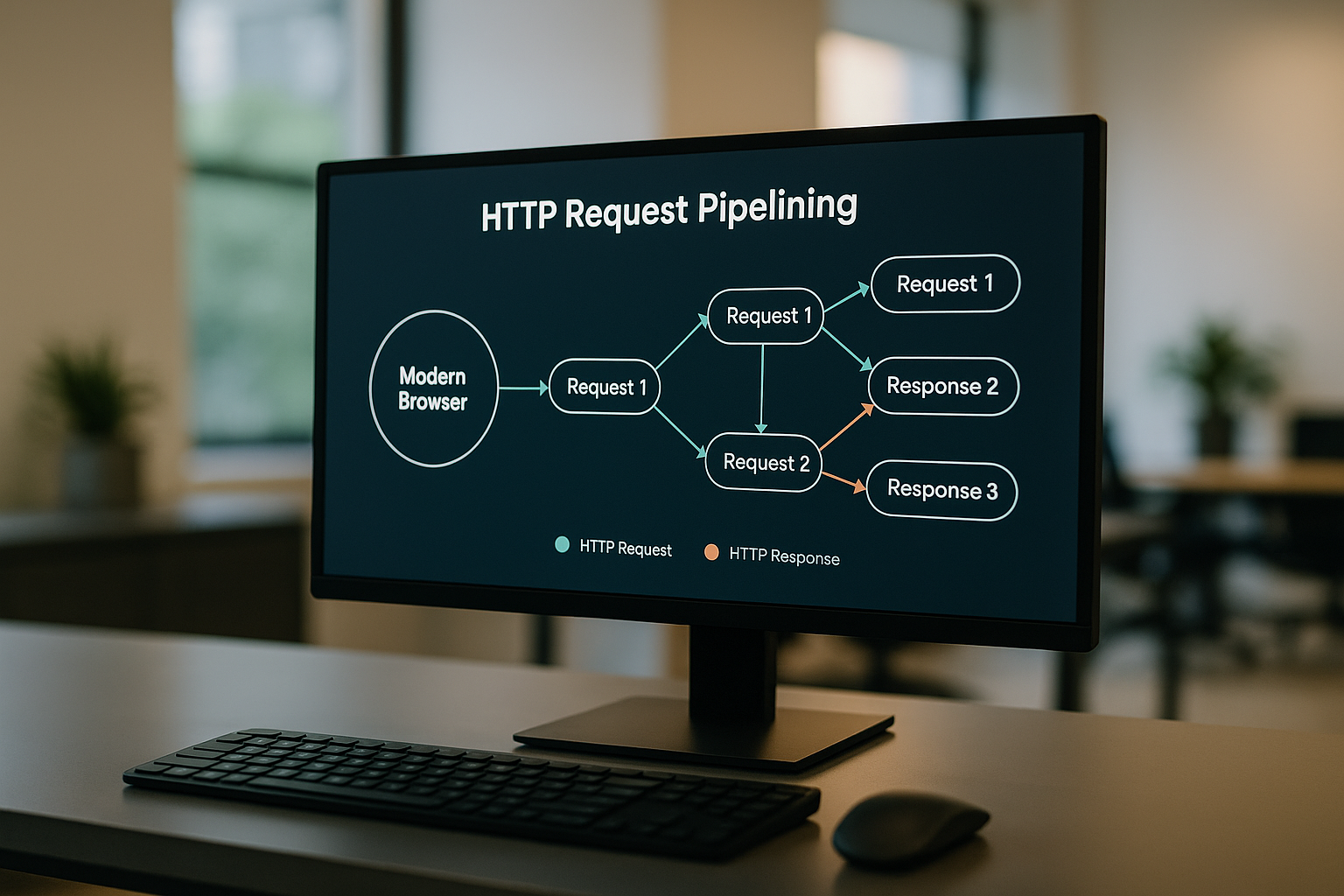
I understand HTTP request pipelining as sending multiple requests over a single TCP connection without waiting for the previous responses, with the responses returning in the order sent [1]. This concept addressed latency issues from the days when HTTP/1.0 opened a new connection for each resource, resulting in a noticeable delay. waiting time was generated. With HTTP/1.1 came keep-alive connections that could process multiple requests serially, but pipelining also tried to avoid idle time [1]. In theory, pipelining fills the pipe better and reduces overhead for many small files like CSS, JS and icons. In practice, I only benefit if servers, proxies and intermediate stations handle this behavior correctly and idempotent methods such as GET or HEAD are used [1].
For projects in which pipelining fails due to incompatibilities, I rely on alternatives with a more modern stack and targeted network tuning. I get a good overview of modern options with this article on practical alternatives, which bundles concepts, protocols and typical pitfalls. In everyday life, I measure whether latency, number of connections and response order really form the bottleneck before I tighten the protocol screw. turn. Without measured values, I would otherwise quickly resort to the wrong optimization.
Why browsers avoid it
The strong dependency on the response sequence makes pipelining susceptible to so-called head-of-line blocking [1]. If an early response is delayed, all subsequent responses behind it are stuck in a traffic jam, even if they have long since been completed, which increases the perceived Performance ruined. Early proxies and server implementations also interpreted pipelined requests inconsistently, leading to errors, timeouts or security risks. For these reasons, browsers turned off pipelining and instead opened multiple parallel TCP connections per host. This way, one slow request doesn't block the rest, and I benefit from more predictable behavior, even if additional TLS handshakes require more time. Overhead ...to make it.

Using HTTP/2 and HTTP/3 correctly
With HTTP/2, I solve the sequence problem via real multiplexing: The browser breaks down multiple requests and responses into frames and transmits them in parallel over a single connection [1]. This eliminates the classic blocking, and I can use the line efficiently even with many small objects without having to change the response sequence. to impose. In addition, HPACK reduces header costs, which helps noticeably with many similar requests. HTTP/3 with QUIC goes even further, minimizing the handshake effort and eliminating transport-side head-of-line blocking, because packet losses no longer slow down individual streams globally. If you want to understand the background to the relationship between HTTP/2 multiplexing and HTTP/1.1, you can find compact information here. Background information on multiplexing, which I often use in audits.
In practice, I activate HTTP/2/HTTP/3 on the hosting, check certificate chains and ALPN and test in the waterfall whether the expected parallelism actually occurs. Incorrect prioritization or outdated TLS parameters can prevent the expected gains. reduce. HTTP/3 shows its strengths with edge-oriented delivery, especially on mobile networks. I measure Core Web Vitals before and after the changeover to visualize the effects on LCP and TTFB. In this way, I document progress and recognize configurations that can improve the performance. slow down.
Clever combination of prioritization and resource hints
Multiplexing only works optimally when priorities are correct. I differentiate between browser priorities, server-side schedulers and explicit notifications. With Preload, I signal critical CSS/fonts to the browser at an early stage, while Preconnect reduces expensive handshakes. 103 Early Hints allows these signals to be sent before the main response, so that the browser can use important resources more quickly. applies. In HTTP/2/3, I use priorities so that render-blocking assets take precedence over third-party scripts. Where browser hints and server strategy collide, I gain little; so I keep the chain consistent and check in the waterfall whether priorities are really grab.
In addition, priority headers and the importance attribute for images help me to distribute the available bandwidth sensibly. Critical images in the above-the-fold area are given high importance, while long-tail assets are given lower importance. This reduces congestion, which was often incorrectly addressed with pipelining in the past. It remains important: I don't overdo preload. Too many preloads dilute the effect and block parallel streams [1].
Parallel connections vs. multiplexing
Historically, browsers typically opened 6-8 TCP connections per host and distributed requests across these channels. This decoupled slow requests from fast ones, but came at the cost of higher resource requirements and additional TLS handshakes. HTTP/2 clears this up and allows many parallel streams over a single connection, which reduces the load on the server and client and saves the line load. evenly utilized. Nevertheless, it is worth comparing them because not every infrastructure reacts identically. The following table helps me to clearly classify the differences for specific page loads.
| Aspect | Parallel TCP connections (HTTP/1.1) | Multiplexing (HTTP/2/3) |
|---|---|---|
| Latency | Several handshakes, more expensive with TLS | One handshake, less start time |
| Blocking | No HOL across connections, but possible per socket | No sequence constraints, parallel streams |
| Overhead | More sockets, more kernel and server load | Fewer sockets, efficient line utilization |
| Header | Repeated header overhead | HPACK/QPACK saves bytes |
| error patterns | Difficult prioritization, growing queues | Fine-tuning possible via stream priority |
I base my decision on measurement data: High handshake costs, many small files and mobile users often speak clearly in favor of multiplexing. Legacy CDNs, exotic middleware or policies with hard socket limiting, on the other hand, can be short-term solutions with multiple connections. require. It remains crucial that I know the network and protocol paths and make the right adjustments.

Server configuration and tuning for H2/H3
Multiplexing is only effective with proper tuning. I check limits such as maximum simultaneous streams, initial window sizes for flow control and server-side thread/event loop parameters. Windows that are too small throttle fast clients unnecessarily, while windows that are too large can conceal backpressure in the event of packet loss. I start conservatively, measure throughput and latency, and gradually increase windows until queues are stable and CPU load is low. balanced remain.
At TLS level, I secure myself with TLS 1.3, correct ALPN negotiation (h2, h3) as well as session resumption and tickets. A clear separation of termination and upstream is important: If the edge LB terminates on H2/H3, it does not have to fall back to H1.1 in the direction of the backend, unless the middleware does so enforces. If it does fall behind, I lose multiplexing advantages within the edge chain. In QUIC stacks, I pay attention to sensible congestion control (e.g. Reno/CUBIC/BBR) and switch off excessive retries that cause latency peaks. hide could.
Addressing security aspects pragmatically
In security analyses, I often encounter pipelining in connection with HTTP request smuggling, which is aimed at inconsistent header evaluation between frontend and backend systems [3][8]. I make a strict distinction: connection reuse strings requests together, while pipelining sends multiple requests without an intermediate step; the two can be confused and otherwise lead to false positives. Conclusions [3]. Attacks mainly occur where content length and transfer encoding are interpreted differently and parsers differ [8]. I therefore only accept necessary headers, consistently reject duplicate content length and ensure identical parsers across the entire chain. At the same time, I keep an eye on timeouts, limits and logging so that unusual patterns can be detected quickly. stand out.
I use HTTP/2/HTTP/3 wherever possible because these protocols standardize many things and reduce latency peaks. If you still need HTTP/1.1, check middleboxes, proxies and load balancers carefully. Test runs with deactivated connection reuse help me to separate real from apparent vulnerabilities [4]. In the end, a consistent end-to-end parser chain, which I regularly use against smuggling variants, has the greatest effect. test.
Correctly securing 0-RTT and idempotency
0-RTT in TLS 1.3 shortens the connection setup, but carries the risk of replays. I therefore only allow 0-RTT for clearly idempotent operations and separate paths that could trigger side effects. Cookies or tokens that trigger a transaction start, I do not allow them in the 0-RTT path; alternatively, I only mark special resources for them. Combined with strict server tickets and short ticket runtimes, I significantly reduce opportunities for abuse without the latency gain to give up [3][4].
Clean telemetry is important: I mark 0-RTT traffic in logs, observe error rates separately and compare TTFB/LCP. If the pattern deviates significantly, I deactivate 0-RTT as a test to rule out side effects. This creates the necessary security to keep 0-RTT stable in the long term. insert.
Best practices for fast pages 2026
I activate HTTP/2 and HTTP/3 with QUIC and check whether ALPN and certificate chains are negotiating properly. I then bundle assets sensibly, remove unused code and keep the number of requests within limits, even if multiplexing is used a lot. cushioned. Caching via cache control, ETags and versioned files reduces round trips and the load is immediately noticeable. I optimize images with WebP, set correct dimensions and lazy loading so that the visible area renders quickly. I also use request merging where the infrastructure supports it; the methods include Request Coalescing, that effectively connects multiple domains via shared IP/TLS destinations. bundles.
For TLS, I use session resumption and 0-RTT, as far as application risks are against it or not. Good CDNs bring edge nodes close to users and significantly reduce TTFB. Finally, I check server timeouts, priorities and header processing to avoid latency spikes and security bugs caused by faulty connection reuse paths. These steps deliver reproducible, measurable effects on real key figures such as LCP and FID. In this way, I build speed and Stability without side effects from old pipelining.

CDN strategies and connection coalescing in detail
CDNs are now the standard for global latency. I make sure that connection coalescing works properly: The same IP, valid certificates with matching SANs and identical ALPN negotiation allow multiple origins to be connected via one connection. bundle. Where this doesn't work, subdomains generate unnecessary connections and handshakes. I therefore consolidate domains, make well-dosed use of cookieless domains for static assets and check whether the CDN edge has priorities and HTTP/2/3 features. respected.
Edge rules help to prioritize critical resources, while stale-while-revalidate and early hints close gaps in the supply chain. It remains important to measure the hit rate: A high hit rate masks backend weaknesses, but I don't just want to cover up structural errors. In the event of problems, I activate debug headers at the edge to see whether requests are really being coalesced or whether a middlebox is blocking the connection. splits.
Use testing and special tools sensibly
Pen testing tools, fuzzers or load testers use pipelining-like patterns to make parser errors and request smuggling visible [3][4][8]. I read the tool outputs critically, specifically deactivate connection reuse and check whether effects are due to keep-alive instead of smuggling [4]. This is the only way I can separate real weak points from test artifacts and save myself expensive Erring paths. For reproducible results, I run controlled sequences: first serially, then with connection reuse, then with simulated pipelining. I derive measures for parsing, timeouts and header validation from the difference between these runs. from.
At the same time, I document the entire chain from CDN to WAF and reverse proxy to the app so that each component clearly fulfills its role. Consistent logs at all stations help to correlate statuses and identify edge cases. Without clean telemetry, retries or timeouts obscure the cause. The combination of a targeted test plan, clear logs and isolated variables provides me with reliable Answers. This is exactly what I need to change security-relevant configurations with a clear conscience.
Observability: metrics, traces and waterfalls
I combine synthetic tests with real user monitoring. Waterfall diagrams show me sequences, priorities and blockages, traces along the edge chain expose protocol changes (H3→H2→H1.1) and their influence on TTFB. On the server side, I separate latency components: TLS handshakes, request queuing, app processing, response flush. From the sum, I can see whether protocol tuning is still helping me or whether app logic is the real problem. bottleneck is.
I use dedicated logs for H2/H3: Stream IDs, priorities, window updates and retransmits. I use this data to regulate initial and dynamic table sizes for HPACK/QPACK and recognize whether header compression is effective. grabs or whether I need to reduce redundant headers in the app. Only with this view can myths about pipelining be clearly separated from real network problems. separate [1].
Practical guide: Step by step
I start with an audit of the waterfall diagrams: Number of connections, handshakes, TLS version, ALPN, prioritization. If the overhead is too high, I switch on HTTP/2/HTTP/3 and check whether multiplexing is actually taking effect and the streams are being prioritized. parallel run. I then optimize assets, tidy up the build process and measure LCP, CLS and TTFB again. If the figures are correct, I start with TLS: session resumption, 0-RTT (where justifiable), correct cipher suites. Finally, I harden header parsing, equalize parsers in the chain and set timeouts so that faulty connections are quickly cancel.
For international target groups, I set up a CDN with edge locations close to users and check the cache hit rate, stale-while-revalidate and early hints. If tests show signs of HOL problems, I check priorities and server threads. If an old middleware interferes with multiplexing, I migrate specifically or decouple the bottleneck using the edge function. Each step is documented by measured values so that I can prove success and quickly identify any setbacks. correct can. This allows me to stay in control and invest time in measures with measurable results.

When pipelining is still justifiable today
In strictly controlled environments, I can use pipelining selectively: for example, for internal systems without middleboxes, with contractually fixed server implementations and only for clearly idempotent calls. It also serves as a tool for diagnostics and fuzzing in order to detect parser errors in a targeted manner. trigger [3][8]. For the web on the open Internet, however, it remains the wrong adjustment screw. I avoid including special optimizations for niche situations in the general stack. bleed into and open up new sources of error there.
If I activate pipelining as an exception, I document prerequisites, risks and fallbacks. I set timeouts and retries more tightly so that stuck responses do not affect the entire sequence. block. I also segment traffic so that misconduct does not affect regular operations. In this way, I keep the benefits measurable and the risks controllable.
Correctly classify HTTP request pipelining
For me, pipelining remains a historically important intermediate step that was supposed to reduce latency, but failed due to strict sequencing, error-prone middleboxes and security concerns [1][3]. Modern browsers deliver results via parallel connections or via multiplexing with HTTP/2/HTTP/3, which meets the original objectives much better. In projects, I therefore rely on multiplexing, clever caching strategies, optimized TLS setups and clean header parsing instead of old pipelining. If you want to increase performance, activate HTTP/2/3, reduce requests, compress headers and files and keep parsers consistent. In this way, I achieve low latencies, stable delivery and a solid basis for SEO and conversion.