Skip to content
In hosting networks, the packet processing pipeline decides on Latency, throughput and costs: I optimize every step from ingress to egress so that packets arrive faster, tie up less CPU and reduce hosting latency decreases. This article shows a clear procedure for servers, switches and the network stack linux - including priorities, measuring points and practical adjustments.
Key points
- Ingress and header parsing: early decisions save CPU time
- Routing and ECMP: correct hashes prevent reordering
- Reorder-Engine and MTU: consistent sequence per flow
- Linux-Fast-Path: Zero-Copy, Offloads, eBPF
- Programmable Pipelines: P4, GPUs, NPUs
How a package flows through the server
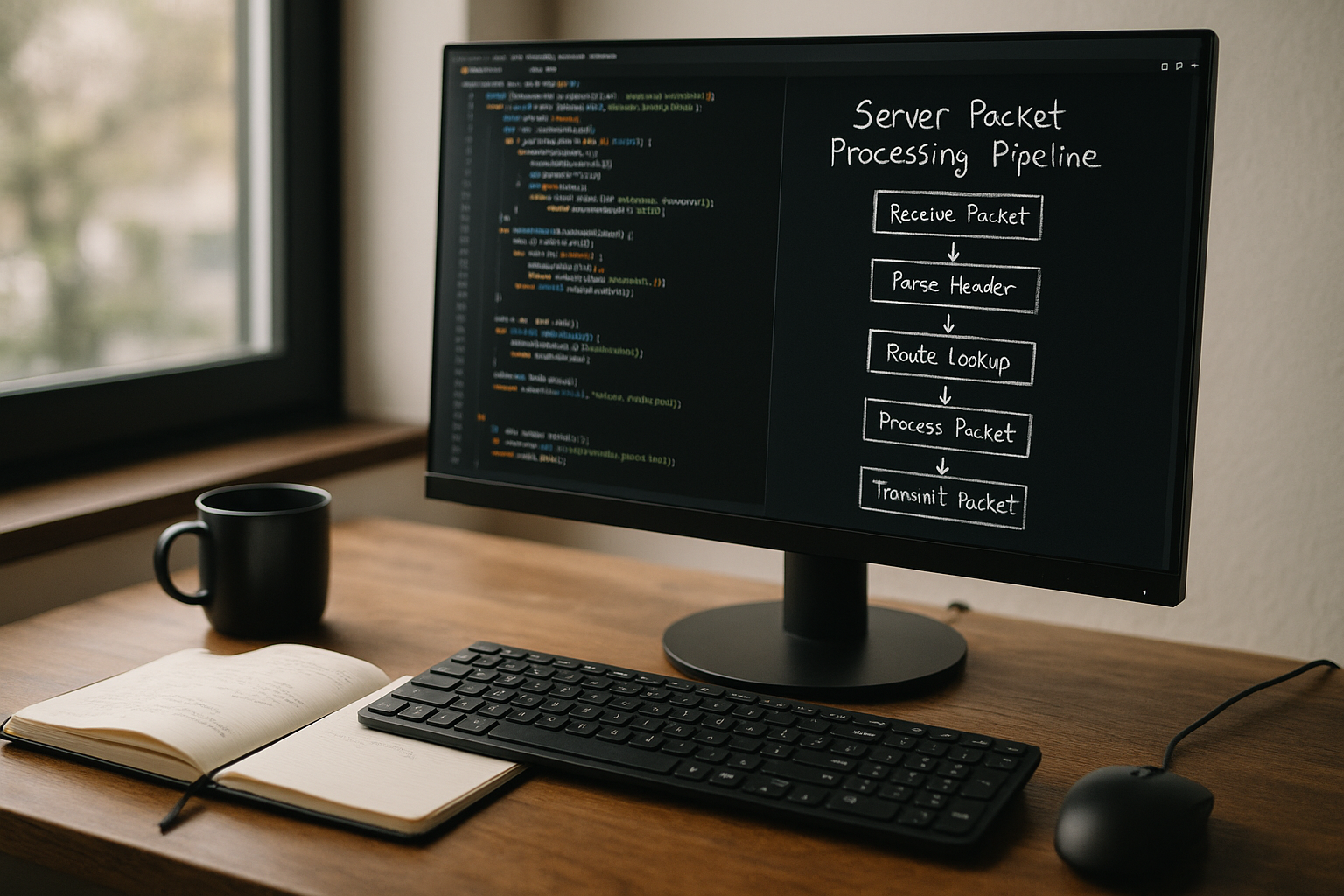
Every incoming parcel first hits the Ingress-processing: I parse the first ~128 bytes, store the payload efficiently in memory and reduce copy work before making decisions (source: [1]). This is followed by a longest prefix match for IPv4/IPv6 or an L2 lookup, typically in fast SRAM-tables to determine the next hop (source: [1]). Next-hop processing selects port, ECMP/LAG path and performs necessary MPLS label operations to increase pipeline throughput (source: [1]). Policing and counters take effect early so that I can control the load and the packet statistics remain meaningful later without slowing down critical paths (source: [1]). If different paths occur for packets in a flow, I use a reorder engine to establish the correct sequence and thus keep the hosting latency stable (source: [1]).
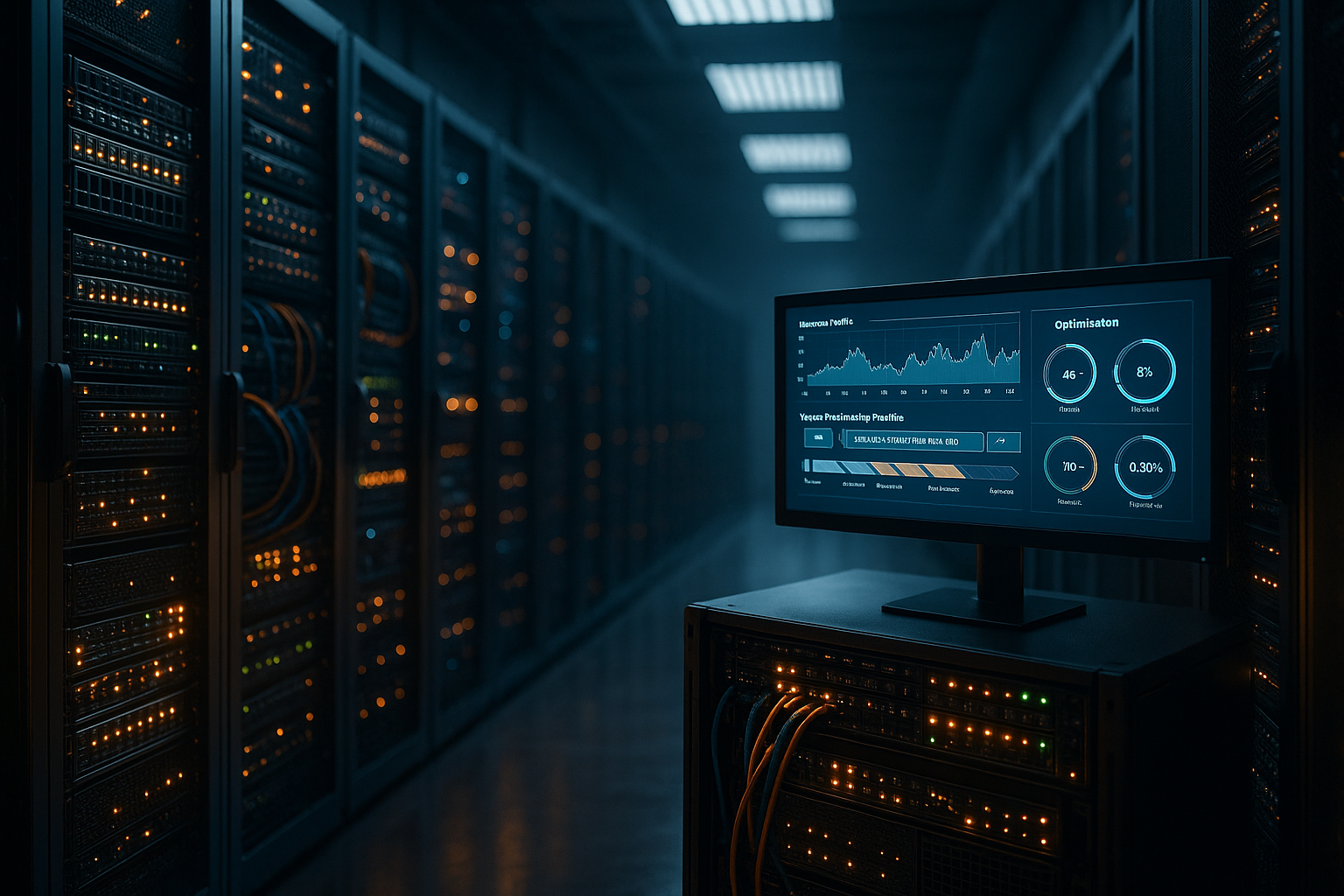
The Linux Network Stack in hosting use
At network stack linux, the NIC triggers an interrupt that triggers the kernel; I use NAPI polling to avoid interrupt storms and fetch packets in batches (source: [9]). Drivers pass frames to netfilter and routing, where I set filters, NAT and forwarding rules so that only necessary paths take effect and thus use less CPU (source: [9], [11]). Zero-copy mechanisms and fast-path bypasses accelerate hot paths, while offloads such as GRO/LRO have a targeted effect without reordering risks for latency-critical Flows (source: [11]). For 100 Gbps and more, I plan NPUs as specialized hardware next to the host stack so that the host only takes over those tasks that really belong there (source: [13]). Details such as Interrupt coalescing I adjust depending on packet sizes and burst profiles so as not to worsen p99 latencies.
XDP, DPDK and userspace bypasses in comparison
For particularly hot paths, I deliberately choose between kernel fast path and userspace stacks. XDP (including AF_XDP) allows me to shorten paths very early in the driver, discard frames or route them to dedicated queues - with low complexity and good coexistence with existing kernel functions (source: [11]). DPDK on the other hand, bypasses the kernel almost completely, binds queues exclusively to processes and thus achieves the highest packet rates with a calculated CPU load, but requires clean isolation, huge pages and strict NUMA discipline (source: [13]).
- XDP/AF_XDP: fast, flexible, close to the kernel; suitable for filters, sampling, light forwarding.
- DPDK: maximum control and performance; ideal for gateways, VNFs and proxy services with clear SLOs.
- Combination: I leave „cold“ paths in the kernel, while I warm up hot paths with eBPF/XDP or outsource them to dedicated DPDK pipelines.
In practice, I evaluate: required offloads, live data visibility, latency SLO per flow, as well as operating costs for deployment and debugging. The decisive factor is that hosting latency remains stable in both worlds and observability is maintained by eBPF, counters and pps metrics (source: [11], [13]).
Targeted reduction of hosting latency
I prevent out-of-order effects by placing ECMP hashes on the five-tuple and the Cues per flow (source: [1]). Where flexible pipelines handle packets differently, a reorder engine per flow or port ensures consistent sequencing and noticeably reduces the Latency (source: [1]). In cloud setups, the MTU tends to slow things down: Private networks often work with 1450 bytes so that tunneling runs stably without fragmentation (source: [4]). If a host or gateway does not adjust the MTU, there is a risk of ICMP problems, retransmits and thus p95 outliers - I therefore check the path MTU and tunnel headers very early on (source: [4]). For overloads, I use traffic shaping with rate limiting, burst and queue management, which reduces congestion and makes drops predictable (source: [11]).

Queueing, scheduling and ECN
On the Egress, I decide with suitable qdiscs the waiting times and drops. For multi-queue NICs I use mqprio as a basic framework and combine it with fq or fq_codel, to favor short flows and dampen bufferbloat. ECN as soon as the underlays support it - in data centers with DCTCP-like workloads, p99 peaks drop significantly without producing hard drops (source: [11]).
- Egress shaping in front of bottlenecks so that congestion is controlled and the hosting latency remains predictable.
- Priority and traffic class mapping in the NIC (ETS/DCB) to protect memory- or latency-critical flows.
- Ingress policer close to the edge to cut runaways before they accumulate cues.
Flexible and programmable pipelines
Programming with P4 moves logic to the data plane: I describe match action tables that FPGAs or specialized ASICs can execute directly (source: [3]). In Hybrid Memory Cube environments, prototypes achieved about 30 Mpps per channel, which greatly relieves header-heavy workloads (source: [3]). In central office designs, I replace rigid paths with MPLS-SR/IP pipelines that efficiently use egress tables for MAC addresses and thus finely control flows (source: [7]). GPUs process standardized operations in parallel and use available RAM efficiently, making certain parsing and classification tasks run faster (source: [5]). For Linux-side hot-path refinement, I use eBPF to bring filters, telemetry and minimal actions into the kernel path without rebooting.
Network architectures in the hosting context
I plan three-tier topologies (core, distribution, access) when scaling is a priority and east-west traffic is widely distributed (source: [2]). Collapsed-core layouts bundle routing, reduce protocol diversity and save ports, which in smaller setups makes the Efficiency (source: [2]). For services such as firewalls and WLAN controllers, I use EVPN to offer layer 3 services cleanly via an IP underlay (source: [2]). High availability requires duplicate components and clean failover paths so that I can perform maintenance without noticeable downtime. Downtime (source: [6], [10]). APIs and virtualization accelerate provisioning, which is why I consider automation a duty, not a nice extra (source: [8]).

Optimization steps in practice
I start with header-first parsing, so that I can decide early on and keep the payload in the Memory only when necessary (source: [1]). For tunnel workloads, I schedule a second pipeline pass after header stripping so that encapsulated packets continue to run correctly (source: [1]). I tune ECMP/LAG hashing to the five-tuple and check the reordering rate and out-of-sequence drops in the telemetry to ensure the hosting latency low (source: [1]). Batching on the NIC and kernel side reduces syscall overhead, while I choose burst buffers so that short flows do not wait into the void. For counters and policers, I minimize expensive memory accesses, but log enough so that analyses remain reliable later on.
| Measure | Effect on latency | Influence on throughput | CPU requirements | Note |
|---|---|---|---|---|
| Header-first parsing | Lower p95/p99 | Increases with small packages | Decreases due to fewer copies | Only touch the payload if necessary |
| ECMP hash on five-tuple | Less reordering | Scaled on several paths | Minimal | Check hash consistency across devices |
| Reorder engine per flow | Stable sequence | Constant | Slightly increased | Useful for flexible pipelines |
| MTU 1450 in tunnels | Less fragmentation | Constant to better | Unchanged | Ensure Path-MTU Discovery |
| Zero-Copy/Bypass | Noticeably lower | Significantly higher | Sinks per package | Only activate for suitable flows |
Kernel and driver tunables that have a measurable effect
To sharpen the pipeline, I carefully adjust the kernel and driver settings - every change is checked with p50/p95/p99 (source: [11]).
- Select RX/TX ring sizes via ethtool so that bursts are buffered but latencies are not unnecessarily extended.
- net.core.rmem_max/wmem_max and set the TCP buffers so that long RTT paths do not throttle; remain conservative for ultra-low latency.
- Only activate GRO/LRO where reordering risks are excluded; deactivate for small interactive flows as a test.
- Use busy polling (sk_busy_poll) on selected sockets for microsecond gains without „burning up“ the system.
- Fine-tune coalescing parameters: moderate batch sizes, dynamic per traffic profile (source: linked article).
NIC queues, flow steering and hash consistency
I direct flows consistently to cores and queues so that cache locality and reorder freedom are maintained. RSS/RPS/RFS and XPS so that the send and receive CPUs match per flow. I control hash keys (Toeplitz) and seeds so that load distribution remains stable without triggering unwanted migrations during reboots. Where necessary, I set ntuple/flower rules to hard-pin special flows to queues (source: [1], [11]).
Sharpen CPU, NUMA and memory paths
On the host, I connect IRQs and RX/TX queues to suitable CPU-cores so that cache locality and NUMA affiliation are correct. I distribute RSS/RPS/RFS in such a way that flows consistently land on the same cores and lock retention does not generate any waiting time. Huge pages and pinning of workers avoid TLB misses, while selected offloads save expensive software paths. For fine-tuning, I rely on Interrupt handling with the right balance of coalescing, batch size and latency SLO. I measure p50/p95/p99 separately per queue so that outliers do not get lost in the average and the hosting latency remains reliable.

Time and synchronization for precise latency
Clean latency measurement requires exact time base. I use PTP/hardware timestamps, closely synchronize hosts and verify TSC stability. This is the only way I can credibly correlate p99 peaks with IRQ load, queue fill levels and ECN events. For precise pacing, I use high-res timers and ensure that power management (C-states) does not generate irregular wake-up times - important for consistent hosting latency for micro-bursts (source: [11]).
Virtualization and overlays in hosting
In virtualized environments, I decide between vhost-net, vhost-vDPA and SR-IOV. For maximum performance, I bind VF queues directly to VMs/containers, but pay attention to isolation and live migration requirements. With OVS/TC-Based pipelines, I check offload capabilities so that matches and actions land in the NIC and the host stack is relieved. I plan overlays (VXLAN/GRE/Geneve) with a conservative MTU, consistent ECMP hash basis and clear monitoring of the underlay paths in order to detect fragmentation and reordering at an early stage (source: [4], [8], [11]).
Traffic management and protection
I classify parcels on Ingress, I use shaping and set policies early to avoid overcrowded queues in the first place (source: [11]). I consistently halve netfilter rules and test rules for hit rate to remove cold paths and reduce decision latency (source: [9]). I consciously choose routing between local delivery and forwarding so that local services do not unnecessarily tip into expensive paths (source: [11]). Clean rate-limiting logic and a predefined dropping strategy help to prevent volumetric attacks, and legitimate Traffic spares. For handshake attacks, I bind a slim SYN flood protection in the fast path so that connections are slowed down in good time.
Transport protocols and offloads in everyday life
I use transport features that tame latency peaks and stabilize throughput: TCP pacing via fq, modern congestion control (e.g. BBR/CUBIC depending on the RTT profile) and ECN if the underlay allows it. kTLS and crypto offloads noticeably reduce the load on the CPU with high connection numbers without forcing additional copies. For site-to-site traffic, I calculate IPsec offload or TLS termination close to the edge so that the host CPU retains headroom for application logic (source: [11]). QUIC benefits from clean ECMP hashing and stable path MTUs; retransmits and head-of-line blocking are thus reduced, the hosting latency remains calculable.
Measurement and observability in operation
I record drop counters, queue lengths and reorder quotas per interface and flow group so that the Causes for latency become visible. eBPF programs provide lightweight probes that hardly interfere with hot paths and provide precise metrics for decision points. I correlate p99 latencies with IRQ statistics and batch sizes to fine-tune the balance of coalescing and response time. For tunnels, I compare the latency with and without encapsulation, check MTU events and validate ICMP reachability regularly (source: [4]). I translate the results into runbooks so that I can roll out changes in a structured manner and create reproducible Effects achieve.
Test strategy, rollout and risk minimization
Before I flip switches in the production network, I make sure I have reproducible tests. Synthetic generators deliver controlled load profiles (small packets, bursts, mixed RTTs), while A/B and canaries validate real user paths. I incrementally switch on offloads, coalescing or new ECMP hashes, monitor p99 and error rates and define clear rollback paths. Runbooks record the sequence, expected countervalues and termination criteria - so the hosting latency can also be controlled in the event of changes (source: [8], [11]).
Typical bottlenecks - and quick remedies
When p95 latencies go up with small packets, I check first Coalescing, batch sizes and the distribution of the RX queues. If drops increase during encapsulation, I check MTU and fragmentation before I go to the scheduler (source: [4]). If a flow loses throughput, I check hash consistency in ECMP/LAG and verify that the reorder engine is not triggered unnecessarily (source: [1]). In the event of CPU spikes, I selectively stop or adjust offloads so that they do not cause additional copies or reordering. If the kernel path remains the bottleneck, I consider zero-copy bypasses and then measure specifically p99values.

Briefly summarized
A high-performance server Package Processing Pipeline results from clear decisions on the ingress, predictable routing and clean egress - paired with reorder and shaping logic that smoothes out latency peaks. In the Linux stack, NAPI, netfilter hygiene, zero copy and well-dosed coalescing are important so that the CPU can cope with load peaks and p99 remains stable. P4, eBPF, GPUs and NPUs expand the options when throughput and flexibility need to increase and standard paths reach their limits. Architectural issues such as three-tier, EVPN and consistent MTUs secure the basis, while telemetry shows punctually where I need to turn. Systematically combining these building blocks reduces hosting latency, increases throughput and gets more out of existing hardware - without chaos in maintenance and operation.