Skip to content
The best WordPress Security Plugins 2025 reliably protects your website against malware, data leaks and hacking attempts. In this article, I'll show you the optimal security toolkit for WordPress - with tried-and-tested plugins, effective protection functions and the latest recommendations for hosting and setup.
Key points
- Firewall and two-factor authentication are indispensable in 2025.
- Malware Scanner should identify threats automatically and in real time.
- Plugins such as Sucuri and Wordfence offer professional security functions even in the basic version.
- Backups back up important data and enable quick restores.
- A secure hostinge.g. via webhoster.de with Pleskfurther increases protection.
In 2025, websites are increasingly becoming the target of automated bots that can carry out thousands of login attempts in a very short space of time. In addition, attackers are developing ever more sophisticated methods to exploit zero-day vulnerabilities and carry out targeted attacks on sensitive areas of a WordPress installation. Implementing a firewall is therefore the first line of defense by proactively blocking suspicious traffic. Two-factor authentication is just as essential: it prevents attackers from gaining direct access to the admin area if passwords are cracked. Anyone who has ever experienced how tedious it can be to restore a hacked website will appreciate the proactive measures.
An additional, often underestimated component is the Regular backup. Even with stable plugin solutions, something can go wrong - be it a human error, a plugin conflict or malware accessing the site. A reliable backup workflow, ideally automated and versioned, ensures that a clean version of the site can be restored at any time. To ensure that such backups are not lost, they should preferably not be stored on the same server, but in a decentralized location or at least in a separate backup storage at your hosting provider.
Why a security toolkit is more important than ever in 2025
WordPress continues to be one of the most popular systems for websites - and therefore unfortunately also one of the main targets of automated attacks. On average, several hundred bot attacks occur every minute on medium-sized sites alone. In 2025, hackers will increasingly rely on Brute force attacks, Zero-day exploits and targeted manipulation of plugins or themes. Conventional protection mechanisms such as captchas or pure blacklists are no longer sufficient.
A multi-layered security concept is therefore mandatory. This includes measures such as login hardening with two-factor authentication, firewall protection at application level and intelligent scanners for code and files. Only a combination of different functions provides effective long-term protection against malware, unauthorized access and data loss. Depending on the size of your project, you should also consider having regular penetration tests carried out or at least using a security scanning tool to detect vulnerabilities at an early stage.
If you need to rescue a hacked WordPress installation, you can Here is effective immediate help with WordPress hacks find. Even though these quick fixes can be helpful, the long-term approach - proactive safeguarding - is the key to the sustainable operation of a successful website.
Comparison: WordPress Security Plugins 2025
The following table shows the most relevant plugins in 2025 with their most important functions and benefits. Note that each plugin has a different focus, so you can choose according to your website type and security needs.
| Place | Plugin | Functions | Special features |
|---|---|---|---|
| 1 | Sucuri | Firewall, malware scan, incident response | CDN connection, DDoS protection |
| 2 | Wordfence | Live traffic, real-time scan, login protection | Central administration for multi-sites |
| 3 | Jetpack | Backup, malware check, 2FA | Performance booster incl. safety module |
| 4 | All In One WP Security | Firewall, account check, login lockdown | User-friendly, clear dashboard |
| 5 | iThemes Security | 2FA, logging, backup | User monitoring ideal for teams |
| 6 | MalCare | Automatic malware scan & cleanup | Hardly any strain on server resources |
Although these plugins are similar at their core (firewall, anti-malware and brute force protection), there are many small differences. Some, like Jetpack, are characterized by a wide range of additional functions, e.g. performance acceleration and anti-spam. Others focus specifically on highly professional and comprehensive malware scans (e.g. MalCare). Ultimately, it's worth paying attention to the special features depending on your needs in order to ideally secure your WordPress setup.

Firewall and malware scanner: Sucuri and Wordfence in use
If you want to actively protect your site against malware, you can use Sucuri hardly pass by. The plugin filters out malicious traffic at DNS level before it reaches your site. This traffic filtering is a clear advantage, especially for large projects, e-commerce websites and editorial platforms. Also included: continuous file monitoring, automatic notifications and recovery services in the event of damage.
Wordfence also offers comprehensive protection, even in the free version. The integrated firewall monitors incoming traffic and blocks attempted attacks within seconds. Particularly helpful: the live traffic monitor shows potential attackers in real time. Agencies benefit from the multi-site support. I have been using it successfully for client projects for years.
In addition, Wordfence and Sucuri ensure that malicious IPs and bots are recorded in extensive databases. As soon as your installation communicates with these databases, your system immediately knows whether an incoming request is suspicious. This gives you a very good chance of being protected against even newly emerging malware campaigns. This active research in external lists and networks is one of the most important reasons why both solutions are ahead of purely local security plugins.
Multifunctional and quick to set up: Jetpack
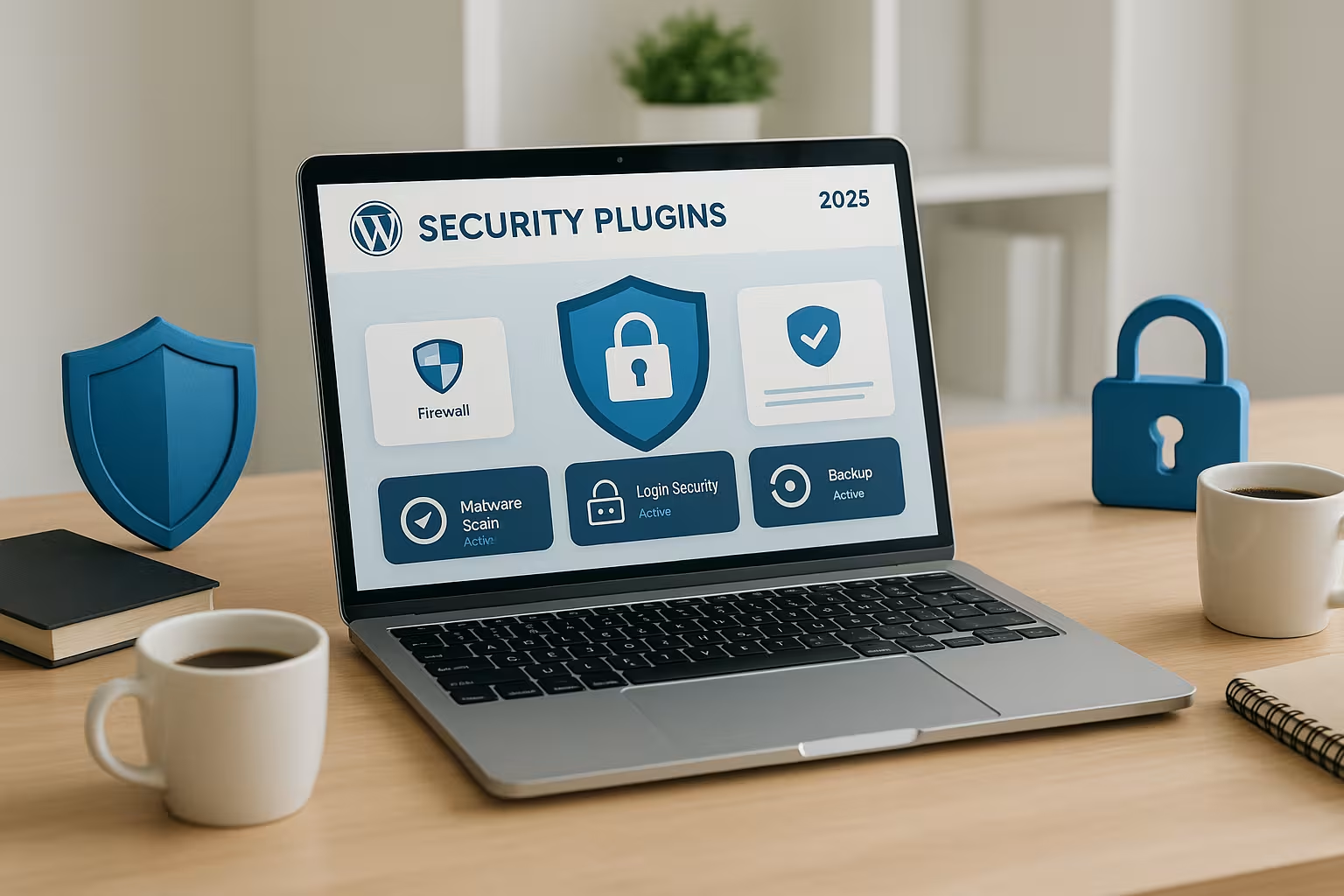
Jetpack Security combines automatic backups, brute force protection and malware detection with a user-friendly interface. If you already use the Jetpack Performance Booster, you can activate the entire security package by upgrading to the Security plan. Particularly useful: real-time backups and one-click recovery.
An anti-spam module is also integrated, which proves useful for comments, contact forms and registration pages, for example. Jetpack's overall package is aimed primarily at operators of small to medium-sized sites who do not want to configure various tools. An important part of this overall offer is that Jetpack provides its services via the Automattic infrastructure, which promises a stable and scalable solution. Jetpack hosting in combination with modern hardware is therefore also a solid option for rapidly growing sites.
Another feature is the uncomplicated analysis function for visitor statistics. If you are planning to use Jetpack as a small "all-inclusive" plugin anyway, you can control security, performance and analysis centrally and save yourself some time-consuming configurations from third-party providers.
Beginner-friendly and flexible: All In One WP Security
The plugin All In One WP Security offers numerous security functions on an easy-to-understand interface. Ideal for beginners, some of whom still work without in-depth technical knowledge. Login protection, password policies and firewall options can be easily set using checkboxes or sliders. Even without the premium version, the plugin has many setting options.
Optionally, the output depth can be adjusted according to user knowledge. If you want to go deeper, you can benefit from detailed reports and a graphical display of access figures. There is hardly any other plugin that enables beginners to secure their website so quickly. In particular, the integration of an additional protection layer for wp-admin and the login lockdown in the event of too many incorrect password entries make security management easier for beginners. If you take the time to read through the extensive instructions and explanations, you will also learn valuable best practices for WordPress security.

Extended security control with Solid Security
iThemes Security - 2025 known as "Solid Security" - is aimed particularly at teams and agencies. The integrated logging function makes it possible to record all activities in the admin area. This not only protects against malicious third parties, but also against unintentional changes within the team.
Two-factor authentication can be implemented via email, app or physical token. Also useful: the plugin provides simple recommendations for WordPress core and file permissions, which further reduces the digital attack surface. Agencies or larger companies with several editors can use the incoming logs to check exactly which changes were made when and by whom. This allows both accidental and malicious manipulation to be detected quickly. If necessary, you can temporarily block individual user accounts or refine the rights to restrict critical access.
Solid Security also attaches great importance to the principle of minimal rights. This means that each WordPress account only receives the access that is absolutely necessary for its work. If an employee leaves the team or a project setup changes, permissions can be reduced to the appropriate level with just a few clicks. This way, you always keep the potential attack surface as small as possible.

Hosting quality also determines security
A plugin is of little use if the Web server is configured insecurely. I therefore recommend professional hosting such as webhoster.de for strong WordPress defense mechanisms. WordPress installations there benefit from segmented servers, automatic malware checks and sensible backup configurations away from the web space.
The security team at webhoster.de constantly monitors the system for suspicious processes and intervenes proactively. In addition, the Plesk administration interface supports the simple implementation of directory rights and detailed access controls.
Bear in mind that high-quality hosting goes beyond simply offering storage space. Quality providers often rely on separate staging environments so that updates or new plugins can be tested first. This prevents a faulty update from immediately paralyzing your live website. Professional hosters also often react earlier to security gaps in the WordPress core itself and provide ready-made patches or offer managed solutions that install all updates regularly and automatically.
What you should look out for in every plugin
Regardless of the plugin name, certain functions are mandatory for every WordPress site in 2025:
- Two-factor authentication via app or e-mail
- Login protection against brute force attempts
- Firewall with signatures for zero-day attack detection
- Behavior-based Scanner for all file structures
- Alarm functions with e-mail or SMS notifications
Any security solution should also update itself regularly, be closely integrated with the WordPress architecture and offer a clear user interface - the simpler it is, the less susceptible it is to errors in day-to-day operation. Make sure that not only the firewall rules but also the malware signatures are updated with every security update.
It is also advisable to carry out a "security check" of your plugins at regular intervals: Are all extensions compatible with the current WordPress version and do they support the latest security standards? A plugin that is no longer maintained or only receives sporadic updates can be a major gateway for attacks. Therefore, always keep an eye on the dates of the updates and read the plugin's changelog in advance for major changes.
Additional safety tips for 2025
Even the best plugin is no substitute for well thought-out usage habits. Always use strong passwords or generated passphrases with strong special characters and random number sequences. A Password manager such as KeePass or Bitwarden makes this much easier. Also reduce the number of admin accounts to a minimum and only grant editor or author rights when necessary. Every additional person with administrator status increases the risk of an attacker exploiting the security vulnerability of a single person.
Keep plugins, themes and WordPress core up to date and only rely on official sources. Especially with premium themes, it can be tempting to download a cheap copy from dubious sources, but this often leads to you unknowingly introducing backdoors, spyware or malware.
Regularly back up your data outside your hosting server. For technical editors or developers, additional password protection at directory level is also recommended - for the wp-admin directory, for example. This can be done using a simple .htaccess configuration, for example: This means that intruders first have to overcome two protection mechanisms before they can even get to the login screen. And very important: sensitize your team against social engineering and phishing. One employee who is susceptible to phishing is often enough to bypass all protection hurdles.
Another aspect that will receive increasing attention in 2025 is the topic of Bot and spam defense. In addition to classic captchas, there are modern, invisible variants that detect automated spam comments or attacks on registration forms without visitors having to actively enter anything. Combined with IP block lists or honeypot functions, you can significantly reduce the amount of spam and relieve your server at the same time.
One last recommendation at the end of this section: Regular audits and log evaluations. Only if you know exactly which security events are taking place in your WordPress installation or on your hosting can you develop long-term strategies against attacks that occur. This will not only reduce the immediate danger, but also allow you to recognize potential patterns and trends in attack attempts.
Final recommendations: What works - and what I recommend
By 2025, individual protective measures will no longer be enough. WordPress Security Plugins such as Sucuri, Wordfence or Jetpack provide sustainable security - if they are configured correctly and maintained regularly. In combination with an analytical view of login activities, secure hosting and technical updates, this results in an effective protection system.
I myself most often use Wordfence on client sites because it is flexible, performant and very well documented. For agencies with multiple sites or budget requirements, Jetpack Backup or iThemes Security are highly recommended. The decision between free basic solutions and paid premium plans also depends heavily on your risk profile and the scope of your projects. If in doubt, it is advisable to start with a basic version, gain experience and upgrade if necessary.
In any case, you should not view your security strategy as a one-off process. Rather, it is a continuous cycle of monitoring, maintenance and optimization. This will ensure that your WordPress site remains reliable and secure in the future.