Skip to content
DNS Round Robin distributes requests across multiple IPs, but caching, client behavior and a lack of health checks limit the effectiveness of real load balancing. I clearly show where Round Robin fails, why failover fails and which alternatives provide reliable capacity control.
Key points
I will summarize the most important statements in advance so that you can quickly evaluate the limits and sensible fields of application. This list forms the guard rails for technical decisions and saves you failures in productive environments. I list the most common causes of uneven distribution and explain how you can mitigate them. I also show you when round robin is sufficient and when to use other methods. This will help you make an informed choice without experimenting in live traffic, which could cost you revenue or reputation because Load peaks remain uncontrolled.
- Caching distorts the rotation and routes many clients to the same IP.
- No failoverDefective hosts remain accessible until the end of the TTL.
- No metricsRound Robin knows neither CPU load nor latency.
- Client biasPriorities such as IPv6-first break the uniform distribution.
- Alternatives such as Load Balancer, GeoDNS and Anycast provide more targeted control.
How DNS Round Robin works in detail
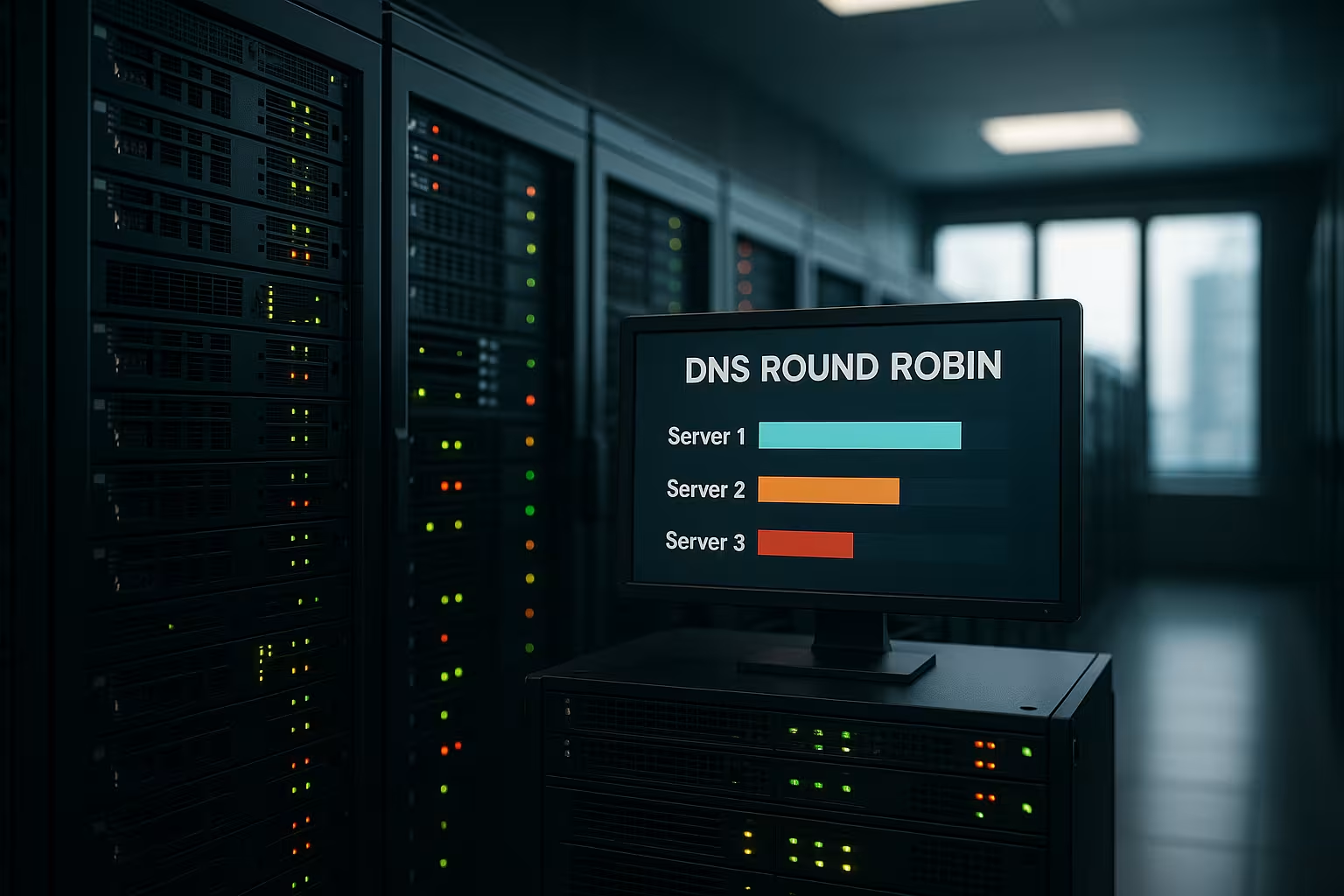
I assign a host to multiple A or AAAA records and let the Authoritative DNS rotate the IP order on responses, which seems to be a Equal distribution is generated. Many resolvers and clients traditionally access the first address in the list and move on to the next lookup. This method depends on a sufficient volume of requests, as the order is balanced out over time. In setups with three to six IPs, the effect can be solid as long as requests are widely distributed. However, the illusion is quickly shattered as soon as caching, transport preferences or connection reuse come into play, which can affect the Rotation slow down.
Why distribution often remains unfair
I regularly see in audits that a popular recursive resolver provides persistent responses to entire groups of users through caching, which overloads one IP for hours and others underchallenged. The set TTL determines the duration of this effect, and even short values do not prevent heavily used resolvers from permanently renewing the cache. Modern stacks also prefer protocols or addresses (e.g. IPv6-first), which undermines the round-robin order in the client. Browsers keep connections open and reuse them, which means that a single host receives a disproportionate number of requests. For technical background on the impact of resolver architectures and TTL, it is worth taking a look at DNS resolver and TTL, because their behavior has a greater influence on the actual load distribution than the planned Rotation.
No real failover: risks in the event of failures
I never consider Round Robin alone to be sufficient Reliability, as defective IPs are delivered until the TTL expiry. If one of six backends fails, roughly every sixth initial contact fails until the client retries itself or tries a different IP. Some applications then respond with error messages, while the page appears sporadically available to other users - a confusing picture. Health checks are missing natively, so traffic continues to flow to the faulty host, even if other servers were free. If you take availability seriously, you should either couple DNS with external health checks and dynamic updates or place an active Load balancer.

No load measurement: Round Robin sees no metrics
I cannot evaluate CPU utilization or response times with Round Robin, which is why overloaded servers continue to receive work even though there is free capacity. lie fallow. Algorithms such as Least Connections, Weighted RR or latency-based distribution are missing at DNS level. Even if I weight IPs, the TTL problem remains because resolvers cache the decision. At peak times, keep-alive and connection pooling further exacerbate the imbalance. If you want to control specifically according to performance criteria, you need mechanisms that read metrics and make decisions in real time. customize.
TTL strategies and DNS design that help
I set short TTLs (30-120 s) if I want to push DNS changes through faster, but accept more DNS load and potentially higher lookup times for Clients. I also separate pools: separate RR sets for static content, APIs or uploads so that individual workloads do not displace others. For planned maintenance, I remove hosts from the DNS early and wait at least one TTL before stopping services. Health check-based DNS providers can filter bad IPs from responses, but caches of external resolvers still delay propagation. All of this alleviates symptoms, but does not replace a stateful Traffic controller.
Client behavior and protocol priorities
I take into account that local stacks prioritize addresses via getaddrinfo() and often choose IPv6 over IPv4, which makes Round Robin silent. undermines. Happy Eyeballs accelerates connections, but also ensures systematic preferences depending on the implementation. Long TCP or HTTP/2 connections bind traffic to a host and distort the desired distribution. Mobile networks, captive portals and middleware change additional parameters that are often missing in laboratory tests. That's why I always check results across different resolvers, networks and clients before I make statements about the Load distribution meet.

When DNS Round Robin still makes sense
I like to use Round Robin when identical, static content runs across several equivalent servers and short disruptions can be tolerated. are. For incoming emails, where a second attempt is common, the method can smooth load without additional infrastructure. Internal services with controlled resolvers also benefit because I can better control caches, TTL and client behavior. Small test environments or non-critical landing pages can be distributed quickly until traffic or requirements grow. However, as soon as revenue, SLA or compliance are at stake, I plan a resilient Alternative in.
Alternatives: Load Balancer, Anycast and GeoDNS
I prefer solutions that read metrics, perform health checks and dynamically redirect traffic so that requests get the best possible experience. Resource achieve. Reverse proxies and Layer 4/7 load balancers support various algorithms, terminate TLS and filter by path if required. GeoDNS and Anycast shorten paths and stabilize latencies by allowing users to reach nearby locations. I explain the details of location-based routing in this comparison: Anycast vs GeoDNS. The following table helps to classify the procedures and shows strengths and weaknesses. Weaknesses:
| Procedure | Traffic control | Failure treatment | Distribution accuracy | Operating costs | Suitable for |
|---|---|---|---|---|---|
| DNS Round Robin | Rotation of the IP sequence | No health checks, TTL delay | Low to medium (cache bias) | Low | Small, tolerant workloads |
| Reverse proxy / software LB | Algorithms (RR, LeastConn, Latency) | Active health checks | High | Medium | Web, APIs, microservices |
| Hardware/cloud LB | Scalable policies + offloading | Integrated checks & auto-removal | Very high | Medium to high | Business-critical services |
| GeoDNS | Location-based routing | Restricted, TTL-bound | Medium | Medium | Regional distribution |
| Anycast | BGP-based to the next PoP | Cushioned on the network side | High (depending on network) | Medium | DNS, edge services, caches |

Practical guide: From RR to real load distribution
I start with an inventory: which services generate revenue, which SLOs apply and how are they distributed? Tips? Then I decide whether a layer 4 or layer 7 load balancer makes more sense and which algorithms fit the patterns. For the move, I plan blue/green or canary phases in which I route partial traffic via the new path. I set health checks, timeouts, retries and circuit breakers conservatively to avoid cascading errors. If you want to delve deeper into procedures, you can find a compact overview of common LB strategies, which I combine depending on the workload in order to Goals to meet.
Measurement and monitoring: Which key figures count
I don't just measure average values, but the distribution, such as p95/p99 latencies per backend, in order to be able to quickly identify any imbalances. recognize. I separate error rates by cause (DNS, TCP, TLS, app) so that I can fix bottlenecks in a targeted manner. The load per host, connection numbers and queue lengths show whether the algorithm is working or whether clients are hanging on individual IPs. Synthetic checks from different ASNs and countries reveal resolver and routing bias. I correlate logs with deployments and configuration changes, so that I can see the effect and impact. Side effects can be separated.

Configuration: BIND options and TTL examples
I activate the rotation of responses in BIND and test whether resolvers in my target group respect the order or use their own order. Preferences enforce. For services with maintenance windows, I choose 60-120 seconds TTL so that I can remove and add IPs quickly. Public zones with global traffic often get 300-600 seconds to limit DNS load without delaying changes forever. For internal tests, I set TTLs even shorter, but accept an increased lookup load on resolvers. It remains important: No matter what values I set, external caches and client stacks determine the real Effect.
Common misconceptions and countermeasures
I often hear that Round Robin guarantees fairness - this is not true under real conditions, because caches and clients dominate and addresses are prioritized. become. Equally common: „Short TTL solves everything.“ In truth, it mitigates effects, but large resolvers continuously refresh popular responses. Others believe that Round Robin replaces CDNs; in fact, edge caches, anycast and local peering are missing. Security arguments also fall short, as Round Robin does not protect against Layer 7 attacks or bot traffic. The most effective countermeasure is: plan measurably, control actively and only use Round Robin where tolerance and security are required. Risk fit together.
Weighted distribution via DNS: limits and workarounds
I am often asked whether I can assign „weights“ with Round Robin in order to load stronger servers more heavily. Purely via DNS, the possibilities remain limited. The common pattern of including an IP multiple times in the RR set only appears to create a weighting: some resolvers deduplicate responses, others cache a certain order for so long that the intended distribution is not achieved. blurred. Different TTLs per record also provide hardly controllable effects, because recursive resolvers often cache responses as a whole. Better workarounds are separate host names (e.g. api-a, api-b) with their own capacity planning or the reference (CNAME) to different pools, which I scale independently of each other. In controlled, internal environments, I can use DNS views or split horizons to provide different answers for each source network and thus manage the load; on the public Internet, however, this approach quickly leads to a lack of transparency and Debugging effort. Providers with health checks and „Weighted DNS“ help somewhat in practice, but remain TTL-bound and are more suitable for coarse control or gentle traffic shifts than for Real-time balancing. My conclusion: weighting via DNS is only a workaround - it only becomes reliable behind a load balancer that reads metrics and makes decisions dynamically. customizes.
Test methods: How to test Round Robin realistically
I never test round robin setups with just one local client, but across different networks and resolvers to make real distortions visible. Reproducible measurement windows (e.g. 30-60 minutes) and clean cache control are crucial. This is how I proceed:
- Vantage Points: Execute access in parallel from multiple ASNs, mobile and fixed networks, VPN locations and corporate resolvers.
- Resolver mix: Include popular public resolvers and ISP resolvers; capture differences in cache behavior and IPv6 preferences.
- Dual stack check: Measure IPv4/IPv6 hit rates per backend to detect IPv6-first bias.
- View sessions: Consider keep-alive/HTTP2 reuse and the effective request distribution per IP on server logs map.
- Inject errors: Selectively deactivate individual backends to see how high the error rate rises until TTL expiration and how quickly clients change.
- Measure distribution: Percentage hits per IP, p95/p99 latencies per backend and error classes (DNS/TCP/TLS/App) segment.
Important: Only hits on the server count, not just DNS responses. A supposedly fair DNS mix can be heavily skewed in HTTP requests if individual clients keep connections open for a long time or network paths are different. perform. Only the combination of DNS, transport and application data provides a reliable picture of the actual Load spreading.
Combined architectures: DNS as entry point, LB as control center
I like to combine DNS with load balancers to utilize the strengths of both worlds. A proven pattern: DNS delivers multiple VIPs from active load balancer instances (per region or AZ), while the LB level handles health checks, weighting and session handling. If a backend drops out, the LB immediately pulls it out of the pool, and the remaining traffic can be handled cleanly within the region. cushioned become. Even if DNS caches still deliver old VIPs, several healthy backends are accessible behind them - the TTL pain shrinks. For global setups, I mix GeoDNS (coarse location steering) with LBs per region (fine distribution): Users land geographically closer and are redistributed there based on latency, connections or utilization. In such architectures, I don't solve blue/green changes via DNS swaps, but via LB weights and targeted routes, because I can control them to the second and react immediately in the event of problems. turn back can. If DNS shifts are still necessary, I gradually increase the proportion (e.g. by adding identical entries for the new destination), monitor metrics closely and have a rollback option ready. This way, DNS remains the gateway, but the actual capacity control is where I can measure it precisely and quickly. Change can.

Error scenarios, retries and runbooks
I plan separately for typical faults: Single host failures, momentary network problems, certificate errors, full disks, but also partial failures (an AZ link unstable, CPU saturation only under peaks). DNS Round Robin reacts to all of this sluggish. That's why I rely on robust client timeouts (fast TCP connect timeouts, conservative read timeouts) and restrictive but effective retry rules: Only resend idempotent requests, include backoff, try alternative IPs early. On the server side, I avoid hard terminations; I prefer to respond with clear error codes (e.g. 503 with Retry-After) so that downstream systems are not blinded by the error. overload. I have runbooks ready for operation:
- Maintenance: Remove host from DNS, wait at least one TTL, drain connections, then stop service.
- Acute failure: Use LB or health check DNS immediately, remove incorrect IP from responses, telemetry (error rate/region) closely observe.
- Partial disturbance: Adjust weights in the LB or set limits to correct misalignments; leave DNA level unchanged.
- Rollback: Document clear steps to restore entries and LB weights within minutes, including communication to On-Call and Stakeholders.
Long-lived connections (WebSockets, HTTP/2) that send traffic to a host are particularly sensitive. shackle. Here I limit max-lifetime and plan connection recycling around deployments or switchovers. This reduces the chance of old, suboptimal paths dominating for hours.
Security and DDoS aspects
I do not believe that Round Robin offers any significant protection against attacks. On the contrary: without a central instance, I believe that rate limits, bot detection, WAF rules and TLS offloading are lacking in a controlled shift. Attackers can specifically „pin“ individual IPs and thus create hotspots, while other backends are hardly affected. Volumetric attacks also hit each origin directly - RR theoretically distributes, but individual paths are lost on the network side from. With active load balancers, on the other hand, I can activate limits, caches and scrubbing paths and detect anomalies per source more quickly. The authoritative DNS layer should also be protected: TTLs that are too short and high lookup rates drive up the query load; rate limiting, anycast DNS and robust name server capacities are mandatory so that DNS itself does not become a Single point of failure becomes. For attacks at application level (layer 7), I also need deep insight into paths, headers and sessions - something that is difficult to centralize without LB/WAF. enforce.
Summary in short form
I use DNS Round Robin as a simple scatter, but stay above limits with caching, client bias, missing measurement and pending Failover in the clear. For reliable distribution, I need health checks and metrics-driven decisions that enable a load balancer or location-based processes. Short TTLs, clean pools and tests across different resolvers help to reduce risks. Small setups benefit in the short term, but growing traffic requires active routing and observability. Those who take these points to heart will keep services available, reduce latencies and distribute costs more efficiently without relying on the deceptive Rotation to leave.