Skip to content
DNS Load Distribution and GeoDNS control requests so that users automatically reach the fastest and most available location. I organize routing rules, health checks and location data in such a way that outages are hardly noticeable and loading times are reduced worldwide.
Key points
I have summarized the following key points so that you can make the most important decisions for GeoDNS and global load balancing. I'll show you when round robin is enough, when dynamic rules apply and how location data accelerates access. I keep an eye on availability, costs and controllability. For real projects, I rely on metrics, health checks and low TTLs. This is how you secure Performance and reliability with increasing range.
- GeoDNS shortens distances: Users land at the nearest location.
- Dynamic Policies distribute according to load, latency and health.
- GSLB combines location, capacity and failover.
- Anycast accelerates DNS responses globally.
- Monitoring keeps rules correct in real time.

How DNS Load Distribution works
I answer every request with the optimal target IP instead of pointing rigidly to a single server. Round robin rotates across several A records and thus divides access evenly without checking the actual load. Weighted round robin deliberately gives stronger servers more shares. For real-time control, I use latency, open connections and availability so that „Least Connection“ or „Fastest Response“ take effect. In this way, sessions end up where capacity and response time match and Failures not attract attention.
GeoDNS: Location-based routing step by step
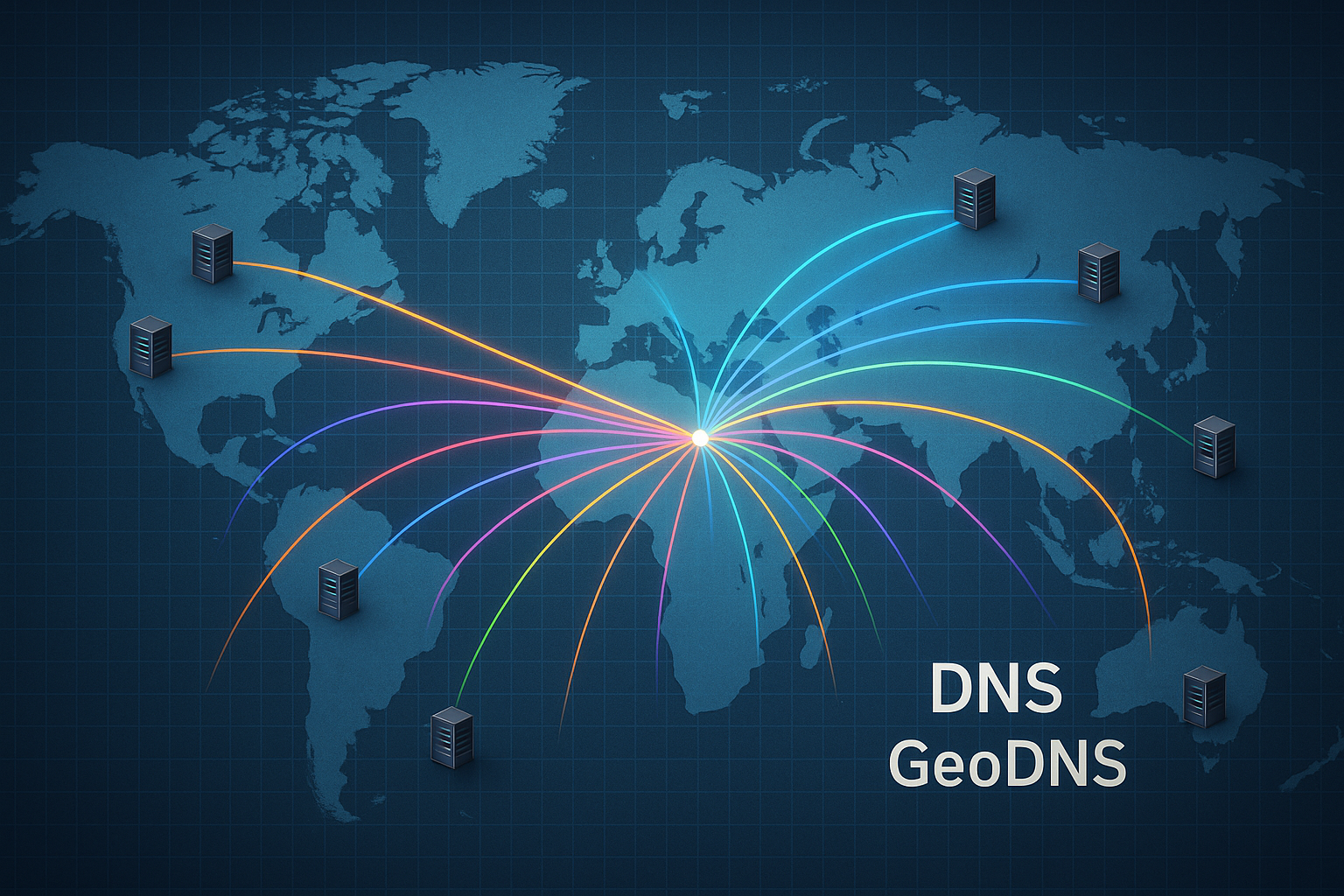
GeoDNS reads the source IP, assigns it to a Region and returns the IP of the nearest location. I refine rules down to countries, cities, data centers or ASN so that regional peaks are distributed cleanly. EDNS Client Subnet helps to make correct decisions, even though there are large resolvers in between. During maintenance, I redirect requests to other locations without disturbing users. For basics and differences, I use the comparison if required Anycast vs GeoDNS, to find the right global Routing to choose.

Algorithms in comparison: When which method fits
I select the algorithm according to Goalsimple distribution, strict latency, high availability or costs. Round robin is sufficient for homogeneous servers, while weighted variants map heterogeneous capacities. In the case of strong fluctuations, I rely on dynamic procedures that take health checks and response times into account. GeoDNS shows its strength with long distances and global user groups. The following table provides a quick overview so that decisions can be made clearly and Operation remains plannable.
| Procedure | Takes load into account | Latency advantage | Failover | Setup effort | Typical use |
|---|---|---|---|---|---|
| Round-Robin DNS | No | Low | Limited (TTL-dependent) | Low | Even base distribution |
| Weighted round robin | Indirect (weights) | Medium | Medium (for health checks) | Low to medium | Heterogeneous capacities |
| Least Connection / Fastest | Yes (dynamic) | High | High (with monitoring) | Medium | Dynamic workloads |
| GeoDNS | Optional | High (shorter distances) | High (regional) | Medium | Global users, CDNs |
| GSLB (Global) | Yes (multi-criteria) | Very high | Very high | Medium to high | Company-wide services |
If a simple distribution is not sufficient, I observe the Round-Robin borders and add mandatory health checks. Short TTLs speed up corrections, but cost more DNS queries. Anycast name servers shorten the path to the authoritative and stabilize Response times. For multi-cloud setups, I define location rules plus dynamic load parameters. This means that control remains consistent even with global rollouts transparent.
Share GSLB, Anycast and EDNS Client Subnet
I combine GSLB with Anycast, so that resolvers worldwide have short paths to the authoritative name servers. EDNS Client Subnet ensures that I make decisions closer to the actual user. If a site goes down, GSLB pulls alternative destinations while Anycast quickly provides the DNS response. For large e-commerce and streaming environments, this pays off in more consistent response times. This is how the Platform even during peaks, without sessions jumping.
Implementation: From A-Records to Health Checks
I start with several A-Records or CNAMEs per hostname and activate health checks on the authoritative DNS. For GeoDNS, I define rules by continent, country, city or ASN and assign suitable target IPs. Dynamic procedures require metrics: Latency, open connections, CPU and error rate. I use dig, nslookup and traceroute to check responses, TTLs and paths. Before the go-live, I simulate failures so that failover and fallback are possible in seconds. grab.
Best practices for performance and availability
I hold TTLs for dynamic targets low, so that caches can be corrected quickly. I update geolocation databases regularly to avoid incorrect assignments. I provide edge locations with identical builds so that routing decisions do not trigger functional differences. For sessions, I rely on horizontal splitting or tokens so that a change of location does not break sessions. I merge logging and metrics centrally so that I can identify hotspots and error paths. recognize.

Challenges: Load, VPNs and Public DNS
Pure round robin ignored Server load and thus creates imbalances with noticeable differences in performance. GeoDNS can make wrong decisions when users come via VPNs or remote public DNS resolvers. EDNS Client Subnet mitigates this, but needs clean integration and privacy compliance. For applications with session binding, I combine DNS rules with in-app mechanisms to keep users connected. An overview of how DNS vs Application Load Balancer helps to bridge the gap between name resolution and L7 control clear to draw.
DDoS resilience and security
I rely on distributed authoritative nameservers with Anycast, so that volumetric attacks do not bundle requests. Rate limits, response minimization and DNSSEC protect against amplification, cache poisoning and manipulation. For application attacks, I need additional layer 7 protection on the target systems. I recognize health checks as a potential attack vector and secure them using ACLs and tokens. This keeps the Accessibility well controllable even under load.
Monitoring, metrics and troubleshooting
I observe Response times, error rates, health check results and geo hit rates per region. Deviations indicate incorrect assignments, routing drift or overload. With active probes from several continents, I recognize DNS propagation and cache effects. I correlate logs with deployments so that config errors become visible quickly. If necessary, I temporarily lower TTLs and rotate defective targets out of the set until causes can be identified. fixed are.
Realistically plan TTL strategies and caching
I differentiate TTLs according to risk and change frequency: For dynamic endpoints, I keep TTLs in the seconds to low minutes range, while static records (MX, SPF, NS) are allowed to live longer. I deliberately set negative caching (SOA-minimum, NXDOMAIN-TTL) so that misconfigurations don't get stuck for minutes. I lower TTLs for releases in advance in stages (e.g. 300 → 60 s), roll out changes and then increase again to reduce costs. Large enterprise resolvers sometimes respect upper bounds; I plan for buffering and verify with measuring points outside my own network. I shorten CNAME chains so that resolvers have to cache fewer intermediate results and latencies remain stable.
DNS design: Apex, CNAME/ALIAS, IPv6 and modern records
At the zone apex, instead of CNAME I use a ALIAS/ANAME (provider feature) so that I can use flexible destinations without breaking DNS standards. Dual stack is set: I publish A and AAAA consistently and test happy eyeballs behavior so that IPv6 routes are not unnoticeably worse. For services with multiple alternatives, I check HTTPS/SVCB-records to announce transport parameters (e.g. ALPN) at DNS level. I limit record chains (CNAME → CNAME) to a minimum and pay attention to identical TTLs so that failover does not fail due to inconsistent caches.
Split horizon, internal zones and VPN
I separate internal and external responses by Split-Horizon DNSEmployees in the company network see private IPs and shorter routes, external users receive global endpoints. For VPN use, I use internal resolvers with policy-based routing and mark them clearly so that GeoDNS does not serve the „wrong“ regions. Where data protection requires it, I deactivate EDNS client subnets for sensitive zones or reduce the prefix length to avoid drawing conclusions about individuals.
Automation, GitOps and IaC for GSLB
I version zones, geo-rules and health checks as Infrastructure as Code (e.g. Terraform/DSL) and deploy them via GitOps pipelines. Changes go through staging zones and pre-checks (syntax, signatures, dry run) before they become active worldwide. For risky changes I use Progressive traffic shiftingFirst 5 %, then 25 %, then 100 %, controlled by weights. Rollbacks are also automated; a „kill switch“ per location immediately turns targets out of the set if health signals tilt.

Rollout, test and chaos strategies
I am planning GameDays The solution includes: selectively switching off locations, artificially increasing latency, throttling health endpoints - and measuring how cleanly failover works. Synthetic checks from several providers validate geo hit rates and region allocation. I practise fallback paths (rollback, TTL reduction, weight shift), document them as runbooks and link them to alarms. This makes incident response reproducible and time-efficient.
Cost and capacity control
I balance TTLs against DNS query costs: Short TTLs increase volume but save expensive downtime minutes. I evaluate health checks according to frequency and number of destinations; a global 10-second interval scales costs up. For multi-cloud setups, I take egress fees into account and steer traffic cost-consciously to regions with favorable outflow - as long as latency and availability SLOs are adhered to. I simulate peak scenarios to quantify capacity limits (CPU, connections, bandwidth) per location and pre-emptively adjust weights.
Protocol details, packet sizes and reliability
I set EDNS0 buffer sizes conservatively (e.g. 1232 bytes) to avoid IP fragmentation and enable Response minimization, so that only necessary data is sent. When responses grow through DNSSEC or ECS, I test UDP-→-TCP fallback and keep nameservers sized to mitigate TCP load. I note that some resolvers round or „cap-en“ TTLs and plan resiliency accordingly. For regions with restrictive network paths, I keep additional anycast nodes ready to avoid timeouts under load.
Data locality, compliance and governance
I implement Regional policies, respect data residency: Users from certain countries only land on sites with approved data flows. I link GeoDNS rules with application rules (feature flags, configuration) to ensure compliance with legal requirements. Changes to geo mappings are subject to approval (dual control principle) and are logged in an audit-proof manner.
Multi-cloud, multi-CDN and layer 7 interaction
I combine GeoDNS with Application Load Balancers per location: DNS decides globally, L7 optimizes locally (WAF, TLS offload, sticky policies). For multi-CDN, I split traffic per region according to performance SLOs and costs, measure real user metrics (RUM) and adjust weights automatically. Session stability on the application side: tokens instead of server-local sessions, asynchronous replication, localized write paths to avoid latency peaks for global writes.
Outlook: Edge, 5G and AI-controlled control
I expect more locations on the Edge, lower latency and more frequent routing adjustments. 5G and regional peering improvements further shorten routes. AI models help to predict peak loads and adjust weights with foresight. DNS remains the fast steering wheel for the first decision before L7 components fine-tune. If you set up GeoDNS and GSLB properly now, you can scale with less effort tomorrow more.

Briefly summarized
I use DNS Load Distribution as a global control layer that makes quick decisions and allocates locations intelligently. GeoDNS shortens routes, GSLB ensures availability, and dynamic rules distribute load according to real metrics. Those who start Round-Robin promptly add health checks, short TTLs and location rules. Anycast strengthens name resolution, while EDNS Client brings subnet decisions closer to the user. With monitoring, clear failover plans and clean testing, the platform remains stable even during peaks. responsive.