Skip to content
Hosting for agencies places special demands on technology, security and support. Digital projects can only be implemented efficiently and stably with high-performance, well-secured hosting.
Key points
- Security through firewalls, DDoS protection and SSL certificates
- Performance via high-performance servers and SSDs
- Scaling options for changing project sizes
- Customer Service with immediate support for technical questions
- Management interface with simple operability

Security: protection for agency projects and customer data
Any Agency processes data from customers, partners or projects. This information must remain secure. Hosting solutions for agencies should therefore Multi-level security functions offer. This includes protection mechanisms such as automatic backups, two-factor authentication and up-to-date server patches.
SSL certificates are standard. Many providers integrate them into their packages free of charge. Firewalls, malware scanners and daily security audits ensure a stable hosting foundation.
Hosting with strong DDoS protection prevents outages in the event of attacks. A data center with certified ISO certification also increases confidence in the infrastructure.
In addition, compliance with certain data protection guidelines is often essential in the day-to-day work of an agency. Particularly in the case of projects for larger companies and public institutions, customers often demand complete proof of GDPR compliance. Clear documentation of security standards and a transparent data protection concept on the part of the hoster are therefore a big plus. I also make sure that the provider offers a solid backup and recovery strategy. It is important to know how quickly data can be restored if something does go wrong. This allows me to react quickly in the event of a crisis and offer my customers professional solutions.
Another aspect of security concerns access rights and user management. Especially if several developers or project managers access the same server, the hosting system should enable finely granulated roles and authorization levels. In this way, sensitive areas remain protected and access logs can be tracked.
High-performance infrastructure: speed and accessibility
Visitors expect lightning-fast loading times. Google rates the Performance also as a ranking factor. A server stack should therefore use modern technologies such as PHP 8+, HTTP/3 and SSD hard disks.
If I run my customer projects on hosting with a content delivery network (CDN), this reduces the loading time worldwide. Caching mechanisms such as Varnish or Redis also improve front-end performance.
Uptime guarantees of 99.9 % or higher are essential. The hoster must also work reliably with high traffic, for example during campaign launches or launches.
Many agencies experience peak loads for certain campaigns or seasonal activities. In order to absorb such peak loads, a stable network connection is important in addition to scalable resource distribution. Many hosters rely on redundant connections that ensure a constant connection even if individual lines fail. The choice of data center location can also have a direct impact on performance. A strategically favorable location enables faster loading times for the target group, which has a positive effect on the user experience.
For particularly complex projects that rely on microservices structures, for example, it is worth looking at hosting offers with container virtualization (e.g. Docker) or Kubernetes. Such solutions allow for a modular and high-performance infrastructure. This makes it easier for agencies to update or scale individual applications as required without affecting the entire system.

Scalability: Flexible resource requirements
Anyone who manages web projects for several customers needs a hosting tariff that grows with them. I opt for a provider whose Tariffs can be easily extended are - without migration effort.
Managed cloud solutions or scalable vServers are ideal. Providers with automatic resource allocation prevent performance problems during traffic peaks. Campaigns remain available at all times.
It should be possible to upgrade directly in the customer interface. Some hosters even offer resources that can be scaled by the hour, such as RAM or CPU.
In agency structures in particular, projects are often only active for a few weeks or months and then - after completion - generate significantly less traffic. This is where a flexible tariff structure pays off, where I can deactivate or cancel resources just as easily as I added them. This saves me unnecessary expenditure in months with low utilization.
Scalability is also important when it comes to teamwork. If a larger development team is added at short notice or several projects go online at the same time, the hosting should be able to quickly provide additional databases, domains and subdomains. This aspect of scaling often also includes managed services: Those who don't have the time or internal resources for server maintenance benefit from offers that take care of monitoring and updating fully automatically. I only have to define the scope, everything else runs in the background.
Reliable customer service around the clock
Technical problems can occur at any time. It's good if the provider offers 24/7 support via chat or telephone. I pay attention to hosting providers with reactive customer service and know-how with CMS such as WordPress or TYPO3.
A direct line to support saves me time. Knowledge databases, forums and video tutorials are particularly helpful. Some providers also offer managed services such as updates or security scans.
A central point of contact for emergencies creates trust and increases operational reliability for agency customers.
In order for service issues to be resolved quickly, the expertise of the support team is crucial in addition to pure availability. It is of little use to me if I have someone on the phone but they cannot understand specific script errors or CMS problems. That's why I not only look at official awards, but also at customer reviews. Testimonials provide information on how support staff react in practical cases and how comprehensive their knowledge of web development, databases or server-side configuration is.
For their part, many agencies take over customer service. This makes reliable communication with the hoster all the more important. If I can rely on my questions being answered quickly and thoroughly, I can pass this information on to my own customers. This increases my professionalism and enables faster project progress.

Technical requirements: These key figures are decisive
I start by analyzing my most important projects: Do I need more memory or heavy CPU utilization? Do I use databases with many simultaneous read accesses? Depending on the result, the Technical requirements to the hosting.
Particularly important are current versions of MySQLMariaDB or PHP. SSH access or Git integration are also helpful for agencies - especially for agile development.
Some providers offer special environments for developers, including staging solutions and automated deployments.
In addition, agencies that manage several domains for different customers should pay attention to structured domain management. Some hosters offer a central dashboard where I can manage all domains, subdomains and DNS settings. This speeds up the work considerably and prevents chaos in communication with the registrar.
The type of project work also plays a role: a shared hosting package is often sufficient for classic websites for small companies. However, if modern web applications with high database query requirements are used, a vServer or dedicated server may be the better choice. I specifically compare the expected traffic, the size of the user community and the intensity of the computing tasks.
For agencies that work intensively on development workflows, it is worth integrating systems with Continuous Integration (CI) or Continuous Deployment (CD). This allows code to be tested automatically and published seamlessly. This reduces errors and stabilizes the project because changes can be tested and rolled out more quickly.
Hosting provider comparison - overview of services
Below I will show you a short comparison table of common providers. The focus here is on criteria such as value for money, support and features.
| Provider | Strengths | Price from | Ideal for |
|---|---|---|---|
| webhoster.de AG | Support & flexibility | 9,90 € | Agencies with customer projects |
| Hostinger | High speed | 2,99 € | Budget-oriented agencies |
| IONOS | Scalable tariffs | 1,00 € | Small and medium-sized enterprises |
| SiteGround | Easy handling | 3,99 € | Agency newcomers |
You can also find a more in-depth comparison in the current hosting comparison 2025.
The cost structure of these hosters is just as important as their scope of services. I check with each provider to see how transparent the prices for upgrades, additional databases or extra domains are. Certain costs are often hidden in small footnotes. I should also consider whether certain features are already included in the packages or whether I need to book them separately. The overall package ultimately determines whether the price-performance ratio is right.
If I plan to host many projects at the same time, I should also note that some providers have a limit on the number of hosted websites per package. This can quickly become a bottleneck and may require an upgrade to a significantly more expensive package. A detailed comparison helps to save costs here in the long term and to decide on a provider that can also cover my needs in the future.

You should clarify these questions before making a decision
I ask myself three key questions before choosing my hoster: What functions do I need on a daily basis? How quickly can resources be expanded? And how competent is the support team real?
Some projects require separate hosting solutions. It is therefore advisable to detailed hosting analysis to be carried out. This provides information about load distribution, access numbers and necessary software compatibility.
Anyone using web apps, internal tools or multisite systems should also ensure that they are Docker- or Kubernetes-ready.
I also wonder how email hosting is integrated into the overall solution. Many customers also entrust their email services to agencies, so I want to make sure that spam filters, virus protection and sufficient storage space for mailboxes are available. With some hosters this can be easily bundled, with others a separate email service may be cheaper or more efficient. A central interface for managing all customer email addresses can save a lot of time and prevent misconfigurations.
For agencies that want to continue to grow in the long term, it can also make sense to look into white label or reseller offers. This allows hosting packages to be resold in your own name without having to maintain the technical infrastructure yourself. This allows me to maintain my own branding while the actual hosting provider remains in the background. This model can create additional sources of income, especially when working with freelancers or partner agencies.
Simple administration at the web host
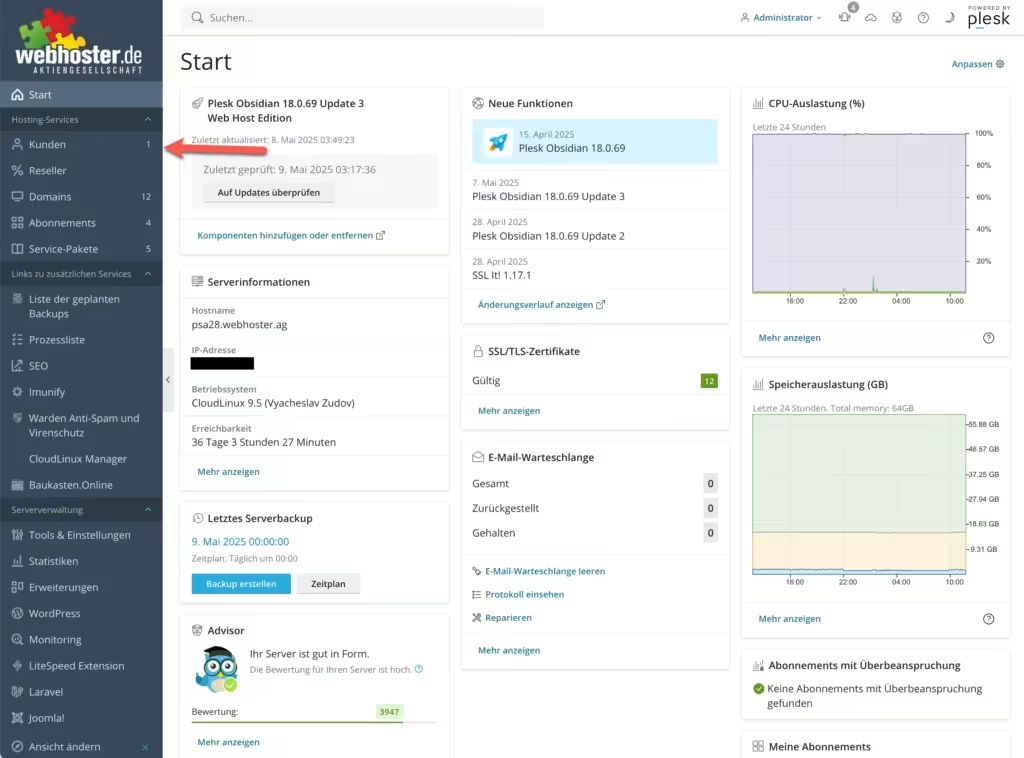
Of course, an easy-to-use administration interface is important. This is where the webhoster.de AG clearly stands out. In this view of a managed server for agencies, you can create your own customers and create separate web hosting accounts - so-called subscriptions. Each customer can then log into the administration interface independently and, for example, install WordPress or create email addresses.
Top hosting solutions for professional requirements
Premium hosting packages offer technical features that go far beyond standard web space. Some providers supply dedicated RAM, private caching solutions or dedicated IP addresses. These features can be crucial for agencies that serve a large number of customers.
I recommend choosing hosting solutions that explicitly to business requirements are coordinated. Availability and quality play an essential role, especially in the corporate environment.
Contract duration, term costs and migration tools should also be checked in order to remain flexible.
Some premium hosters also offer extended options for data security and access controls to protect sensitive customer data from unauthorized access. For agencies that also implement complex e-commerce projects, high-performance database servers and PCI DSS compliance (important for credit card payments) are a must. Magento, Shopware and WooCommerce stores in particular benefit from a stable and optimized environment.
Many providers now rely on container orchestration, which enables an even finer distribution of system resources. This allows me to use dedicated containers for databases, front-end servers or Redis caching, for example. This flexibility speeds up development processes and makes maintenance easier. Even if such hosting packages are more expensive, they save resources in larger projects and reduce downtime.
Before I make a final decision, I should also compare the different service level agreements (SLAs). These define, for example, guaranteed response times in the event of faults, the scope of backups or recovery obligations on the part of the hoster. A comprehensive SLA can be decisive when working with critical end customers and underlines the professionalism of the hoster.

Conclusion: My conclusion after more than 10 years of project experience
Good hosting for agencies saves money in the long term because it reduces downtime and supports workflows. Security, performance and a Reliable support are indispensable building blocks.
I recommend regularly questioning whether the current hosting is still suitable for your day-to-day work - especially in the case of new projects, technical developments or increasing requirements. It is worth checking offers annually.
The better the foundation, the more efficiently digital services can be delivered. Hosting is not a detail - it is crucial for speed, trust and growth.
In recent years, I have learned that the best hosting doesn't always have to be the cheapest, but in the end it saves me a lot of time and hassle if problems are solved quickly and development processes run smoothly. Especially in the day-to-day running of an agency, the quality of the hosting often determines how relaxed or hectic a project is in the end. Solid backups, structured deployment and competent contact persons contribute significantly to my customers' satisfaction. In the end, it's not just my agency that benefits from a smart choice of hosting, but also my entire customer base.