Skip to content
In hosting, outbound reputation determines whether emails from my infrastructure land reliably in the inbox or fail at gateways. I show you how I Monitoring, smtp blacklist monitoring and technical authentication in such a way that the delivery rate remains stable and risks are detected early.
Key points
- Reputation actively measure outgoing IPs and domains and evaluate trends
- Blacklist checks Automate and resolve incidents in a structured manner
- SPF/DKIM/DMARC consistently implement and evaluate
- Traffic segmentation Introduce according to type, volume and risk
- Feedback loops and metrics for quick corrections

What does outbound reputation mean in hosting?
By outbound reputation, I mean the reputation of each sending IP and domain, which is generated via complaint rates, bounces, spam traps and technical signals. This reputation determines whether recipient servers accept, throttle or block emails immediately, so I measure it continuously and intervene quickly. For beginners, this means that every mail influences the score, every misconfiguration increases it Risks. For teams with high mail volumes, a clean separation of system mails, transactional mails and marketing pays off significantly. Those who delve deeper into E-mail infrastructures avoids typical stumbling blocks with IP and domain setups.
How reputation checks work
Receivers do not evaluate a single key figure, but many signals that together shape the picture of the sending systems. I therefore not only check blacklists, but also look at error rates, TLS rates, delays and DMARC reports over time. Large providers classify IPs in levels, and even small outliers can worsen the classification. I keep my MTA logs clean so that I can immediately recognize and correct patterns such as sudden hard bounce spikes. This allows me to actively control before a Damage arises and the deliverability tips over.

Blacklist monitoring as an early warning system
smtp blacklist monitoring provides me with the fastest signal when an IP or domain has become conspicuous. I automatically check common RBLs and immediately trigger a playbook that identifies the source, volume and affected parties. Shared environments tend to have chain effects, which is why I analyze senders cleanly and equalize sending streams before more customers suffer. If you want to understand why IPs suffer together, you can find out more about common blacklists often caused by shared resources or unclean sender data. In this way, I reduce backlogs, keep escalation times short and secure the Delivery.
Set up technical authentication correctly
I use SPF with clear include chains, DKIM with strong keys and DMARC with step-by-step policy escalation. I also check PTR records, consistent HELOs, TLS enforcement and a clean EHLO identity per sending IP. I look at DMARC alignment on a daily basis because it prevents many false positives and stops abuse. MTA-STS and TLS reports help me with delivery issues to hosters with strict TLS requirements. These building blocks strengthen the Credibility of every single mail and stabilize the outbound reputation.
Consciously control IPv6 and dual stack
I operate shipping dual-stack, but I separate IPv4 and IPv6 in pools with their own telemetry. For each IPv6 address, there are clean AAAA/PTR records, a suitable HELO and a certificate with a suitable SAN. Since some providers evaluate IPv6 more conservatively, I slow down the warm-up there and keep separate rate limits per protocol. If I see asymmetric assumptions (e.g. IPv4 ok, IPv6 throttled), I temporarily prefer to route via the stable side without jeopardizing the overall authenticity.
Forwarding, ARC and backscatter protection
When forwarding, SPF and therefore DMARC break quickly. I therefore sign outgoing redirects with ARC, to keep the original authentication verifiable for downstream servers. For classic aliases, I secure return paths via SRS so that SPF does not fail at the target. Against Backscatter I set strict zero-sender rules for DSNs, reject undeliverable recipients as early as the RCPT phase and avoid generated NDRs to forged senders. This keeps my reputation clean, even though I allow legitimate forwarding.

Signal metrics that I check daily
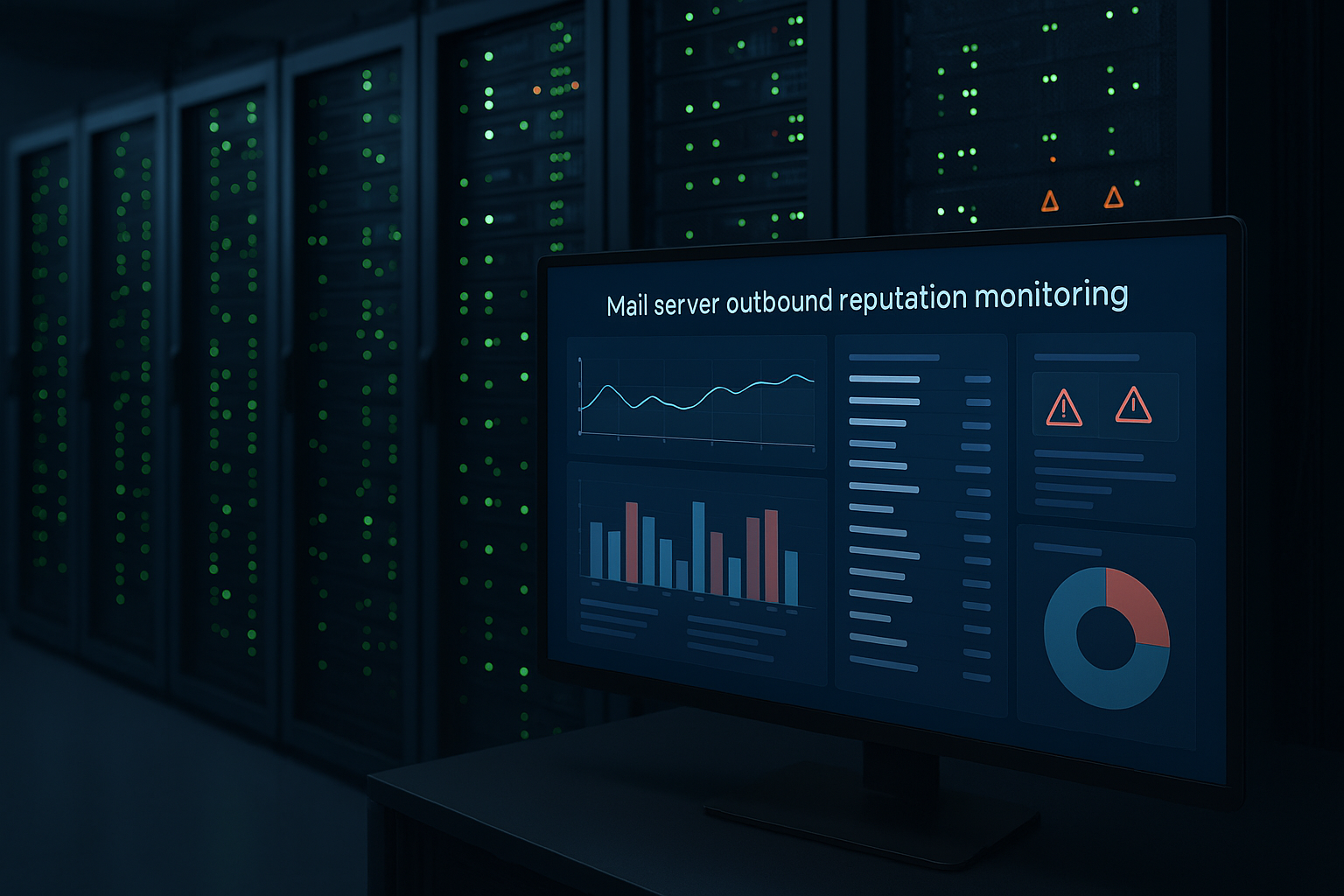
I manage outbound reputation in a data-driven way and work with fixed threshold values that I evaluate and adjust over time. To do this, I consolidate logs, feedback loops and DMARC reports in a dashboard that highlights anomalies in color. This allows me to recognize early on whether an IP is throttling, a pool is tipping or a domain is deviating. The following overview shows typical signals, sample values and my reactions in monitoring. This look at hard Facts prevents blind spots.
| Signal | Example value | Monitoring action |
|---|---|---|
| Hard bounce rate | > 5 % in 1 h | List check, temp stop, isolate source |
| Complaint rate | > 0.2 % per day | Check sender, adjust content, confirm opt-in |
| Spam trap hit | ≥ 1 in 24 h | Lock segment, clean up source, scan history |
| Unknown user rate | > 1 % in campaign | Hygiene check, tighten syntax filter |
| RBL entry | Hits on SBL/XBL | Start incident playbook, apply for delisting |
| DMARC-Fail | > 0.5 % | Check alignment, adapt 3rd party transmitters |
| Queue latency | > 300 s Median | Detect throttling, adjust rate limits |
| TLS error rate | > 0.3 % | Check cipher/protocols, renew certificates |
Data sources and dashboard architecture
I feed logs from MTA, SMTP proxies, spam filters, auth systems and DNS into a central pipeline. Uniform Correlation via message IDs and connection IDs turns scattered events into a traceable dispatch chain. I normalize bounce codes (enhanced status codes), map provider-specific error texts to uniform classes and visualize acceptance rates for each target domain. Alerting is level-based: Warning for trend breaks, incident for threshold values and pager for RBL hits or heavy queue build-up.
I evaluate DMARC-RUA daily, aggregating by sender domain, from subdomain and source IP. I use RUF selectively to pinpoint misconfigurations without collecting too many personal details. I set up retention in such a way that I can recognize seasonal patterns, but do not retain sensitive data for an unnecessarily long time.
Provider-specific audit trails and seed tests
I hold test mailboxes and Seed lists with large providers to independently measure inbox placement, time to delivery and spam folder rates. I also monitor server-side reactions: Greylisting cycles, TARPIT behavior and connection resets. A realistic picture emerges from this combination: High acceptance rates are good, but if seeds increasingly end up in spam, content or engagement quality is often lacking. I then adjust sending windows, subject lines, frequencies or sender names and measure the impact in the next run.

Traffic segmentation and IP strategy
I clearly separate dispatch types: system messages, transactional emails and marketing run via separate IP pools and often via their own subdomains. This keeps the score for critical notifications clean, even if a campaign fails. For high volumes, I use dedicated IPs, warm them up gradually and keep volume profiles stable. I coordinate reverse DNS, HELO names and certificates per pool so that each signal appears consistent. This order reduces side effects and strengthens the Control over any current.
Warm-up and volume planning in detail
I run new IPs and domains with clear Warm-up plansStart with small, highly engaged segments, increase daily in defined stages, never jump abruptly. I deliberately vary content (not just password resets) so that providers see a realistic usage profile. During the warm-up, I increase observation density: finer metrics intervals, tougher abort criteria and immediate pauses for bounces/complaints. I roll back tilted steps instead of chasing a bad score.
For foreseeable load peaks (e.g. quarter mails), I smooth curves via Lead time, I distribute volumes across time zones and match senders to time windows in which experience has shown providers to be more generous. This keeps the recipients' learning curve stable and I avoid hard throttling.
Rate limits and flow control
I control sending rates at host, subnet and domain level so that recipients do not see any load peaks. Adaptive limits react to soft bounces and greylisting without stopping campaigns completely. I use back-off strategies that relieve MTA queues and protect the score. At the same time, I report clear limits to the sender so that they can plan their volume. This keeps the Throughput-curve smooth and the outbound reputation stable.
Capacity planning and reliability
I plan MTA capacity with buffers, separate spools per pool and isolated worker queues. Outbound relays are distributed redundantly across zones; DNS TTLs are selected so that failover takes effect quickly without becoming flat. I regularly test Degradation modeslimited bandwidth, individual IPs offline, TLS constraints on the recipient side. An important key figure is the maximum secure sending rate per pool under real conditions, not just in the lab.
For maintenance, I define drain phases in which queues run in an orderly fashion before systems go offline. I log changes (change logs) and roll them back quickly in the event of negative effects. This keeps infrastructure changes transparent and low-risk for deliverability.
Security and misuse protection
A major lever for reputation is the Avoidance of compromised accounts. I set strict auth policies, MFA for admin and API access, limit allowed envelope senders per customer and block risky patterns (e.g. sudden bulk senders, unusual countries, conspicuous subject series). Heuristics for output spam recognize bulk similarities, unusual link densities and sudden error code shifts. If a heuristic hits, a soft stop takes effect and the customer receives clear findings data for the clean-up.
Outbound virus and phishing scans run inline with fail-open thresholds for emergencies, but fail-closed for known malicious indicators. I secure API endpoints against misuse, limit token rights, rotate keys and log granularly. This prevents individual incidents from spreading to entire IP pools.
Error analysis and incident playbook
If an AVL hit occurs, I work through a fixed playbook: clarify the scope, identify the source, stop shipping, rectify the cause, collect evidence, initiate delisting. I document every step so that follow-up cases run faster and training courses remain tangible. It is important to separate technical causes such as auth failures from content-related problems such as misleading subject lines. I then start a controlled restart with close monitoring. This structured Procedure reduces downtime and protects the score from consequential damage.
Change management and pre-flight checks
Before new domains, IPs or routing changes, I run Pre-flight checksDNS consistency (SPF, DKIM, DMARC, PTR), TLS chain, HELO/reverse DNS match, test mails to standard providers, DMARC evaluation after 24/48/72 h. I pack changes into small packages, first activate a Canary-pool and only roll out more broadly for stable metrics. For high-load phases, there are freeze windows without non-critical changes.

Using feedback loops and postmaster data
I register sending domains and IPs with large providers and evaluate the return channels on a daily basis. Complaint events are immediately incorporated into blocks, list hygiene and sender training. About Feedback loops I recognize trends before they trigger blacklists. DMARC-RUA/RUF reports also show me spoofing attempts, which I curb with strict policies. This is how I keep the Return channel active and make decisions based on real user reactions.
List hygiene and contents
I demand clean opt-ins (preferably double opt-in), clear unsubscribe links and respect suppression lists system-wide. Bounces are categorized: Hard bounces end up on the block list immediately, soft bounces receive defined repetition windows. I clean up inactive recipients via re-engagement routes with limited attempts, after which they are muted. This reduces complaints and the engagement signals remain positive.
I check content for clarity, expectation management and consistency of sender name, subject and preheader. I keep tracking to a minimum and minimize link redirects. Optionally, I use sender branding (e.g. BIMI) as soon as DMARC is set to quarantine/reject and the other fundamentals are right. Quality before quantity - this has a direct impact on reputation.
Roles: Host, domain owner, service provider
As the host, I provide the clean infrastructure and ensure policies, monitoring and response times. Domain owners are responsible for clean opt-ins, clear unsubscribe options and consistent sender data. External shipping services must be correctly integrated into SPF/DKIM/DMARC and respect their own limits. If a customer goes off track, I intervene, restrict shipping and clarify the cause transparently. This clear Distribution of roles prevents disputes and protects the deliverability of all parties involved.
Transparent customer communication
I communicate status, key figures and incidents openly and provide actionable steps, not empty phrases. Dashboards with plain-text instructions help to rectify errors quickly and avoid future risks. I explain the effect of SPF/DKIM/DMARC without buzzwords and show how small changes can have a big impact. Customers receive tips on list maintenance, mailing frequency and subject lines that reduce complaints. How to grow Trust, and the outbound reputation increases predictably.

Briefly summarized
I ensure deliverability by making outbound reputation measurable, automating smtp blacklist monitoring and seamlessly implementing technical authentication. Segmented IP pools, clear limits and structured playbooks keep incidents to a minimum and prevent consequential damage. A strong setup is based on data, fast reactions and clear communication with senders. With consistent processes, the email infrastructure remains resilient, even if loads fluctuate or individual campaigns break out. Those who apply these principles protect their score, strengthen the Deliverability and saves support costs over time.