Skip to content
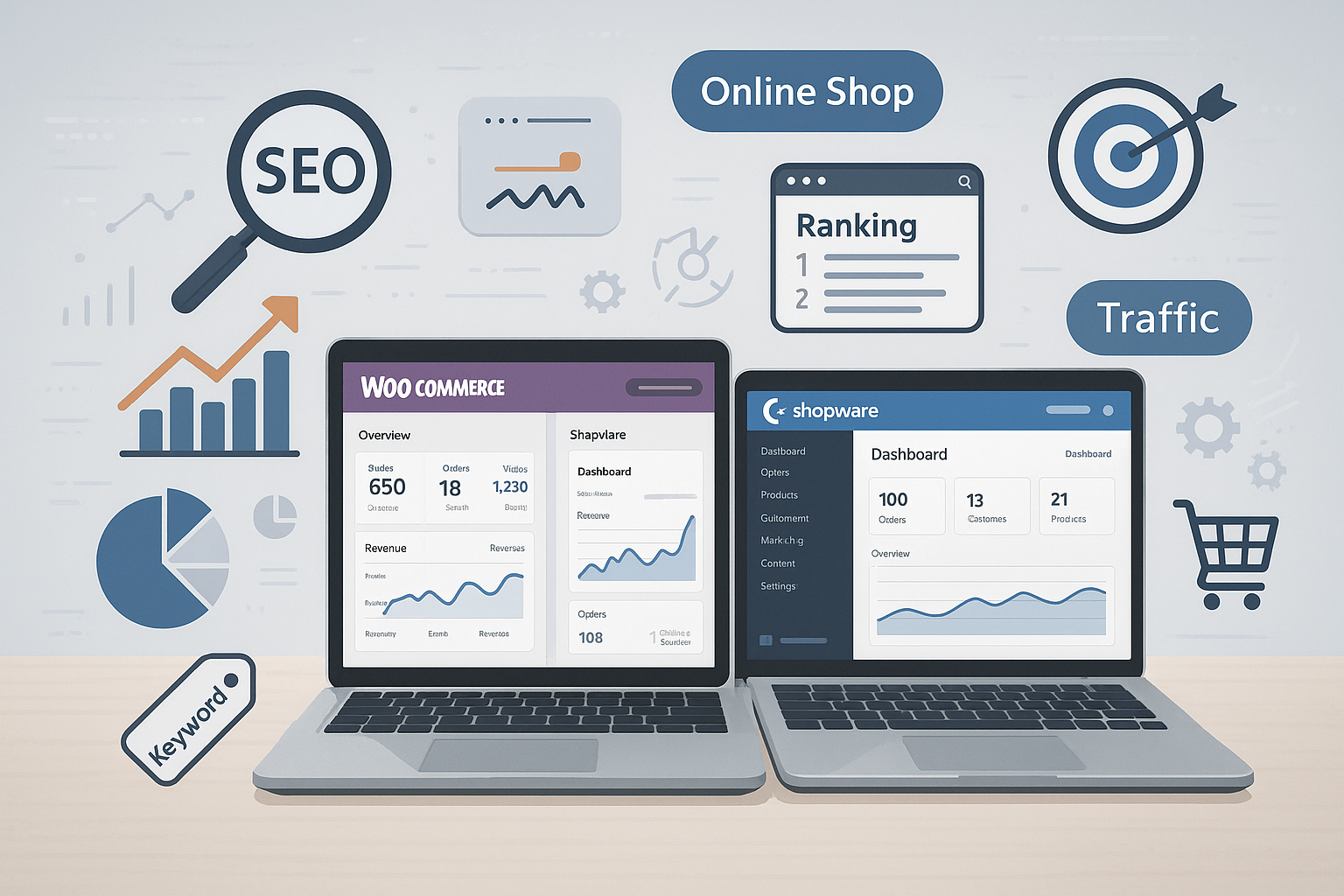
I'll show you how seo for online stores in WooCommerce and Shopware - from technology and content to evaluation. With clear measures, you can align URLs, metadata, structured data and loading times to increase visibility and generate more sales can.
Key points
- Performance prioritize: fast servers, caching, image compression.
- Structure clarify: clean URLs, internal linking, breadcrumbs.
- Content in-depth: product texts, category stories, guides.
- Data enrich: schema.org, reviews, FAQ snippets.
- Monitoring establish: Rankings, conversions, error reports.

Why SEO counts in the store
Product searches often start with Google, and a large proportion of e-commerce traffic comes directly from the Search. I make sure that your store appears in search results with relevant keywords, gains clicks and converts them into sales. Good rankings are achieved when technology, content and user guidance work together and make the next step to the purchase clear. This includes clear structures, strong snippets and a smooth checkout process without hurdles. For a quick start, I use a practical roadmap like this one 10 tips for your storeprioritize quick wins and postpone nice-to-haves. In this way, you continuously build up your reach and increase the Conversion.
Technical basis: Hosting and performance
Without fast loading times, every store gives away ranking potential and sales, which is why I start with Performance and reliability. SSD storage, PHP opcode caching, server caching, HTTP/2 or HTTP/3, Brotli compression and a CDN reduce the time to first byte and the largest contentful paint. I prepare images with WebP/AVIF, responsive sizes and lazy loading to save bandwidth. I also control Core Web Vitals, activate server-side caching, minimize scripts and keep plugins lean. A suitable host with e-commerce expertise makes everything easier and saves money in the long term Costs.
This is how I classify providers according to performance features for stores:
| Provider | Performance | Support | E-commerce specialization |
|---|---|---|---|
| webhoster.de | Very high | Top | Yes |
| Provider B | high | Medium | Partial |
| Provider C | medium | Medium | No |
For operation, I also pay attention to clean redirects, secure TLS configuration, an error-free robots.txt, an up-to-date XML sitemap and logging for 4xx/5xx errors. This keeps the store accessible for crawlers, users experience quick responses and you reduce abandonment. The sum of these measures delivers better rankings, higher click-through rates and a more direct path to purchase. Technology doesn't work invisibly in the background, but makes a noticeable difference. Speed.
Control filters, facets and pagination correctly
Faceted navigations can bring visibility - or burn index budget. I therefore define clear rules: Leave basic categories indexable, selectively release individual valuable facets (e.g. brand, size, color), but allow combinations to be indexed via Canonical to the main category. Parameters that control sorting or availabilities remain at noindex, follow and are not listed in the sitemap. Paginated categories are given consistent titles and logical internal linking; instead of rel=next/prev, I rely on high-quality page 1 snippets that introduce the series well and ensure that important products are not just hidden on page 5.

Shopware SEO: quick wins for better rankings
In Shopware, I start with speaking SEO URLs, unique Keywords in the title and a convincing meta description for each category and product. I activate breadcrumbs, optimize pagination and reduce thin content with meaningful category texts. For product variants, I rely on clear rules: independent pages only for search queries, otherwise consolidate. I use schema.org for Product, Offer and AggregateRating to improve the presentation as a rich result. For more in-depth steps, I use compact guides such as Shopware 6 SEOso that important settings are not left behind. This allows you to quickly create visible effects and strengthen the Click rate.
Shopware 6 vs Shopware 5: what's worth it
Shopware 6 brings tangible benefits in terms of metadata, image alt texts, URL patterns and the flexible shopping experience, which builds content in a modular way. I use dynamic field assignments to consistently fill the title and description with product features. hreflang can be set system-wide so that international stores do not create cannibalization. Varnish caching and modern architecture ensure shorter loading times. If you are still on Shopware 5, you should plan a migration concept that takes SEO signals and transfers them securely via redirects so that Traffic is preserved.
| Feature | Shopware 5 | Shopware 6 |
|---|---|---|
| Metadata | Manual, template-based | Dynamic, integrated |
| hreflang | Own meta element | Available system-wide |
| Image SEO | Limited customization | Individually configurable |
| Loading speed | Good, room for improvement | Very good, with Varnish |
Settings that work immediately
I check the SEO URL templates, define meaningful patterns for categories and products and remove unnecessary parameters. For images, I provide meaningful file names and alt texts based on the most important Attributes. I check the automatic sitemap after go-live and exclude filter pages that do not provide any added value. I block paginations or facets in robots.txt if they waste index budget. In this way, I strengthen the relevant pages and prevent crawlers from wasting resources and Signals dilute.
Variants, availability and seasonality
I summarize variants if users are not specifically looking for the variant. Then I use a clear Canonical on the main version and aggregate reviews so that the strongest signal lands on a URL. For sold-out products, I keep pages with availability-I also publish the OutOfStock/InStock information online, offer alternatives and back-in-stock alerts. If a product is permanently discontinued, I redirect to successors or the next most suitable category - 404/410 only if there really is no replacement. I keep seasonal categories as evergreen hubs and update content instead of rebuilding them every year.
Shopware: Making sensible use of content and extensions
Good content sells because it meets search intentions and reduces buying doubts, so I build category texts with real benefit arguments. Product pages contain clear benefits, size information, answers to typical questions and clean Structure. A blog in the store supplements tests, comparison articles and how-tos on suitable topics. I make targeted use of extensions: SEO audits in the backend, image compression, tracking integrations and redirect management. I keep plugins lean, avoid duplicate functions and update them regularly so that the store fast remains.
WooCommerce SEO: basics that you can implement immediately
With WooCommerce, I start in the permalink settings, remove stop words from URL slugs and keep categories consistent. I maintain the title and description for each product, activate structured Data via an SEO plugin and work with individual schema fields. Internal linking supports thematic clusters: from guides to categories, from categories to top products. For speed, I rely on server caching, image compression, critical CSS and script defer. I get more speed with this compact guide: Performance boost for WooCommerce. This reduces loading times, the bounce rate drops and the Turnover often increase measurably.
Content, ratings and trust in WooCommerce
User reviews provide fresh content that Google reads and convinces customers, which is why I actively promote and moderate them. I integrate review snippets, answer questions on product pages and add real Photos of buyers. A short Q&A block reduces queries and increases conversion. Product texts discuss materials, fit, compatibility and care to reduce the number of returns. In guides, I solve specific problems, provide internal links to suitable products and offer checklists as Added value.
Deeper use of structured data
In addition to Product, Offer and AggregateRating, I use extended Scheme-fields: brand, gtin, mpn and specific attributes that create real comparative value. For variants, I aggregate ratings and prices cleanly without creating duplicate markups. I mark discount promotions with priceValidUntil and clearly define shipping and return information in the content. I check that the JSON-LD data matches the visible information - deviations lead to a loss of rich results. For FAQ blocks on categories, I only use FAQPage if there are real questions and answers, not artificial bloat.

Other store systems in comparison
Magento provides enormous flexibility, but requires good hosting resources and clear Processes in operation. Shopify scores with simple maintenance, but can involve additional apps and costs for special requirements. Shopware impresses with its strong German-speaking community, rapid further development and API-first approach. WooCommerce remains unbeatable if you want to closely integrate content marketing with store functions. In the end, it's the implementation that counts: if you structure, write and measure cleanly, you'll get good results with any system. Results.
Internationalization and hreflang in practice
For multilingual stores I plan Structures early: clear language/country directories (e.g. /en/, /en-US/), consistent currencies and unique hreflang pairs with self-reference. I replace automatic geo-redirects with clearly visible language switches so that crawlers can reach all variants. I do not translate content verbatim, but adapt keywords, units of measurement, legal information and payment methods. Price and shipping information can change language, but no new index duplicates are created - facets and filters remain consistent, sitemaps are clearly separated for each market. In this way, we avoid cannibalization and strengthen the local Relevance.
Monitoring and performance measurement
I regularly check Search Console, check indexing status, Core Web Vitals and search queries with potential. In Analytics, I create e-commerce events, funnel reports and segments for landing pages to make effects visible. Rank tracking for priority keywords shows whether content and technical adjustments are bearing fruit. I analyze 404 pages, redirects and server errors so that no valuable traffic is lost. Traffic fizzles out. With alerts on ranking drops or crawl errors, I react quickly, test hypotheses and prioritize measures according to impact and Expenditure.

Crawl budget, log files and error culture
I value Server logs to see which bots crawl which areas and how often. Accumulations on irrelevant parameters trigger rules in robots.txt, canonicals or internal link cleanup. I assign 5xx errors with alerts, 4xx peaks indicate broken links or delisted products. I secure staging and prelive systems with password protection so that no duplicates slip into the index. For large catalogs, I structure sitemaps according to categories/brands and update them incrementally so that new products are crawled more quickly and Latencies in the index.
Consent, tests and measurability without SEO risk
I design content banners Lightweightso that CLS/INP remain stable: embed CSS in advance, no blocking scripts, asynchronous tracking after consent. For more precise data, I rely on server-side tagging and first-party cookies within the legal guard rails. I play out A/B tests in an SEO-safe manner: the same HTML structure, no hidden content per variant, short test periods and control via client-side switching so that no cloaking signals are generated. This ensures that the measurement remains reliable without any negative impact on rankings.
30-day plan: this is how I proceed
Week 1: Technology audit, measure core web vitals, create a list of priorities and develop actionable Quick-Wins mark. Week 2: Server caching, image formats, critical CSS, streamlining scripts and documenting initial pre/post measurements. Week 3: Optimize category texts, product texts, internal linking and snippets, paying attention to search intent. Week 4: Check structured data, activate reviews, close redirect errors and build a reporting system with KPIs. Finally, I set a content backlog with 10 topics that combine demand, margin and ranking opportunity so that progress can be tracked. stops.
Operating rhythm and governance
After the start, I save results with a fixed RhythmWeekly KPI check, bi-weekly content sprints, monthly tech reviews. I standardize content briefings (target keyword, intent, structure, internal links, schema, images) so that quality remains scalable. Releases run via staging, with automatic checks for meta tags, canonicals, sitemaps and core web vitals. A redirect process with approval prevents link loss in the event of changes. This turns SEO from a one-off project into a stable operation that reliably delivers sales.

My overview at the end
Successful store SEO is the result of clear priorities: performance first, then structure, then content and data. I rely on short feedback cycles: measure, adapt, repeat measure. Shopware and WooCommerce already provide the necessary tools, you just need to use them consistently. Fast hosting, lean plugins and clean templating decisions pay off in terms of rankings and conversion. If you optimize regularly and make successes visible, visibility grows sustainably and the store sells more.